Moonlight
Mariners' Museum, Uncurated Search Results
Type: Bugeye
Year: 1877
Builder: J. Bradshaw
Location:

These records are found in the online catalog of The Mariners’ Museum and Park in Newport News, Virginia. Uncurated search results are presented to give researchers and interested readers an idea of whether the museum’s archives contain information about this vessel and whether it may be worthwhile to visit the museum’s catalog search page for further investigation. Uncurated results may be inaccurate or incomplete.
Search mode: Exact Name. Search phrase(s): "Moonlight". Results returned: 81. Results displayed in this table: 81.
Use these buttons to send uncurated search results to your own app or text document for further research. First, check the box for any row, or click "Select All" then uncheck any rows. Then click "Show Selections". You can then copy your selections from the text box and past them into your app.
| Fetch? | Row ID | Media | Date | Vessel | Place | Related Places | Inscription/Marks | Subject | Notes | Archive Number |
|---|---|---|---|---|---|---|---|---|---|---|
| 1 | No image URL. | Tarpon fishing–Florida. | Tarpon fishing by moonlight at Sarasota, Fla. | LB88900 | ||||||
| 2 | 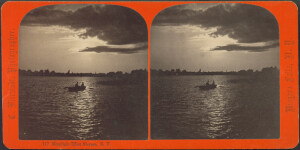 | USA; NEW YORK; NIAGARA FALLS | in recto:117 Moonlight Effect Niagara, N.Y., C. Bierstadt, Photographer., Niagara Falls, N.Y.; in verso: STAMP: CHARLES R. PATTERSON COLLECTION., inscription: illegible Aug 20th, Bought at Niagara | View of moonlight on water at Niagara, New York, with two men in a boat. | MS0091/02.02-02#252 | |||||
| 3 | No image URL. | on recto: New York Bay, moonlight., Sold only by U"niversal View Co. Philadelphia Pa. Lawrence Kan. William H. Raw. Publisher Philadelphia, U.S.A. | View of New York harbor waters by moonlight. | MS0091/02.02-02#251 | ||||||
| 4 | 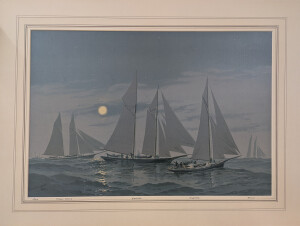 | SHORT DESCRIPTION: Chromolithograph, plate XIV, of Frederic Schiller Cozzens and J.D. Jerrold Kelley's 'American Yachts: Their Clubs and Races' published by Charles Scribner's Sons. Titled 'Moonlight on Nantucket Shoals ' showing yachts Ibis, Tidal Wave, Estelle, Sagitta and Aeolus. NOTES: LP 200- LP 225 are part of a set of lithographs in colors on wove paper by Frederic Schiller Cozzens (American, 1846-1928). Cozzens and Lt. J.D. Jerrold Kelley collaborated on the book 'American Yachts: Their Clubs and Races.' Between 1883 and 1884 Cozzens worked on watercolors of yachts and their marine settings which were turned into a folio suite of chromolithographs to accompany text written by Kelley. | CL18638 | |||||||
| 5 | No image URL. | VESSEL INFORMATION - VESSEL NAME: AMERICANA SHIPBUILDER: BUFFALO DRY DOCK CO. BUILDER LOCATION: BUFFALO, NEW YORK SHIP OWNER: STEAMER AMERICANA LINE, MESECK LINE | CL9751 | |||||||
| 6 | SHORT DESCRIPTION: The print shows a view of Harpers Ferry from above Jefferson Rock, looking down on the town and the two rivers. The Shenandoah is on the right and merges with the Potomac that enters from the left side and continues into the distance. The Baltimore & Ohio railroad bridge crosses the Potomac at the confluence of the rivers, and the town is in the foreground. St. Peter’s Church and steeple are visible, and two people are walking along a path that leads into the town. NOTES: From “Picturesque America, or The Land We Live In” volume 1, published in New York by D. Appleton and Co. publishers, 1872. The print is before page 329. The print says 1874. | CL16228 | ||||||||
| 7 | No image URL. | VESSEL INFORMATION: VESSEL NAME: MAYFLOWER (1901-1902 Merchant Vessels of the United States gives name as May Flower) VESSEL TYPE: 1901-1902 Merchant Vessels of the United States gives vessel type as steamer side-wheel, and as an inland passenger vessel. DESIGNER: G. P. Cushing BUILDER LOCATION: Massachusetts, Chelsea BUILDER: Montgomery & Howard BUILD DATE: 1890; The Boston Globe of December 25, 1890, page 6 reports on the launch of the steamboat Mayflower on December 24th, 1890. HOMEPORT: Boston DIMENSIONS: 184'3" (length of keel); 202'5" (length overall); 32'5" (breadth of beam); 10'4" (depth of hold); 5'8" (draft light); gross tonnage 728, net tonnage 575 ENGINE: Vertical beam, by W & A Fletcher Co., Hoboken, New Jersey. Diameter of cylinder 48", stroke 9 feet SHIPLINE: Nantasket Beach Steamboat Company; Nantasket Boston Steamboat Company (1941 Merchant Vessels of the United States) VESSEL HISTORY: Built for the Nantasket Beach Steamboat Company for the route between Boston and Nantasket Beach. The Mayflower provided passenger service between Boston and Nantasket Beach from the 1890s through the 1940s. --Trial trip June 20th 1891, could carry 2000 passengers. --On August 11, 1917 the vessel was rammed by a U.S. Navy submarine. The steamboat Rose Standish was nearby and removed the passengers. The Mayflower made it to port and was repaired. --On Thanksgiving Day in 1929 (November 28th), the company's six steamers were docked for the winter at Nantasket's Steamboat Wharf (Nantasket Pier). On that day, a large fire broke out and destroyed five of the steamers -- the Nantasket, Mary Chilton, Old Colony, Rose Standish and Betty Alden. Only the Mayflower was pulled to safety and survived the fire. --In 1945 she was taken out of service (The Boston Globe, July 22, 1940, page 9 shows boat is still in service). The Boston Globe of November 16, 1940, page 4 contains an article stating that the bankruptcy plans for the Boston-Nantasket Steamboat Company and that three of the companies vessel would be seized for the bank. --The Boston Globe, May 29, 1941, page 16 reports that the Boston-Nantasket boat service would start that day with the departure of Mayflower from Pemberton at 7:45. --The Boston Globe, July 4, 1943, page 4: reports the service of Mayflower, which had been out for repairs would be put into service that day. --The Sun Journal, June 9, 1944, page 4: reports the steamboat service was inaugurating its 126th year and would make three trips daily. Later in the season the steamers Mayflower and Allerton would be added to the service. --The Daily Press, July 10, 1949, page 37 contains an article on the display of the canvas cover and gives the history of the vessel. The article states: The Mayflower continued in the Nantasket Beach served even though World War II interfered with the excursion program. In 1945 she was dry docked and her wooden hull was found to be in excellent condition. Plans were to convert her into an oil burner but these were shelved when the bids proved to be too high. Too, in order to pass the US Steamboat Inspection Service, it was necessary to insulate the walls of the fire room and install new tanks. All this proved to be too costly so the old steamboat was laid up. --The Boston Globe, September 28, 1948, page 8: reports on a petition for a permit to put the retired Nantasket steamboat Mayflower on a cradle on filled in tidewater flats in Hull.. Dr. William M. Bergan requested permission to fill flats between Salisbury Street and George Washington Blvd and to place the Mayflower on a cradle. The old steamboat would be used as a museum, or be coverted into apartments for veterans. --Grounded at Nantasket Beach in 1949 (A newspaper article indicates Mayflower was installed on George Washington Blvd in 1949) and converted into a nightclub called the Showboat. Doesn't disappear from the Merchant Vessels of the United States until 1949. --The Showboat operated for many years, but by the 1970s, it had become a derelict and abandoned structure. In the autumn of 1979, it caught fire under unknown circumstances and burned to the ground. | CL9827 | |||||||
| 8 | No image URL. | Bonhomme Richard (Frigate : 1779). | Captain Pierre de Landais, commander of the continental frigate Alliance; the moonlight encounter off Scarborough head. | LB58163 | ||||||
| 9 | 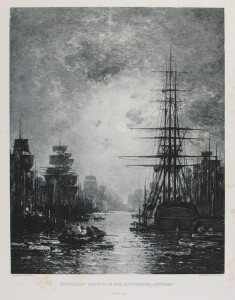 | MOONLIGHT EFFECT IN THE KATTENDYK, ANTWERP | CL9782 | |||||||
| 10 | 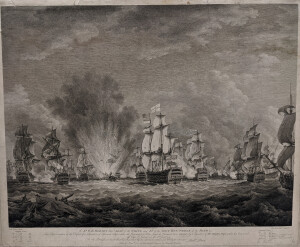 | SHORT DESCRIPTION: Hand colored engraving by Daniel Lerpiniere and John Boydell after a painting by Richard Paton of the January 16, 1780 Moonlight Battle off Cape St. Vincent. Admiral George Rodney's flagship, HMS Sandwich (90 guns), sits near the center of the image in a port-quarter view. To the left, and near Sandwich's port bow is the exploding Spanish ship Santo Domingo (or San Domingo). To the right of Sandwich a Spanish ship in port-quarter view is firing a port-broadside. British and Spanish ships engaging each other surround the Sandwich. In the foreground in the left bottom corner men are clinging to sails and rigging floating in the water. NOTES: The Battle of Cape St. Vincent took place off the southern coast of Portugal on January 16, 1780 during the American Revolutionary War. A British fleet under Admiral Sir George Rodney defeated a Spanish squadron under Don Juan de Lángara. The battle is sometimes referred to as the Moonlight Battle because it took place a night, an unusual occurrence. Rodney and a fleet of about twenty ships-of-the-line were escorting a fleet of supply ships to relieve the Spanish seige of Gibraltar when he encountered Lángara's squadron. Lángara attempted to run into the port of Cadiz but Rodney's copper-sheathed ships chased his fleet down. The battle began in the mid-afternoon and lasted until after midnight. The British captured six ships, but two were either grounded destroyed or retaken. The Spanish ship's included Fenix (Lángara's flagship), Princesa, Diligente, Monarca, San Julian and San Eugenio. Another ship, Santo Domingo, blew up. After the battle Rodney successfully resupplied Gibraltar and Minorca/Menorca before continuing to the West Indies. | CL15318 | |||||||
| 11 | LABEL COPY: MOONLIGHT EXCURSION TO OLD POINT COMFORT Steamboat Pocahontas (1893-1939) Chromolithograph, prior to 1906 VESSEL INFORMATION - VESSEL NAME: POCAHONTAS VESSEL TYPE: SIDE-WHEEL STEAMBOAT SHIPBUILDERS: HARLAN & HOLLINGSWORTH SHIP LINE: VIRGINIA NAVIGATION CO. | CL19309 | ||||||||
| 12 | 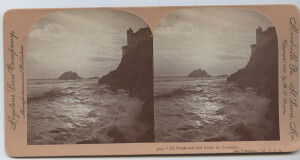 | USA; CALIFORNIA; SAN FRANCISCO | 5045 -- Cliff House and Seal Rocks by Moonlight, San Francisco, Cal., U.S.A., Keystone View Company, Manufacturers and Publishers., Meadville, Pa. St. Louis, Mo., Copyright 1897, by B.L. Singley(?); STAMP: CHARLES R. PATTERSON COLLECTION. | View of a cliff house and seal rocks by moonlight. On the back of the stereoview is some information about the location shown in photo. | MS0091/02.02-02#266 | |||||
| 13 | 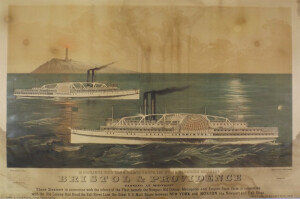 | NOTES: The Fall River Line was a famous and long-running passenger transportation service (1847–1937) that connected New York City and Boston via a combination of overnight steamboat travel along Long Island Sound (and Narragansett Bay) and rail connections. Passengers typically took a night boat from New York to Fall River, Massachusetts, then continued by train to Boston (or vice versa), making it a luxurious and popular "rail-water" route, especially during the Gilded Age. The company was founded by Richard Borden who began a regular steamboat service between New York City and Fall River in 1847 (the Bay State Steamboat Company/Bay State Line). In 1863 the Bay State Steamboat Company was sold to the Boston, Newport and New York Steamboat Company, and the railroad was extended between Fall River and Newport, Rhode Island. In 1869 the line was sold to the Narragansett Steamboat Company (Narragansett Steamship Company). In 1872 the Fall River Line was completely reorganized and became part of the Old Colony Railroad, under the name Old Colony Steamboat Company. In 1893, the Fall River Line became part of the New York, New Haven and Hartford Railroad (commonly called the New Haven Railroad). Under this railroad's influence, the steamboat operations (including the prominent Fall River Line) were reorganized and operated through the New England Navigation Company (organized January 1, 1905, the Fall River Line became a division in 1906). By the early 1910s (evidenced by references like 1913 stock certificates and reports), operations and marketing increasingly used New England Steamship Company (often abbreviated N.E.S.S. Co.). The shift to the new name likely occurred gradually between 1905 and 1910, with the name "New England Steamship Company" becoming the primary public and operational identity by the late 1900s/early 1910s. No single "renaming date" is pinpointed in primary sources, but the effective transition to the Steamship Company name for day-to-day branding and management was complete by around 1910–1912. The New England Steamship Company directly managed and marketed the Fall River Line's fleet of elegant side-wheel steamships (such as the Pilgrim, Priscilla, Puritan, Commonwealth, and Providence). After its employees went on strike in the middle of 1937, the company chose, in the face of ongoing losses due to land transportation, to liquidate rather than negotiate with the union. Vessels operated by the line: Bay State (1847), Massachusetts (1847), Empire state (1848), State of Maine (acquired 1849), Metropolis (1854), Old Colony (1865), Newport (1865), Bristol (1867, acquired 1869), Providence (1867, acquired 1869), Pilgrim (1883), City of Fall River (1883, freighter), City of Brockton (1886, freighter), Puritan (1889), Plymouth (1890; rebuilt 1906-1907), City of Taunton (1892, freighter), Priscilla (1894), Providence (1905), and Commonwealth (1908). VESSEL INFORMATION- VESSEL NAME: PROVIDENCE VESSEL TYPE: SIDE-WHEEL STEAMBOAT BUILD DATE: 1866 BUILDER: WILLIAM H. WEBB AND COMPANY BUILDER LOCATION: NEW YORK DIMENSIONS: 362.0 X 48 X 16’6”; 2962 GROSS TONNAGE, 2064 NET TONNAGE ENGINE BUILDER: JOHN ROACH AND SONS OF NEW YORK SERVICE DATES: 1867-1886 DATE OF DISPOSAL: 1901 PLACE OF DISPOSAL: BOSTON VESSEL HISTORY: Providence was originally built for the Merchants Steamship Company. She was placed in commission June 17th, 1867. It had over 220 staterooms and was able to carry 840 passengers. Freight capacity of forty carloads. When that company folded Providence was taken over by the Narragansett Steamship Company. In 1869 the Bristol Line and Fall River Line were consolidated under the Narragansett Steamship Company. In 1872 the Fall River Line was reorganized as the Old Colony Steamboat Company. She could accommodate about 1000 passengers. She was used on the Fall River Line between New York and Fall River, also to Providence until surpassed by more modern steamers. | CL8257 | |||||||
| 14 | 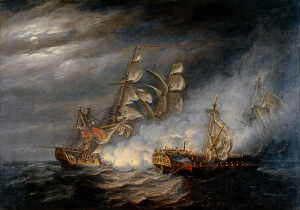  | SHORT DESCRIPTION: Oil painting on canvas titled ‘Capture of La Virginie by HMS Indefatigable by moonlight, April 21, 1796” by British artist Nicholas Pocock. Signed “N. Pocock” in the lower left corner and dated 1797. The image shows a dramatic night time scene of two ships, one under full sail and the other with severe rigging damage, racing over the ocean firing broadsides at each other. The skies are dark and cloudy. The moon appears in the upper left corner with thin dark clouds streaming over it. The clouds around the moon show bright white from the light of the moon. At the center HMS Indefatigable is partially visible in a starboard broadside view. The hull of the French ship La Virginie and billowing smoke and fire obscure a large portion of Indefatigable's hull and lower rig. The British ship is in the process of firing a broadside. A large red ensign flies from the top of the gaff yard. The flag has a large hole under the union and near the hoist. The gaff yard supporting the flag and mizzen or spanker sail, which is furled, is broken and dangling. A lantern appears to be hanging next to the flag from the end of the gaff yard. The ship’s mizzen topmast is broken and is shown laying across the mainsail yard. The mizzentopsail is billowing behind the British ensign. Several rigged sails appear under the flag and under the mizzen, but it's unclear which sails these represent (possibly staysails?). Lines of broken rigging are hanging over the stern and trailing down in the water behind the ship. On Indefatigable’s mainmast the mainsail appears hauled up, the maintopsail is set and is severely damaged, essentially shredded and billowing in the wind. The maintopgallant and mainroyal sails are set and the maingtopgallant has several shot holes visible. A long red streaming English commissioning pendant is flying from the top of the main mast. All three mainstaysails are set and billowing out in the wind. On the fore mast the foretopsail, foretopgallant and the foreroyal are set and visible above the smoke. The two lower sails have numerous shot holes. To the right of Indefatigable and in the foreground is the French frigate La Virginie. The starboard side of the ship is shown with the cannon ports brightly lit from the firing of the guns on the port side. The forward part of the ship is obscured by the darkness. The rig is completely wrecked and only the stub of the mizzenmast remains. A large French tricolor is draped over the stern starboard quarter and a section of a mast or yard (mizzen?) is trailing in the water underneath it. Rigging hangs over the stern and trails behind the vessel. The mainmast is broken just above the main top. The rigging supporting the lower mast appears intact, but a large section of a mast with a yard and sail has stabbed, upside down, into a hole in the side of the ship. The mainyard is dangling down from the remainder of the mainmast supporting the remainder of a shredded sail. The fore topmast is shown, possibly in the act of falling, taking the yard and sail with it. The yard of the foretopsail is shown snapped in half and bending towards the bow. The yard for the foresail appears intact but there is no sail on it. The bow of the vessel and lower foremast is obscured by the darkness and smoke. The deck of La Virginie appears to be covered by men. At the stern a man can be seen who appears to be shouting through a speaking trumpet. NOTES: Text from volume one of ‘The Naval History of Great Britain…’by William James, pages 361-362: On the 20th of April, in the morning, as Sir Edward Pellew, having despatched home the Revolutionnaire and her prize, was lying to, while the latter weathered the Lizard, a suspicious sail appeared coming in from the seaward. Her not answering the private signal, when she tacked from the squadron, marked her out as an enemy; and Sir Edward, having ordered the Argo to Plymouth, made all sail in chase, accompanied by the frigates Amazon and Concorde. After a chase of 15 hours, and a run of 168 miles, the Indefatigable, from her superior sailing, was enabled to come up with the strange frigate; whom the wind had prevented from steering for Ushant, otherwise she must have escaped. At a little past midnight [21st] the action commenced, and continued, at close quarters, both ships under a crowd of sail, during one hour and 45 minutes. The French frigate, by this time, had lost her mizzenmast and maintopmast, and was otherwise greatly crippled; nor was the Indefatigable much less disabled, having lost her gaff and mizzen topmast, as well as the use of her main topsail, both leech-ropes having been shot away. Having no after-sail to back, the Indefatigable unavoidably shot past her opponent; and owing to the latter’s masterly manoeuvres, had some difficulty, in this dilemma, to avoid being raked. While the Indefatigable lay ahead, reeving new braces, in order to come to the wind and renew the action, the Concorde (the Amazon not far behind) got up, and took a commanding position under the stern of the French ship. Whereupon the latter, having four feet of water in the hold, and being greatly damaged in hull, masts, and rigging, fired a lee-gun and struck her light, as a signal of surrender. The prize proved to be the French 40-gun frigate Virginie, Captain Jacques Bergeret, a remarkably fine ship, and armed precisely according to the establishment of her class. The Indefatigable was a cut-down [razee] 64-gun ship, and mounted twenty-six long 24-pounders on the main deck, and two long 12-pounders and eighteen 42-pounder carronades on the quarter-deck and forecastle, total 46 guns, with a complement of 330 men and boys. Of these the Indefatigable…did not lose a man. The Virginie, on the contrary, out of her crew of 330 men and boys, as deposed to by her officers, had only one less than is stated in Captain Pellew’s letter, lost 14 or 15 men killed and 27 wounded, 10 of them badly. This statement shows that the French frigate, except in number of men, was greatly inferior to the ship with which she fought; yet Captain Bergeret did not surrender until a second frigate [Concord] was preparing to rake him, and a third [Amazon] approaching under all sail to join in the action. No one was more ready than Sir Edward Pellew himself to do justice to his enemy on this occasion. The Virginie, as we have already stated, was a remarkably fine frigate, and became in consequence, a valuable acquisition to the class of British 38s. Sir Edward, however, had been misinformed when in his official letter he stated, that the Virginie was “158 feet long and 43 broad.” On the contrary, the Virginie measured but 151 feet 3-3/4 inches on the lower deck, and her extreme breadth was only 39 feet 10 inches. In fact, she was a ship considerably shorter and narrower than the Indefatigable, and was exceeded in size by several of the French 40-gun frigates which had previously been captured. NOTES: Excerpts from 'Edward Pellew, Viscount Exmouth, Admiral of the Red' by C. Northcote Parkinson, London: Methuen & Co. Ltd., pages 147-155: On April 20th, 1796, Captain Pellew in HMS Indefatigable was off the Lizard. At 9:00AM a sail was sighted on the weather quarter. Indefatigable made the private signal but it was not answered. At that time the Lizard bore NE by E ½ E about 4 leagues. Indefatigable, HMS Amazon and HMS Concorde tacked and made all sail to chase. Pellew recorded ‘These 24 hours strong breezes & hazy, all sail set in chace, at 4 the Concorde & Amazon a great distance a stern, at 6 the chace hoisted French colors. We hoisted the same, at ½ pt. 6 saw a ship in the west stand’g to the south’d, at 9 lost sight of the Squadron, at ½ past 11 in royals and studding sails ¾ pt. 11 the chace hoisted French colours (again), we hoisted English & gave 3 cheers, a.m. ½ pt. 12 the chace began firing, at 1 our gaff & mizzen topmast were shot away, at ½ past 2 she struck, proved La Virginie National French frigate of 44 guns & 339 men, four days out of Brest…’. The chase had covered 168 miles and lasted 15 hours. The contest was not an equal fight, besides the presence of two other English frigates, the French ship was inferior in broadside weight having only 342 lbs. as compared to Indefatigable’s 522 lbs. The Virginie was commanded by Captain Bergeret, who reported: that at daybreak on the 1st instant, lookouts spotted nine sails to the NE, which course I was making to have sight of the Lizard. Made more sail to reconnoiter them and at ½ past 8, when 2-1/2 leagues distant from the ships and 8 leagues distant from the coast, determined five of the ships were frigates. The wind was blowing a fresh gale from the southeast. Bergeret stated that Virginie was chased ‘but not being to windward of the Indefatigable that ship being even to windward of the rest of the enemies. I ran large to prevent his having that advantage over me. For the first hour his Chace was unsuccessful whilst in the mean time she Dropped the other frigates, but the wind experiencing a Change Successively in their direction and strength at 3.0 O'Clock P.M. We were about half a League distant from the Indefatigable, being then as much favored as he, we dropped him a little till the beginning of the Night, but my fore top Gallant yard being carried away at the same instant, he fetched me again, leaving the other fregates at a great distance. The great Moon light kept me in sight of him till 11 O'Clock 55 Minutes when being in the impossibility of shunning him, I fired upon him my Stern Chaces but soon coming up with me quarter Shot distance, he began to fire upon me, the wind being upon his quarter. Our first Broad Side did him a great deal of Damage which however did not prevent him to come yard arm to yard arm, and there by the quickness of his fire, he did me the greatest damage. The main Deckers are the only guns which I have been able to fire, after the first shots the Men quartered on the forecastle and Quarter deck left their situations and hid themselves except the Captains; being obliged to gIve those guns over, it is not without blows that I have been able to make them secure their guns. The main deck however has been well fought, the Indefatigable bearing up so as to put his Bowsprit into my Shrouds, I made the Motion to engage wIth the wind ahead but either through Manoevre or Damage which he has sustained, he hove all aback and received in that position two broadsides which cut his gaff, his Mizen Top Mast and Crossjack yard--and I immediately, favored by the Smoke, bore up to get away, without being able to go more than 3 or four Cable lengths from him; he soon got to rights again and returned upon me with the greatest impetuosity.’… …’At a 1/4 after 1, I lost my Mizen Mast and the Indefatigable bringing again his Bowsprit in my Shrouds, I once more luffed up in the wind on purpose to rake him by the bows which he prevented by hauling his wind—his sails being less damaged than the Virginie's who had then but her fore and fore top Sails up--he went ahead of me, which made me resolve to come to the Wind and by that means to Rake him by the Stern, when my main top mast fell across the Main yard which with the Mizen Mast prevented me from firing but three guns. It was not for a long time in his power to fire upon us, he bore up to get at a greater distance to engage anew. I was myself obliged to use the hatchets to clear away the Wreck of the Masts which falling, the Deck was almost always of Service until two o'clock, when a frigate coming within a pistol Shot, without however firing but in such a position as rendered it impossible for us to bring a single gun to bear upon him, the pieces of my fore and fore top Sails remaining not being sufficient to steer the frigate and the 3rd of the enemies coming up fast towards us, I stroke my Colours, not being able to defend myself any longer, having besides four feet in the hold.’ Bergeret reported that 13 men had been killed and about 30 wounded, 17 of them dangerously. Virginie was leaking at a rate of 36 inches an hour. He reported that ‘Indefatigable besides the damage mentioned before lost her fore top Sail yard and her main top mast. She has kept almost whole her fore Sail and her Mizen only.’ On April 24th HMS Concorde was ordered to tow Virginie into Plymouth. Indefatigable put into Falmouth on the evening of the same day but sailed to Plymouth to refit on the 27th. NOTES: [Text by John O. Sands, Spring 1981, Mariners' Museum Journal, page 2-3] The painting depicts an action during the wars of the French Revolution, and is entitled "Capture of LA VIRGINIE, French Frigate of 44 guns, by H.M.S. INDEFATIGABLE Commanded by Sir Edward Pellew, by moonlight, April 21st, 1796. The painting is of interest for its technical details, its rendition of the ships and the engagement, and also for the attitudes which it reflects. These ships were among the most advanced fighting machines available in their day, and the damage which they could inflict was immense. To the knowledgeable viewer, it must be immediately recognized that the scene depicted is a virtual holocaust. The viewer who has not had his imagination dulled by moving pictures and sound track will hear in his mind the gun fire, feel the heat of the battle, the pain of the participants. The moonlight makes the scene all the more dramatic as it imbues the action with an eerie quality of light. The thrill of generating such a sublime emotion can only be appreciated from a safe vantage point. It was not until scientific expeditions of the late 18th century had cleared the seas of monsters and demonstrated that one need have no real fear of the edge of the earth that one could afford to encounter unbridled nature in a painting. Similarly, when war had become a formalized ritual, fought by professionals in distant places, the public at large could afford to titillate its emotions with scenes of battle. VESSEL HISTORY: HMS INDEFATIGABLE, 44 (razee). Built in 1784 at Bucklers Hard as a 64-gun, 5th rate ship. In 1795 the ship was "razeed" down to a 44-gun frigate by removing forecastle and quarterdeck and altering former upper deck (now weather- or spar-deck) to 42-pounder carronades from the 18-pounder long guns previously mounted. Two other 64`s (ANS0N and MAGNANIME were altered in the same way at the same time, because of unfounded rumours of French super-frigates armed with 24-pounder long guns being produced in large numbers. (Actually only 4 French 24-pounder frigates were built. See POMONE and ENDYMION) VESSEL HISTORY: LA VIRGINIE: 5th rate, 38 guns. 1066 tons as built. 151½ ft x 40 ft. French warship, captured by the British Royal Navy on April 21st, 1796 in the Atlantic. Turned into a receiving ship in 1817. Sold in 1827 to be broken up. La Virginie was a 40-gun frigate of the French Navy, the lead ship of its class, constructed in Brest, France. Launched On July 26, 1794. The Virginie-class frigates were designed by French naval engineer Jacques-Noël Sané, a prominent figure in French shipbuilding during the late 18th century, and were part of a series of ten ships ordered and built between 1793 and 1802. | CL12223 | |||||||
| 15 | No image URL. | VESSEL INFORMATION - VESSEL NAME: BOSTON BELLE VESSEL BUILT: 1945 SHIPBUILDER: LUDERS MARINE CONSTRUCTION CO. BUILDER LOCATION: STAMFORD, CONNECTICUT SHIP OWNER: WILSONN LINE, WILMINGTON, DELAWARE EX: LCI#1258- U.S.N. | CL9744 | |||||||
| 16 | 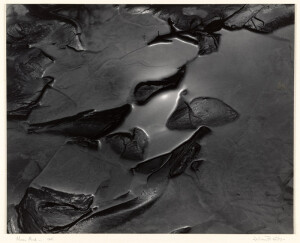 | 1968 | On recto, bottom left corner below print, in pencil, Moon Mud - 1968 and in bottom right corner below print, in pencil, William Giles~. On verso of mat, bottom left side, William Giles "Moon Mud" - 1968. | Marine photography; Photography, Abstract; Moonlight in art | Black smooth reef rocks partially submersed in water with moonlight reflecting off of water. | MS0554.05/-02#05 | ||||
| 17 | 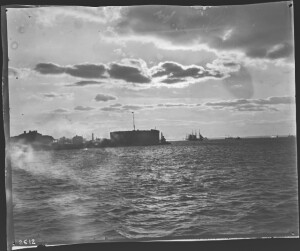 | Castle Williams (New York, N.Y.). | Castle William; 2612 | Fortification–New York (State). | Shows a view looking across the water at Castle Williams. The fortification has fallen into the shadows and is only seen here in silhouette. Stanton's notebooks contain the following information about this item: "Date unknown", "Moonlight (Castle Wm)". The name Moonlight might refer to one of the sailing ships seen far in the background, but there is not enough information to disambiguate this name among similarly named vessels. | MS0094/01-#2612 | ||||
| 18 | 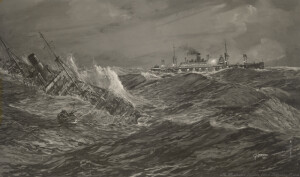 | 1926 | Original illustration was signed LR: | Photographic copy from the Illustrated London News dated February 6, 1926. Image shows the Antinoe in rough seas and the President Roosevelt in the distance. A small rowboat is also visible with crew aboard. Original text reads: "This Slendid Example of Skill and Gallantry": The "President Roosevelt" rescuing the "Antinoe's" Crew. In bright moonlight aided by the liner's searchlight: A life-boat from the "President Roosevelt" taking off the last thirteen men from the "Antinoe." | MS0730/-#01 | |||||
| 19 | 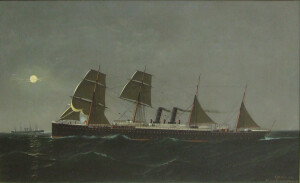 | VESSEL INFORMATION - VESSEL NAME: EIDER SHIPBUILUDER: JOHN ELDER & CO. BUILDER LOCATION: GLASGOW, SCOTLAND SHIP LINE: NORTH GERMAN LLOYD VESSEL DATES: 1884-1892 VESSEL DIMENSIONS: 403 x 47, 4719 tons VESSEL HISTORY: Lost by stranding on the Isle of Wight on January 31, 1892 with no loss of life. Sister Ship EMS. LABEL COPY: TRANSATLANTIC STEAMSHIP ELDER (1883-1892) Oil on canvas, 1884 Museum Collection, 65.153 Jacobsen tried a few moonlight scenes; this one seeems to be his most successful. North German Lloyd Line's ELDER lasted less than ten years in transatlantic service. She ran ashore on the Isle of Wight, England in 1892. | CL12590 | |||||||
| 20 | 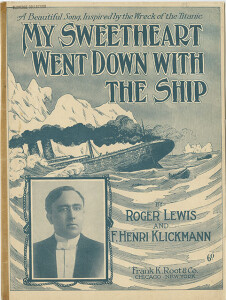 | 1912 | Titanic (Screw schooner : 1912)–Songs and music. | Stamped in TL corner: "ELDREDGE COLLECTION" | Shipwrecks–North Atlantic Ocean; Popular music–1911-1920 | For voice and piano. "A Beautiful Song, Inspired by the Wreck of the Titanic" is printed above the title on the cover, which includes a drawing of the Titanic sinking. Includes advertisements for "Moonlight Waltz" by Victor Lasalle and "In the Far Off West" by Roger Lewis and F. Henri Klickmann on p. 2; and the "Firefly Dance" by Victor Lasalle and "I will Love You when the Silver Threads are Shining Among the Gold" by Roger Lewis and F. Henri Klickmann on page 6. | MS0093/-006.04#01 | |||
| 21 | 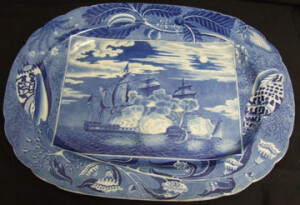 | SHORT DESCRIPTION: Staffordshire china with a transfer print of the battle between the USS CHESAPEAKE & SHANNON during the War of 1812. NOTES: Notes made in the China File by Nola Hill - work done in the '40's or early 50's per Harold Sniffen, 12/7/81.. Moonlight Battle Between the CHESAPEAKE and SHANNON (Ref Antiquarian July 1930) Staffordshire (no maker's name) PROOF Medium blue (unknown and unlisted piece) Platter 19-1/2 x 14-3/4 inches | CL7099 | |||||||
| 22 | No image URL. | River steamers–History–United States; Excursion boats–History–United States | Moonlite at 8:30 : __the excursion boat story __by Alan L. Bates and Clarke C. Hawley | LB81792 | ||||||
| 23 | 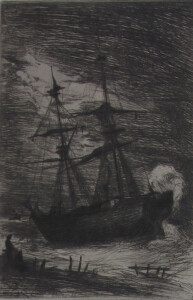 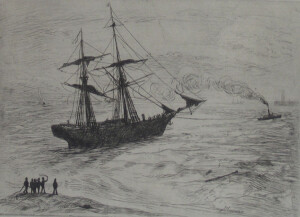 | NOTES: Brig, Unidentified, Wrecked and Saved. From a real incident which happened off the coast at Littlehampton. NOTES: [From The Portfolio, London, 1876] THESE two little etchings represent a real incident. The vessel went ashore at Littlehampton, in Sussex, and was saved after a few days by a small steam-tug and a high spring-tide. The etching, which represents the vessel ashore, was drawn upon the copper directly from nature. It is a night effect, with rays of moonlight breaking through the clouds. The little steam-tug is close at hand, to be ready at day-break for the high morning-tide. When the sun rose the vessel was got off, and safely towed into port. This subject was not etched from nature, for want of time, but from a rapid sketch. | CL18050 | |||||||
| 24 | 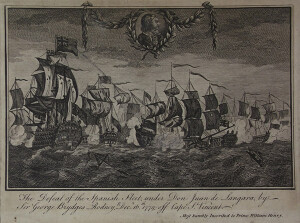 | NOTES: The date inscribed on this piece is incorrect. The battle occured on January 16, 1780. Print shows a naval battle between the British fleet, under the command of Sir George Brydges Rodney, and a much smaller Spanish fleet, under the command of Don Juan de Langara, off Cape Saint Vincent, Portugal. Includes insert of cameo portrait, possibly of Prince William Henry. NOTES: This image was published in 'The town and country magazine, or, Universal repository of knowledge, instruction, and entertainment.' London : Published by J. Hamilton, Jr., March 1780, between pages 152 and 153. NOTES: The Battle of Cape St. Vincent took place off the southern coast of Portugal on January 16, 1780 during the American Revolutionary War. A British fleet under Admiral Sir George Rodney defeated a Spanish squadron under Don Juan de Lángara. The battle is sometimes referred to as the Moonlight Battle because it took place a night, an unusual occurrence. Rodney and a fleet of about twenty ships-of-the-line were escorting a fleet of supply ships to relieve the Spanish seige of Gibraltar when he encountered Lángara's squadron. Lángara attempted to run into the port of Cadiz but Rodney's copper-sheathed ships chased his fleet down. The battle began in the mid-afternoon and lasted until after midnight. The British captured six ships, but two were either grounded destroyed or retaken. The Spanish ship's included Fenix (Lángara's flagship), Princesa, Diligente, Monarca, San Julian and San Eugenio. Another ship, Santo Domingo, blew up. After the battle Rodney successfully resupplied Gibraltar and Minorca/Menorca before continuing to the West Indies. | CL301 | |||||||
| 25 | 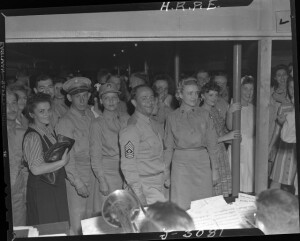 | 7/7/1943 | Mohawk (Steamship : 1904). | J3081 - View of dancers aboard the SS Mohawk on the moonlight ride. 7-7-43 Official photograph U.S.Army Signal Corps, HRPE, Newport News, Va. | Parties–Virginia–Newport News.; Bands (Music)–Virginia–Newport News. | Men and women standing in front of a band aboard the Mohawk. | P0003/01-#J-3081 | |||
| 26 | 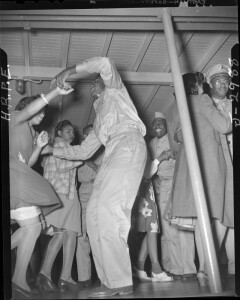 | 7/3/1943 | Mohawk (Steamship : 1904).; United States. Army. Sanitary Company, 785th. | J2988 Josephine Barrett and Cpl. Albert Thomas taking part in the dancing aboard the SS Mohawk which was used by the 785th Sanitary Company and their guests for a moonlight ride. 7-3-43 Official photograph U.S.Army Signal Corps, HRPE, Newport News, Va. | Dance–Virginia–Newport News.; Parties–Virginia–Newport News. | Josephine Barrett and Corporal Albert Thomas dancing with others aboard the Mohawk. | P0003/01-#J-2988 | |||
| 27 | No image URL. | Potomac (Side wheel steamer : 1935). | Potomac River. | Steamboats–Maryland.; Excursion boats.; Piano and theater organ music–Washington (D.C.). | This collection contains one item, a videotape of the steamboat Potomac under way, in 1947. The video was made from an original 16mm color film, made by Bedford F. Penn, for the meeting of the Steamship Historical Society of America. The film includes images of the boat underway, the walking beam and valve lifters in action, a stop / start sequence, the pilot house and deck views. Added to the original silent 16mm film is a mujsical accompaniment composed and performed on a Wurlitzer theater organ by Raymond A. Brumbacher, then organist at the Kennedy Center, in 1988. --SS Potomac, of the Potomac River Line, offered excursion service from 1935 to 1948 during the day to Chapel Point Park (MD), an amusement park at the confluence of the Port Tobacco and Potomac Rivers, and to the various attractions at Colonial Beach, VA. At night, Potomac sailed on moonlight excursion cruises on the Potomac. | MS0842 | ||||
| 28 | 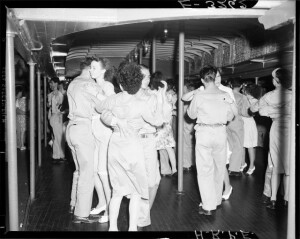 | 7/17/1943 | Mohawk (Steamship : 1904). | E3262 - View of dance floor during moonlight cruise aboard the SS Mohawk. Cruise was for enlisted men of NAB. 7-17-43 Official photograph U.S.Army Signal Corps, HRPE, Newport News, Va. | Dance–Virginia–Norfolk.; Dance parties–Virginia–Norfolk. | Couples dancing aboard the Mohawk. | P0003/01-#E-3262 | |||
| 29 | 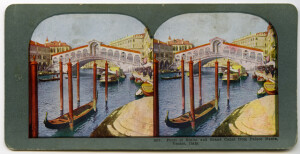 | ITALY; VENICE | LABEL ON VERSO: NOTHING CAN BE MORE ENCHANTING THAN THE FIRST TRIP ON TH E CANALS OF VENICE. ALL THE PICTURES THAT OUR IMAGINATION PAINTED FOR US, WHEN FIRST WE READ OR HEARD ABOUT THIS CITY OF WONDERS AND A ROYAL PAST, PALE INTO INSIGNIFICANCE BEFORE REALITY, ESPECIALLY IF SUCH A TRIP IS CITY IS UNDERTAKEN ON A MOONLIGHT NIGHT. THE GRAND CANAL IS THE MOST IMPOSINGLY OF ALL THOROUGHFARES OF THE CITY. ITS WINDS GRACEFULLY AMONG A DOUBLE ROW OF MARBLE PALACES AND CHURCHES, MANY OF WHICH ARE DOOMED TO DECAY, BUT STILL TESTIFYING OF DAYS OF MAGNIFICENT PROSPERITY. THE PONTI DI RIALTO, THE ONLY BRIDGE SPANNING THE GRAND CANAL, CONSISTS OF A SINGLE ARCH, 90 FEET IN SPAN AND 24 FEET HIGH, AND WAS BUILT OUT OF MARBLE IN 1590. TWO RANGES OF SHOPS DIVIDE THE BRIDGE ROAD INTO THREE NARROW AISLES. IN SHAKESPEARE'S "MERCHANT OF VENICE." THE BRIDGE U\IS MENTIONED AS A MEETING PLACE OF MERCHANTS. A8723 | 857. PONTE DI RIALTO AND GRAND CANAL, VENICE, ITALY | MS0522/02-01.03#12 | |||||
| 30 | 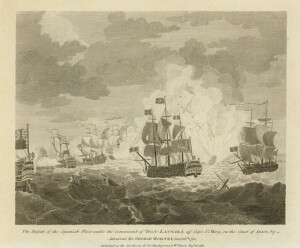 | NOTES: The text underneath this image is incorrect. This action took place off Cape St. Vincent in Portugal. NOTES: Prints LE 1272 and LE 1273 are by the same publisher, but the name is spelled differently on each image. On LE 1272 the publishers name is spelled Mackgowan and on LE 1273 the name is spelled MacGowan. The British Museum indicates the correct spelling is Macgowan and that the publisher was at the address No. 27 Paternoster Row. Active at this address until he went bankrupt in December 1781. NOTES: The Battle of Cape St. Vincent took place off the southern coast of Portugal on January 16, 1780 during the American Revolutionary War. A British fleet under Admiral Sir George Rodney defeated a Spanish squadron under Don Juan de Lángara. The battle is sometimes referred to as the Moonlight Battle because it took place a night, an unusual occurrence. Rodney and a fleet of about twenty ships-of-the-line were escorting a fleet of supply ships to relieve the Spanish seige of Gibraltar when he encountered Lángara's squadron. Lángara attempted to run into the port of Cadiz but Rodney's copper-sheathed ships chased his fleet down. The battle began in the mid-afternoon and lasted until after midnight. The British captured six ships, but two were either grounded destroyed or retaken. The Spanish ship's included Fenix (Lángara's flagship), Princesa, Diligente, Monarca, San Julian and San Eugenio. Another ship, Santo Domingo, blew up. After the battle Rodney successfully resupplied Gibraltar and Minorca/Menorca before continuing to the West Indies. | CL15657 | |||||||
| 31 | 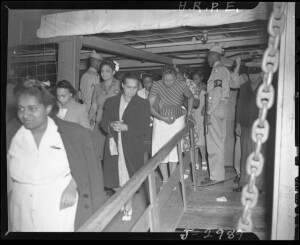 | 7/3/1943 | Mohawk (Steamship : 1904).; United States. Army. Sanitary Company, 785th. | J2989 Members of the 785th Sanitary Company and their guests coming down the gangplank after a moonlight ride on the SS Mohawk. 7-3-43 Official photograph U.S.Army Signal Corps, HRPE, Newport News, Va. | Parties–Virginia–Newport News. | Men and women walking down gangplank of the Mohawk. | P0003/01-#J-2989 | |||
| 32 | 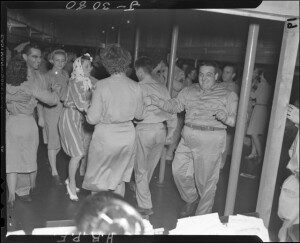 | 7/7/1943 | Mohawk (Steamship : 1904). | J3080 - View of dancers aboard the SS Mohawk on the moonlight ride. 7-7-43 Official photograph U.S.Army Signal Corps, HRPE, Newport News, Va. | Dance–Virginia–Newport News.; Parties–Virginia–Newport News. | Dancers aboard the Mohawk. | P0003/01-#J-3080 | |||
| 33 | 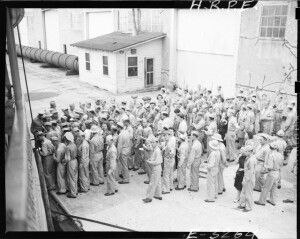 | 7/17/1943 | United States. Army. Norfolk Army Base (Va.). Pier 1. | E3264 - Group of enlisted men and their guest on pier at NAB waiting to board SS Mohawk for moonlight cruise. 7-17-43 Official photograph U.S.Army Signal Corps, HRPE, Newport News, Va. | Soldiers–Virginia–Norfolk. | A crowd of men and women waiting on pier 1 at the Norfolk Army Base to board the Mohawk. | P0003/01-#E-3264 | |||
| 34 | No image URL. | VESSEL INFORMATION - VESSEL NAME: SANDY HOOK VESSEL DESIGNER: GEORGE G. SHARP SERVICE DATES: 1889-1951 SHIPBUILDER: HARLAN & HOLLINGSWORTH BUILDER LOCATION: WILMINGTON, DELAWARE VESSEL DIMENSIONS: 260.5 x 37.1 x 15.6 SHIP'S OWNER: CENTRAL RAILROAD OF NEW JERSEY | CL9819 | |||||||
| 35 | 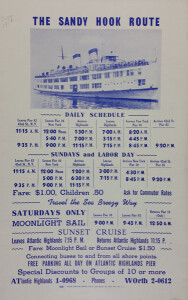 | VESSEL INFORMATION - VESSEL NAME: SANDY HOOK SERVICE DATES: 1889-1951 SHIPBUILDER: HARLAN 7 HOLLINGSWORTH SHIP OWNER: CENTRAL RAILROAD OF NEW JERSEY VESSEL DIMENSIONS: 260.5 x 46 x 17.3 VESSEL SOLD: 1951 | CL9843 | |||||||
| 36 | 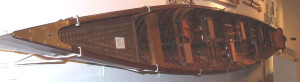 | SHORT DESCRIPTION: Rowing pleasure barge, builder unknown, circa 1880. This "Pleasure Barge" (rowing shell) was designed to accommodate oarsmen and their "lady friends" plus a coxswain, a bowman and two chaperones. Each of the 6 sliding oarsman seats were adjacent to a cane passenger seat for their companion with the pair alternating sides. The chaperones were provided with a double lazy back seat in the stern. Thwarts were also provided for the coxswain who steered the barge in the stern and the bowman in the bow. Perhaps the bowman also provided music of sorts on a mandolin or ukelele. It is 45 feet long and has a round bottom lapstrake hull with mahogany planks over oak frames. The six reproduction oars were made by the Rock Hall Boat Shop in Burgess, Virginia in 1989 are based on the 1881 oar of Harvard oarmaster T. Donoghue. NOTES: Handle length of oars is measured from the inboard end of the oar to the bearing face of the leather. This and the overall length are made in rough proportion to the width of the boat at the position where that oar is to be used, so the grip area (unfinished) will be correctly in front of the rower and the handle length is proportioned to the outboard length for the optimum combination of leverage and ease of pull. NOTES: Boats of this type were being built by companies such as the R. J. Douglas Co. of Waukeegan, Illinois in the late 19th century when competitive rowing was a popular sport. Enthusiasts formed clubs, pooled their funds to purchase racing shells, and met with other clubs for regattas. Some clubs also owned barges which member sused to take their lady friends on outings. These outings were frequently described in Harper's Weekly in the 1880's, with delightful engraved illustrations of the barge parties on moonlight cruises. INVENTORY: These items are associated with this boat. Please see component parts supplemental record for additional information - two oarlock straps, sliding seats, screws, wingnuts. | CL182 | |||||||
| 37 | No image URL. | VESSEL INFORMATION - VESSEL NAME: CITY OF KEANSBURG SHIPBUILDER: H.A. MARVEL BUILDER LOCATION: NEWBURGH, NEW YORK SHIP OWNER: KEANSBURG STEAMBOAT CO. VESSEL HISTORY: Built in 1926 and launched 1926 May 27 at Newburgh, NY. DIMENSIONS: 231 feet long | CL9861 | |||||||
| 38 | SHORT DESCRIPTION: Image from the Battle of the Nile showing the French ship L'ORIENT in flames at the center. An English vessel is anchored to the right. NOTES: Portions of this print have been treated to appear transparent when held up to a light. In this image, the L'ORIENT appears bright with flames when the print is backlit. NOTES: [Antony Griffiths, Prints and Printmaking: An Introduction to the History and Techniques] Transparent prints were a process invented and published by Edward Orme in his "Essay on Transparent Prints" London, 1807. An ordinary etching or engraving was hand colored both on the front and back. The hightlights were then varnished on both sides and thus the paper became translucent when held up against the light. ADDITIONAL INFORMATION: SEE: ORME, Edward. An essay on transparent prints, and on transparencies in general. London. 1807. The book gives "Detailed instructions on making transparent prints by the inventor of the method. As an artist and publisher, Orme had promoted the fashion for transparencies and hoped even to spread it abroad, the text of this book being in French and English. Transparent prints, of which seven examples are given, are meant 'to supply the place of painted glass', and to make lanterns, lampshades, fire screens etc. Easy to make, they are coloured prints chemically treated thereby rendering parts transparent when held to the light and giving an effective illusion of moonlight, fire etc. Popular in the early 19th century, few have survived, their use inevitably leading to destruction." | CL19843 | ||||||||
| 39 | 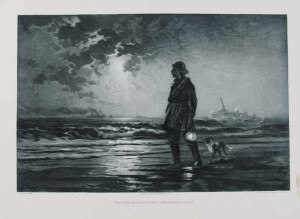 | NOTES: LIFESAVING PATROL OF THE NEW JERSEY COAST. - This paintings is one of the great interest, as it gives a true portrait of one of the duties of the brave men who compose the corps of lifesavers which is maintained by the government along the sea-coast. While the majority of the population are snugly ensconced between blankets, these brave and hardy fellows trudge watchfully along the beach, so that if any vessel should be in distress or wrecked they can give the alarm immediately, and thus save valuable time, which often means many lives. These men are often rough and uneducated; but they carry in their breasts true and brave hearts, and there is not a case on record where the lifeguards have shrunk from exposing their lives, or have been dismayed by any danger. The painting is strong and true in color, and gives a most faithful representation of the sea by moonlight. The artist is to be congratulated upon the results of his labors, as he has undoubtedly produced a masterpiece. Edward Moran was born in Lancashire, England in 1829, studied under James Hamilton and Paul Weber in Philadelphia., U.S.; went abroad in 1862. He is an associate of the national Academy and a member of the Philadelphia Academy of Fine Arts. | CL9981 | |||||||
| 40 | No image URL. | Matson Navigation Company–History. | Passenger ships–History. California–San Francisco; Steamboat lines–History. California–San Francisco | The white ships : __Matson Line to Hawaii, New Zealand, Australia via Samoa, Fiji, 1927-1978 __Duncan O'Brien | LB100480 | |||||
| 41 | 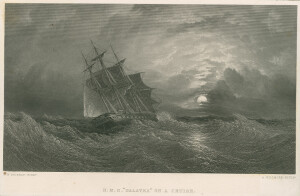 | SHORT DESCRIPTION: Black and white engraving titled "H.M.S. "Galatea" on a cruise." The image was published on page 80 The Art Journal of 1875. It the HMS Galatea in rough waters with the moon hidden behind clouds. NOTES: Text from the Art Journal that accompanies the image, page 80: The works of Mr. Brierly have long placed him in the foremost rank of our water-colour painters in the representation of marine subjects, for it is to such that he almost, if not entirely, limits his practice, as evidenced chiefly in the gallery of the Water Colour Society, of which institution he is an Associate Member. When the Duke of Edinburgh sailed in 1867-1868, on his first cruise round the world in the Galatea, his Royal Highness was accompanied by Mr. Brierly, whose pencil was engaged frequently in depicting the various marine incidents of the voyage. The picture from which the accompanying engraving was executed represents the vessel, a splendid frigate, on her passage from the Cape of Good Hope to Australia, in October, 1867; she experienced some very heavy weather, particularly when nearing the Island of St. Paul's, where the ship was caught in a cyclone, in which she was nearly laid upon her beam-ends, and narrowly escaped the loss of her masts. It seems to be the advent of this incident which suggested to the artist the subject of his picture, for there are in it indications of a storm, and the crew of the Galatea are preparing for it by shortening sail. The picture was painted for the Duke of Edinburgh from a sketch exhibited in 1872-1873 at the gallery of the Society of Water Colour Painters. With reference to the sketch, we need only repeat our own remarks after examining it in the gallery: *' In the drawing No. 54, by O. W. Brierly, there is an indescribable poetic grandeur. It represents an English frigate sailing by moonlight under a goodly spread of canvas. We may accept the brave ship as the Galatea, and Mr. Brierly has done full honour to her, for there never has been exhibited a more perfect marine-picture of its kind." When we say that the finished work has in it all the excellences of the sketch carried out with more refinement of manipulation, no further commendation of this beautiful picture is necessary. Mr. Brierly, within the last three or four years, has painted and exhibited some capital historical marine-pictures; such, for example, as 'Blake going on board the Resolution off Dover, to take command of the Fleet fitted out against the Dutch, in June, 1652;' 'Magellan discovering the Straits between Patagonia and Terra del Fuego, afterwards called the Straits of Magellan, 1520;' 'Blake, with a Squadron of five Ships, waiting to attack the Royalist Fleet, anchored in the Tagus, under the command of Prince Rupert, 1651;' and 'Drake taking the Spanish Galleon Capitana, one of the Armada, to Torbay, on the morning of July 22, 1588;' with others. | CL15561 | |||||||
| 42 | 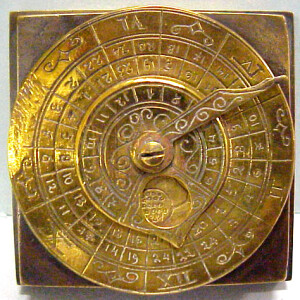 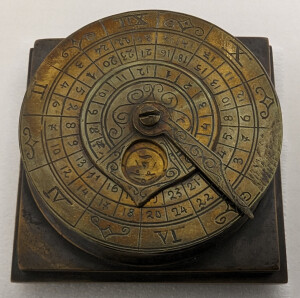 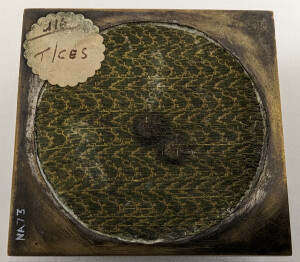 | SHORT DESCRIPTION: Moon dial, Italian origin. Although in the Collection file this is dated seventeenth century, the authenticity of this instrument should be doubted. It is more likely to be a nineteenth century copy. NOTES: An expert on sun dials & early Italian instruments should be consulted. TIME-SPACE: 1800-1900. | CL3241 | |||||||
| 43 | 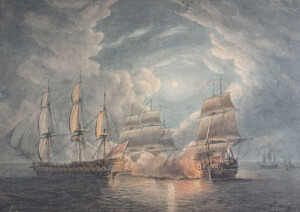  | SHORT DESCRIPTION: Watercolor by Dominique Serres showing the October 18, 1782 naval action between the French ship Scipion and the British ships HMS London and HMS Torbay. If the inscription can be believed, the image was painted in 1785. The nighttime scene shows Scipion at the right, firing into the stern of HMS London. HMS Torbay is in the background between the two ships firing towards Scipion, only her masts and sails are visible above the smoke and cannon fire. In the background at the right are the French frigate Sibylle and the British 14-gun sloop HMS Badger, which took no part in the battle. NOTES: Louis XVI made Capt. Grimouard a Count for his actions and commissioned a painting of the action from Auguste-Louis de Rossel de Cercy (1736-1804). The painting, titled 'Combat du Scipion contre le London', is in the collection of the Musée national de la Marine, Paris. That institution dates the painting at 1786. A copy of the painting given by Louis XVI to Marshal de Castries is dated 1788. Dominque Serres supposedly painted his view in 1785. Interestingly, one of these images appears to have been used as the basis for an engraving titled "The London Man of War Capturing the Marengo Admiral Linois" in a battle on March 13, 1806, although the ship's positions are changed (London is raking Marengo through the stern). ROUGH TRANSLATION: Combat of Scipion French ship of 74 Cannons Commanded by Captain Grimouard and the English warships the LONDON of 98 Cannons and the TORBAY of 74 - on the coast of St. Dominic in the moonlight painted in 1785 for the King of France by Dominique Serres - and very badly rebuilt by Marshal de Castries, Minister of the Navy of France. NOTES: Charles Eugène Gabriel de La Croix de Castries, marquis de Castries, baron des États de Languedoc, comte de Charlus, baron de Castelnau et de Montjouvent, seigneur de Puylaurens et de Lézignan (25 February 1727, Paris – 11 January 1801, Wolfenbüttel) was a French marshal. He was the Secretary of the French Navy from October 13, 1780 to August 24, 1787. Serres comment seems to indicate that the French attempted to raise and rebuild Scipion after her sinking. NOTES: The Action of October 18, 1782 was a minor naval engagement of the American Revolutionary War. The French 74-gun ship of the line Scipion, Captain Nicolas Henri de Grimouard, accompanied by the 40-gun frigate Sibylle, Capt. Théobald-René, the Comte de Kergariou Locmaria, were chased by two Royal Navy ships of the line, the 98-gun HMS London, Capt. James Kempthorne, and the 74-gun Torbay, Capt. John Gidoin. Outmanoeuvring her larger opponents, Scipion obtained a favourable position that allowed her to rake London through her stern, causing severe damage to London's rigging and masts which allowed Scipion to continue running from the superior British force. Scipion went to anchor in Samaná Bay but while doing so hit a rock and sank. Sibylle succeeded in escaping the area. | CL6581 | |||||||
| 44 | 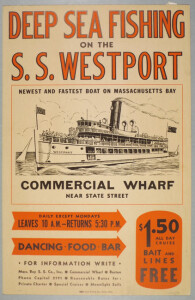 | VESSEL INFORMATION - VESSEL NAME: WESTPORT VESSEL BUILT: 1911 SHIPBUILDER: WILLIAM MCKIE BUILDER LOCATION: EAST BOSTON, MASSACHUSETTS SHIP OWNERS: MT. DESERT AND BLUE HILL LINES DIMENSIONS: 246 tons; 125' length, 21'2" beam, 8'5" draft VESSEL HISTORY: Westport, a 246 gross ton coastal passenger steamship built at Boston, Massachusetts in 1911, was operated in New England waters by the Eastern Steamship Lines from then until November 1918, when she was chartered by the Navy. Commissioned at that time as USS Westport (ID # 2362), her name was changed to USS Adrian within a few days. She was sent south to Norfolk, Virginia where she served as an ambulance boat for the next several months. Adrian returned to Boston in September 1919. She was decommissioned and returned to her owners by the end of that month. | CL9793 | |||||||
| 45 | 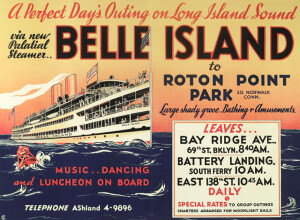 | NOTES: There is one (1) duplicate copy in storage and one (1) in the cafe. VESSEL INFORMATION - VESSEL NAME: BELLE ISLAND SHIPBUILDER: T.A. MARVEL BUILDER LOCATION: NEWBURGH, NEW YORK SHIP OWNER: STEAMER BELLE ISLAND CO. VESSEL DIMENSIONS: 200.5 x 42.0 x 11.3 ALL SHIP'S NAMES: USS COL. JAMES A. MOSS, MARIA DE LOURDES (BRAZILIAN) VESSEL HISTORY: Sold to British in 1942. | CL9801 | |||||||
| 46 | 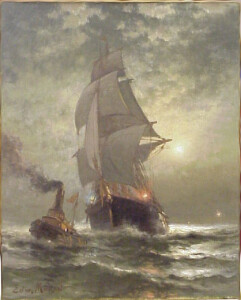 | SHORT DESCRIPTION: NOTES: Moran painted a number of similar paintings. LABEL COPY: SAILING BARK AND TUGBOAT Edward Moran (American, 1829-1901) Oil on canvas, circa 1890 Museum Collection. 76.4 (New paintings 9-20-94, pg. 3) LABEL COPY: STANDING OUT, C. 1890 Oil on canvas by Edward Moran (American, 1829-1901) Sailing an outboard course, the graceful and proud sailing ship must accept the help of a steam tug to get out of the harbor or else wait for the next tide and good wind. This triumph of technology over the "simpler life" was a common theme for artists of the late nineteenth century, who mourned the loss. This scene was to become almost a cliche of the period. James Gale Tyler painted similar works, and described them as drugstore pictures, because the red and green running lights reminded him of the vials of colored water in pharmacy windows. 76.4 (September 1984) | CL11855 | |||||||
| 47 | 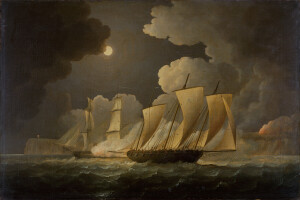 | SHORT DESCRIPTION: Painting depicts a battle a night under a full moon between two sailing vessels, an English brig and a French lugger. Both vessels are under full sail and have their cannon run out. The British vessel in the background is firing on the French vessel in the foreground where men can be seen over the top of the railing. In the background a fire is raging on land at the right and a lighthouse stands on a cliff at the left. NOTES: The French vessel is a chasse maree or lug rigged vessel which is the type favored by French privateers. | CL8669 | |||||||
| 48 | 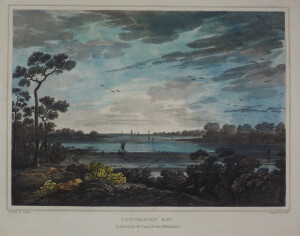 | CURATORS NOTES: Picturesque Views of American Scenery, No. II.; This is a version of the 2nd state of this print. ADDITIONAL INFORMATION: Deak, Gloria Gilda. Picturing America, 1497-1899. Prints, Maps and Drawings Bearing on The New World Discoveries and on the Development of the Territory that is Now the United States. From the I.N. Phelps Stokes Collection and Other Collections In the Miriam and Ira D. Wallach Division of Art, Prints, and Other Photographs of the New York Public Library. Volume I & II. Princeton, N.J.: Princeton University, p. 213-214, catalog 315. Stauffer, David McNeely and Mantle Fielding. American Engravers Upon Copper and Steel. Volume I & II. New York: The Grolier Club, 1907, p. 1343. Stokes, I.N. Phelps. The Iconography of Manhattan Island, 1498-1909. 6 volumes. New York: R.H. Dodd, 1915-28, vol. 3, p. 567. Koke, Richard J. Checklist of John Hill (1770-1850). New York: New York Historical Society, 1961, p. 37-56. Fielding, Mantle, Dictionary of American Painters, Sculptors and Engravers. Lancaster, Pa.: Lancaster Press, 1910. Picturesque Views of American Scenery The drawings for this series were executed by Joshua Shaw, landscape painter, who conceived the idea for the Picturesque Views. A native of England, Shaw had exhibited at the Royal Academy in London before crossing the Atlantic. In 1817, bearing a recommendation of his work from Benjamin West, he settled in Philadelphia. He found it puzzling, by the second decade of the nineteenth century, so little of the landscape had found its way to artists canvases. He undertook to travel through several states, making sketches on the spot and soliciting advance subscriptions for the engravings based on his paintings. Within three years of his arrival, Shaw’s celebrated Picturesque Views came into being, representing the first systematic attempt to record the New World’s landscape. Shaw was fortunate in having the collaboration of John Hill, also a native of England and a master of aquatint, for his portfolio. The ambitious objective was to issue six numbers (sets), each containing six views "with occasional vignettes." Ultimately, only three numbers were issued. Initially undertaken by Thomas Moses as publisher, the project was turned over to M. Carey & Son. Later, because of the appeal of the views, the portfolio was republished in 1835 by Thomas T. Ash. The first state of the title page is rare, inasmuch as Moses Thomas withdrew from the project: he published none of the subsequent views. On the inside of the portfolio wrapper, the titles of the views are given as listed below. No. 1 1. Title page, vignette (Four different versions) 2. Washington’s Sepulchre Mount Vernon 3. View of the Falls of Schuylkill 4. Jones’ Falls Near Baltimore 5. View Near the Falls of Schuykill 6. View of the Spot Where Gen. Ross Fell Near Baltimore 7. Falls of St. Anthony on the Mississippi No. II 8. Lynnhaven Bay (Virginia) LP 3759 9. Spirit Creek, Near Augusta, Georgia 10. View By Moonlight, Near Fayetteville 11. Burning of Savannah 12. Norfolk; from Gosport, Virginia LP 185, 2nd state 13. View of the Wisahiccon, Pennsylvania No. III 14. Vignette Monument Near West Point 15. Passaic Falls, New Jersey 16. View of the Hudson River 17. Hell Gate, Near New York 18. Bolling’s Dam, Near Peterburgh, Virginia 19. Oyster Cove (Virginia) LP 4008 20. Passaic River, Below the Falls Accompanying each print is a letter press edition (TMM does not have these). | CL7918 | |||||||
| 49 | 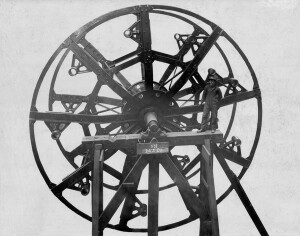 | After 1936 | Worker posed on wheel for scale. The SS Tashmoo and her date with doom. By Don Lochbiler-February 7, 2000. Still, she was a proud and luxurious ship. For decades she was the best-loved vessel on the Detroit River. Her fame was so great that most Detroiters came to think Tashmoo Park was named after the boat, instead of vice versa. Tashmoo Park was the pleasure spot set in the pleasant greenery of the St. Clair Flats (in the area of Harsens Island), where the steamer Tashmoo stopped several times daily on trips between Detroit and Port Huron. When the park opened in 1897 it was regarded as the crowning touch that gave Detroit as fine a summer playground as any city on the lakes could boast. Besides its stately groves of old trees with plenty of picnic tables, a baseball diamond, swings and rides, the park had a casino and a dancing pavilion so big everybody goggled. It had real Indians too. They paddled over from the Canadian reservation on nearby Walpole Island and sold moccasins and beadwork to fun seekers from Detroit. Developed by the Star-Cole Line, the park was delightful for one-day family excursions on the steamer Darius Cole or the big new Greyhound. At 50 cents a round trip, it was a real bargain. A reporter for The Detroit News-Tribune took the trip and was enthusiastic about what he found: "One's first trip to the Flats is a red-letter day in life's calendar. This western Venice seems to be a spot where tired feet and dusty pavements are no more, but where the people float through liquid streets." Since establishment of the Lake St. Clair Fishing and Shooting Club in l872 later to become the Old Club private clubs, cottages and hotels proliferated at the Flats. Tashmoo Park broadened the resort's popularity base to include virtually all Detroiters. The hotels ran a wide gamut. At Joe Bedore's, six-bottle men always could be sure of lusty companions. At the other end of the scale, the Island House offered rustic charm to many families from the South who came year after year to escape the heat back home. The dignified Muir House, operated by Mrs. C. M. Muir, was advertised as "the only temperance house at the Flats." In 1897, the newest and most pretentious hostelry was Riverside Hotel, a mile beyond Star Island. It attracted admiration for its fine expanse of lawn between the main building and the dock. Under rainbow-hued parasols, women guests paraded on the lawn and verandas to watch the passing show of Great Lakes vessels threading the channel hardly a fair-sized croquet stroke away. Ore and grain freighters were numerous, but the big attractions were the cruise ships for the Upper Lakes. Waving passengers thronged their decks. The Detroit & Cleveland Navigation Co.'s new steamer, the City of Mackinac, took cruisers to Mackinac Island from Detroit at $12.50 for the round trip, meals and berth included. The Detroit, Windsor & Soo Line offered a seven-day trip to Georgian Bay and Lake Superior for $l7. The aristocrat of cruise ships, the Canadian Pacific's Alberta, charged $20 for a journey to Fort William, Ontario The most welcome sight of all for ship-watchers at the Flats, however, was the Tashmoo. The schedule she maintained through the resort area seemed incredible. In less than an hour, the Tashmoo made 10 stops. What words can recapture the excitement of a Tashmoo landing? The seemingly reckless approach to the dock; the spouting foam of the reversed paddlewheels bringing her to a sudden halt; the shouted greetings across the narrowing span between ship and shore; the clanging bells. Swiftly followed the accurately tossed hawser loops dropping on the piles, the gangplank lowered and the passengers hurrying off while the never-stilled engines throbbed impatiently. Within seconds the rising gangplank nipped at the heels of any dawdling passenger. Retracted hawsers whistled through the air; bells clanged again; more spouts of foam. Then the fluttering handkerchiefs of farewell dwindled behind. Only the Tashmoo could do it with such flair. She had her trial run in 1900. Adm. George Dewey and his bride were among her first passengers. Her epic race with the City of Erie and President Theodore Roosevelt's ride on her soon after he became President added to her eclat. But on Dec. 8, 1927, the doubts the old rivermen expressed for so long about the steamer came to the fore. That was the day the Tashmoo, in the worst storm on the river in years, disappeared without a soul on board. A 60-mile-an-hour gale was blowing, driving snow before it. During the night the temperature dropped 40 degrees, to 8 above. In the predawn blizzard The Detroit News dispatched a reporter and photographer to assess storm damage along the waterfront. At the office of the White Star Line, sucessors to Star-Cole, at the foot of Griswold, the team for the paper found the big story in the person of a white-faced watchman, Robert McCrumb. McCrumb waved at the dock where for many weeks the Tashmoo was moored at winter anchorage, made secure by 14 heavy steel cables. "She's gone," he said. "Gone right up the river." McCrumb remained at his post while the storm mounted. "Then the cable started snapping," he said. "They went one after the other, like they were grocery string." McCrumb heard a crash, muffled by the wind, moments after the Tashmoo broke loose. On this tip the newsmen pushed their way a block east, to the Woodward Avenue dock of the Detroit and Windsor Ferry Co. What the Tashmoo hit, they learned, was the ferry Promise. Anton Mensen, her engineer, and three crewmen leaped to the dock after the impact. They were getting up steam for the ferry's first morning run across the river. "Just like she was starting on her regular summer run up to Port Huron," a crewman volunteered. Taking off in their vintage Model T roadster, equipped with isinglass side-curtains, the searchers made their next inquiry at the foot of Randolph, home base for the fireboat James Battle. Had anyone seen the Tashmoo heading upstream? "No, and we haven't seen the Flying Dutchman, either," answered a skeptical fireman. When further explanation convinced him that he was not being ribbed, he offered a suggestion: "There's only one thing can stop that fool boat," he said. "The Belle Isle Bridge." Visibility was near zero when the Model T reached the bridge, but long before the searchers sighted the Tashmoo they could hear the anguished banging of the ship against the concrete abutment. And then, there she was listing tipsily to port, her sides gashed, but still seemingly determined to batter her way up to Lake St. Clair. Two tugs arrived, and after a struggle to get lines aboard, they pulled the Tashmoo away from the bridge. In tandem formation, they tried to tow her to the Detroit Shipbuilding Co. dock at the foot of Orleans, where she was built. Still she wasn't subdued. Abeam of the Walkerville ferry dock at the foot of Jos. Campau, the Tashmoo snapped the hawser and once again plunged upstream toward the bridge. She was only 10 yards from it when the tugs got lines on her once more. This time she followed them to harbor. Repaired and refurbished, the Tashmoo lived on for nine more years until the sad night of June 18, 1936. She was chartered for a moonlight ride that evening by the Pals Club, a Hamtramck social group. A crowd of 1,400 gathered at the foot of Griswold. River traffic delayed the Tashmoo's return from her day trip, one of the cut-rate Friday excursions to Port Huron sponsored by the News. She left dock at 9:20 p.m., 20 minutes after her longtime rival in the moonlight trade, the Columbia, was speeding downriver. The Tashmoo made up most of the deficit. She reached Sugar Island, near Grosse Ile, at l0:35 p.m., and started on the cruise homeward at ll:20. As she came out of Sugar Island Channel a shock was felt throughout the ship. Passengers were told that there was engine trouble. Jean Calloway's orchestra played on, and the dancing never was more lively. But in the engine room it was different. The Tashmoo had struck a submerged rock. The wound was mortal. As water poured in through a hole in the hull faster than the pumps could handle it, the engine room crew stoked the boiler fire in a swirling, waist-deep flood. Capt. Donald MacAlpine called for full speed ahead. Ten minutes after the shock, the Tashmoo docked at the Brunner-Mond Co. coal wharf above Amherstburg on the Canadian side. Only after passengers and crew were safely ashore did the grand old steamer sink to the bottom in 18 feet of water. The Tashmoo's days of glory were over. The SS Tashmoo lies partly submerged after striking a rock and ripping her hull open off Amherstburg on June 18, 1936. | P0001.004/01-#PC62 | ||||||
| 50 | 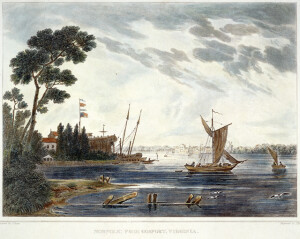 | NOTES: View of the port taken from a spot a little above the navy yard. Picturesque Views of American Scenery, No. II. This is a version of the 2nd state of this print. ADDITIONAL INFORMATION: American Historical Prints, p. 102 & 60. Drepperd, C.W., "Early American Prints"; Emmerson, John C., "Steam Navigation in Virginia and Northeastern North Carolina, 1826-1836". Deak, Gloria Gilda. Picturing America, 1497-1899. Prints, Maps and Drawings Bearing on The New World Discoveries and on the Development of the Territory that is Now the United States. From the I.N. Phelps Stokes Collection and Other Collections In the Miriam and Ira D. Wallach Division of Art, Prints, and Other Photographs of the New York Public Library. Volume I & II. Princeton, N.J.: Princeton University, p. 213-214, catalog 315. Stauffer, David McNeely and Mantle Fielding. American Engravers Upon Copper and Steel. Volume I & II. New York: The Grolier Club, 1907, p. 1343. Stokes, I.N. Phelps. The Iconography of Manhattan Island, 1498-1909. 6 volumes. New York: R.H. Dodd, 1915-28, vol. 3, p. 567. Koke, Richard J. Checklist of John Hill (1770-1850). New York: New York Historical Society, 1961, p. 37-56. Fielding, Mantle, Dictionary of American Painters, Sculptors and Engravers. Lancaster, Pa.: Lancaster Press, 1910. Picturesque Views of American Scenery The drawings for this series were executed by Joshua Shaw, landscape painter, who conceived the idea for the Picturesque Views. A native of England, Shaw had exhibited at the Royal Academy in London before crossing the Atlantic. In 1817, bearing a recommendation of his work from Benjamin West, he settled in Philadelphia. He found it puzzling, by the second decade of the nineteenth century, so little of the landscape had found its way to artists canvases. He undertook to travel through several states, making sketches on the spot and soliciting advance subscriptions for the engravings based on his paintings. Within three years of his arrival, Shaw’s celebrated Picturesque Views came into being, representing the first systematic attempt to record the New World’s landscape. Shaw was fortunate in having the collaboration of John Hill, also a native of England and a master of aquatint, for his portfolio. The ambitious objective was to issue six numbers (sets), each containing six views "with occasional vignettes." Ultimately, only three numbers were issued. Initially undertaken by Thomas Moses as publisher, the project was turned over to M. Carey & Son. Later, because of the appeal of the views, the portfolio was republished in 1835 by Thomas T. Ash. The first state of the title page is rare, inasmuch as Moses Thomas withdrew from the project: he published none of the subsequent views. On the inside of the portfolio wrapper, the titles of the views are given as listed below. No. 1 1. Title page, vignette (Four different versions) 2. Washington’s Sepulchre Mount Vernon 3. View of the Falls of Schuylkill 4. Jones’ Falls Near Baltimore 5. View Near the Falls of Schuykill 6. View of the Spot Where Gen. Ross Fell Near Baltimore 7. Falls of St. Anthony on the Mississippi No. II 8. Lynnhaven Bay (Virginia) LP 3759 9. Spirit Creek, Near Augusta, Georgia 10. View By Moonlight, Near Fayetteville 11. Burning of Savannah 12. Norfolk; from Gosport, Virginia LP 185, 2nd state 13. View of the Wisahiccon, Pennsylvania No. III 14. Vignette Monument Near West Point 15. Passaic Falls, New Jersey 16. View of the Hudson River 17. Hell Gate, Near New York 18. Bolling’s Dam, Near Peterburgh, Virginia 19. Oyster Cove (Virginia) LP 4008 20. Passaic River, Below the Falls Accompanying each print is a letter press edition (TMM does not have these). | CL17733 | |||||||
| 51 | 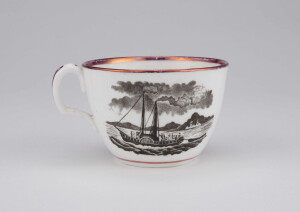 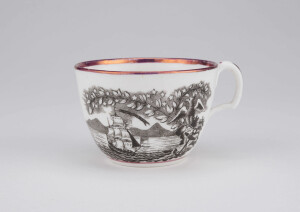 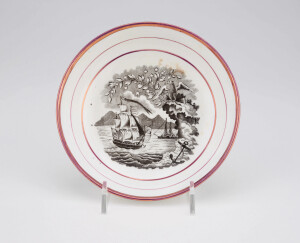 | SHORT DESCRIPTION: Staffordshire china tea service including a teapot, teapot stand or tray, creamer, waste bowl, 8" plate, six cups and six saucers. Each piece decorated with a transfer print showing a warship that is probably the American 18-gun sloop of war Hornet on one side and an excursion steamer on the other. Cup has rounded sides and one handle. The sailing ship is flying an American flag over a British flag on the mainmast, at the front of the ship near the bowsprit, and again at the stern indicating that this is a captured British vessel. There is an eagle sitting on a promontory at the right with a olive branch covered with stars behind. The sidewheel steamer on the reverse side is travelling in front of hilly terrain and there is a double turreted white building in the background. NOTES: The images on this piece are frequently attributed to be the Cadmus, the vessel that brought the Marquis de Lafayette to the United States in 1824 and a Robert Fulton steamboat. However, the sailing ship most definitely has an American flag flying over a British flag on the mainmast, at the front of the ship near the bowsprit, and again at the stern indicating that this is a captured British vessel. According to P.D. Gordon Pugh in "Naval Ceramics" the tea set bearing these images is thought to have been created as a memorial to Captain James Lawrence and his victory over the HMS Peacock during the War of 1812. The image of the sailing vessel is thought to be Lawrence's 18-gun sloop of war Hornet. The paddle-steamer depicted in the series was originally thought to be Fulton's Clermont, but is now regarded to be an excursion boat carrying sight-seers to the area where Captain Lawrence's victory over the HMS Peacock occurred. A description of the battle by Julia D.S. Snow in “A Pottery Memorial to Captain James Lawrence, United States Navy” states that the battle between Peacock and Hornet occurred near a “white turreted fortification” at the mouth of the Demerara River. This may be reflected in the double turreted building that appears behind the steamer. As the Peacock was sunk during the fight with Hornet this is most likely just a patriotic representation of the event produced by British manufactories for sale on the American market. FN 174, a plate by Enoch Wood commemorating the “Landing of the Fathers at Plymouth, Mass” has a medallion at the left side that bears a resemblance to the images on this set. It shows the same steamer and the eagle sitting on the olive branch. An image in the medallion to the right is labeled Enterprise and Boxer but most definitely shows the Francis Kearney’s depiction of a moonlight battle between two frigates (the Hornet and Peacock). Based on this image pieces with this imagery are being tentatively attributed to Enoch Wood. The dates are tentatively set at circa 1815 to 1818. Objects in the collection with this image include: FN 273, FN 274, FN 285, FN 286, FN 287, FN 288, FN 534, FN 535, FN 536, FN 537, FN 538, FN 539, FN 540 NOTES: This tea service was purchased from Parke-Bernet Galleries, Inc. in the sale no. 922 of the materials collected by George Horace Lorimer. INVENTORY: FN 0534.01/1944.200.01 Teacup; FN 0534.02/1944.200.02 Teacup; FN 0534.03/1944.200.03 Teacup; FN 0534.04/1944.200.04 Teacup; FN 0534.05/1944.200.05 Teacup; FN 0534.06/1944.200.06 Teacup; FN 0535.01/1944.200.07 Saucer; FN 0535.02/1944.200.08 Saucer; FN 0535.03/1944.200.09 Saucer; FN 0535.04/1944.200.10 Saucer; FN 0535.05/1944.200.11 Saucer; FN 0535.06/1944.200.12 Saucer; FN 0536A-B/1944.200.13A-B Teapot and lid; FN 0537/1944.200.14 Teapot stand or tray; FN 0538/1944.200.15 Creamer; FN 0539/1944.200.16 Waste bowl; FN 0540/1944.200.17 8” Plate. | CL5704 | |||||||
| 52 | 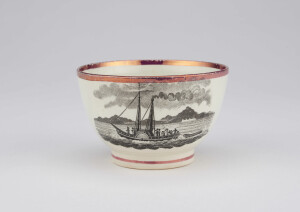 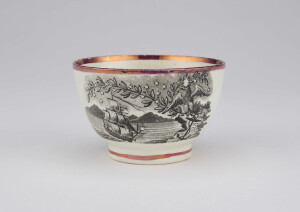 | SHORT DESCRIPTION: Staffordshire china cup and saucer with a transfer print showing a warship that is probably the American 18-gun sloop of war Hornet on one side and an excursion steamer on the other. Cup has rounded sides with no handle. The sailing ship is flying an American flag over a British flag on the mainmast, at the front of the ship near the bowsprit, and again at the stern indicating that this is a captured British vessel. There is an eagle sitting on a promontory at the right with a olive branch covered with stars behind. The sidewheel steamer on the reverse side is travelling in front of hilly terrain and there is a double turreted white building in the background. NOTES: The images on this piece are frequently attributed to be the Cadmus, the vessel that brought the Marquis de Lafayette to the United States in 1824 and a Robert Fulton steamboat. However, the sailing ship most definitely has an American flag flying over a British flag on the mainmast, at the front of the ship near the bowsprit, and again at the stern indicating that this is a captured British vessel. According to P.D. Gordon Pugh in "Naval Ceramics" the tea set bearing these images is thought to have been created as a memorial to Captain James Lawrence and his victory over the HMS Peacock during the War of 1812. The image of the sailing vessel is thought to be Lawrence's 18-gun sloop of war Hornet. The paddle-steamer depicted in the series was originally thought to be Fulton's Clermont, but is now regarded to be an excursion boat carrying sight-seers to the area where Captain Lawrence's victory over the HMS Peacock occurred. A description of the battle by Julia D.S. Snow in “A Pottery Memorial to Captain James Lawrence, United States Navy” states that the battle between Peacock and Hornet occurred near a “white turreted fortification” at the mouth of the Demerara River. This may be reflected in the double turreted building that appears behind the steamer. As the Peacock was sunk during the fight with Hornet this is most likely just a patriotic representation of the event produced by British manufactories for sale on the American market. FN 174, a plate by Enoch Wood commemorating the “Landing of the Fathers at Plymouth, Mass” has a medallion at the left side that bears a resemblance to the images on this set. It shows the same steamer and the eagle sitting on the olive branch. An image in the medallion to the right is labeled Enterprise and Boxer but most definitely shows the Francis Kearney’s depiction of a moonlight battle between two frigates (the Hornet and Peacock). Based on this image pieces with this imagery are being tentatively attributed to Enoch Wood. The dates are tentatively set at circa 1815 to 1818. Objects in the collection with this image include: FN 273, FN 274, FN 285, NF 286, FN 287, FN 288, FN 534, FN 535, FN 536, FN 537, FN 538, FN 539, FN 540 NOTES: Notes made in the China File by Nola Hill - work done in the '40's or early 50's per Harold Sniffen, 12/7/81... Border purple lustre Liverpool ware Cup 5-1/2 inches (early type without handle) Saucer 3-1/4 x 2-1/4 inches | CL5714 | |||||||
| 53 | 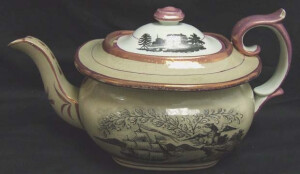 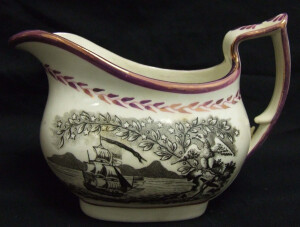 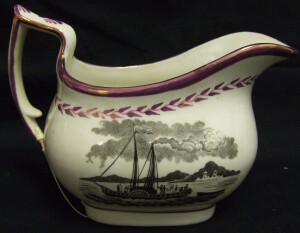 | SHORT DESCRIPTION: Staffordshire china tea service including teapot, creamer and six cups and saucers. Each piece is decorated with a transfer print showing a warship that is probably the American 18-gun sloop of war Hornet on one side and an excursion steamer on the other. The sailing ship is flying an American flag over a British flag on the mainmast, at the front of the ship near the bowsprit, and again at the stern indicating that this is a captured British vessel. There is an eagle sitting on a promontory at the right with a olive branch covered with stars behind. The sidewheel steamer on the reverse side is travelling in front of hilly terrain and there is a white building in the background. NOTES: The images on this piece are frequently attributed to be the Cadmus, the vessel that brought the Marquis de Lafayette to the United States in 1824 and a Robert Fulton steamboat. However, the sailing ship most definitely has an American flag flying over a British flag on the mainmast, at the front of the ship near the bowsprit, and again at the stern indicating that this is a captured British vessel. According to P.D. Gordon Pugh in "Naval Ceramics" the tea set bearing these images is thought to have been created as a memorial to Captain James Lawrence and his victory over the HMS Peacock during the War of 1812. The image of the sailing vessel is thought to be Lawrence's 18-gun sloop of war Hornet. The paddle-steamer depicted in the series was originally thought to be Fulton's Clermont, but is now regarded to be an excursion boat carrying sight-seers to the area where Captain Lawrence's victory over the HMS Peacock occurred. A description of the battle by Julia D.S. Snow in “A Pottery Memorial to Captain James Lawrence, United States Navy” states that the battle between Peacock and Hornet occurred near a “white turreted fortification” at the mouth of the Demerara River. This may be reflected in the double turreted building that appears behind the steamer. As the Peacock was sunk during the fight with Hornet this is most likely just a patriotic representation of the event produced by British manufactories for sale on the American market. FN 174, a plate by Enoch Wood commemorating the “Landing of the Fathers at Plymouth, Mass” has a medallion at the left side that bears a resemblance to the images on this set. It shows the same steamer and the eagle sitting on the olive branch. An image in the medallion to the right is labeled Enterprise and Boxer but most definitely shows the Francis Kearney’s depiction of a moonlight battle between two frigates (the Hornet and Peacock). Based on this image pieces with this imagery are being tentatively attributed to Enoch Wood. The dates are tentatively set at circa 1815 to 1818. Objects in the collection with this image include: FN 273, FN 274, FN 285, FN 286, FN 287, FN 288, FN 534, FN 535, FN 536, FN 537, FN 538, FN 539, FN 540 NOTE: The teapot lid appears to be a replacement. NOTES: Notes made in the China File by Nola Hill - work done in the '40's or early 50's per Harold Sniffen, 12/7/81. INVENTORY: FN 0285/1938.617.01A-B Teapot with lid; FN 0286/1938.617.02 Creamer; FN 0287.01/1938.617.03 Teacup; FN 0287.02/1938.617.04 Teacup; FN 0287.03/1938.617.05 Teacup; FN 0287.04/1938.617.06 Teacup; FN 0287.05/1938.617.07 Teacup; FN 0287.06/1938.617.08 Teacup; FN 0288.01/1938.617.09 Saucer; FN 0288.02/1938.617.10 Saucer; FN 0288.03/1938.617.11 Saucer; FN 0288.04/1938.617.12 Saucer; FN 0288.05/1938.617.13 Saucer; FN 0288.06/1938.617.14 Saucer. | CL5716 | |||||||
| 54 |   | SHORT DESCRIPTION: This page is comprised of eight individual scenes involving Negroes and their arrival at Fort Monroe, Virginia. The large central image depicts runaway slaves coming up to Federal sentrys and crossing the drawbridge as they enter into the sanctuary of Fort Monroe. The scene in the upper left-hand corner depicts a slaveowner from Richmond, Virginia manumitting his slaves at Fort Monroe in the presence of General Butler. The general refused to release the negroes to the southerner unless he was willing to swear an oath of allegiance to the Federal Government. The scene directly beneath this one depicts negroes being "mustered" into the service of the Federal Government. The bottom left-hand scene illustrates negroes in the woods escaping at night. The top middle scene shows a group of negroes approaching Union sentries at night asking for asylum from General Butler at Fort Monroe. In the top right scene, a slave owner from Richmond, Virginia is depicted attempting to claim thirty runaway slaves at Fort Monroe. The scene below this depicts runaway slaves at Fort Monroe preparing rations and performing other utility-oriented tasks. The bottom right scene depicts runaway slaves working under the direction of Federal troops in the trenches. | CL24182 | |||||||
| 55 | 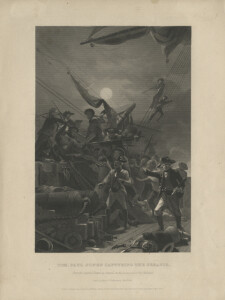 | SHORT DESCRIPTION: Black and white image of a deck scene depicting John Paul Jones and crew fighting in hand-to-hand combat in the moonlight. Jones is holding a telescope in one hand and a pistol in the other. A second pistol is in his belt. It appears as if the two ships are side by side and the crew of the HMS SERAPIS is climbing over the side of the ship and onto the deck where John Paul Jones is standing. There is a man firing a gun from the rigging. The combat is taking place with swords, bayoneted rifles and small spears. Dead and injured are laying on the deck around Jones. Comes from 'Battles of the United States by Sea and Land' by Henry B. Dawson, 1858. The image appears after page 556 in book I. NOTES: Excerpts from 'A Naval History of the American Revolution' by Gardner Weld Allen, pages 442-485: In January 1779, the French purchased a 14-year old East Indiaman called Duc de Duras. It was converted into a man-of-war despite being structurally weak and a slow sailer by Captain John Paul Jones. The vessel was renamed Bonhomme Richard in honor of Benjamin Franklin, Jones's friend and benefactor. Jones spent months preparing for a cruise against the English islands. The American frigate Alliance was detained in France by Franklin to support Jones's expedition. Three French vessels, Pallas, a merchantman or privateer fitted out as a 32-gun frigate; Cerf, an 18-gun cutter; and Vengeance, a 12-gun brigantine, were also given to Jones. The squadron was ready for sea by the middle of June and sailed from Groix Roads, near L'Orient on June 19th on a shakedown cruise during which a convoy would be escorted to Bordeaux and other ports. Franklin's orders to Jones were to cruise to the north of the British Isles and after six weeks put into Texel in order to convoy vessels from Holland to France. The squadron sailed from Groix Roads on August 14, 1779. On the 23rd the squadron was off Cape Clear. Two prizes had been taken and sent back to L'Orient. A third was taken by boat action but later lost in a fog. The Cerf dropped out of the expedition after receiving damage in a gale on August 26th. The same gale separated the ships of the squadron, but Bonhomme Richard and Vengeance proceeded northward and were off Cape Wrath by September 1st where they fell in with the Alliance and prize she had taken. The same day a British letter of marque was taken. These were later given up by Danish authorities to the British consul. On September 2nd the Pallas rejoined the squadron. The squadron cruised a few days between Orkney and Shetland and took a few unimportant prizes. Another gale and adverse winds prevented the squadron from sighting land again until September 13th when the Cheviot Hills were sighted. Two colliers were taken on the 14th. One of the prizes was sunk during a gale on the 17th. British Revenue Cutters specially fitted out and armed for service against the American squadron alerted the British population about the approached of Jones's squadron. The squadron sailed south and a few more prizes were taken. By September 21st the squadron was off Flamborough Head at which point two brigs were captured and a small fleet of vessels were chased. On September 23rd, the squadron encountered a Baltic fleet of 41 vessels under convoy by the 44-gun [but carrying 50 guns] frigate HMS Serapis, Captain Richard Pearson, and the hired armed ship Countess of Scarborough. Bonhomme Richard and Serapis entered a bitter engagement about 7:00PM. Jones described the action in an October 3rd report to Benjamin Franklin: "The battle being thus begun was continued with unremitting fury. Every method was practised on both sides to gain an advantage and rake each other, and I must confess that the enemy's ship, being much more manageable than the Bonhomme Richard, gained thereby several times an advantageous situation, in spite of my best endeavors to prevent it. As I had to deal with an enemy of greatly superior force, I was under the necessity of closing with him, to prevent the advantage which he had over me in point of manoeuvre. It was my intention to lay the Bonhomme Richard athwart the enemy's bow, but as that operation required great dexterity in the management of both sails and helm and some of our braces being shot away, it did not exactly succeed to my wishes. The enemy's bowsprit, however, came over the Bonhomme Richard's poop by the mizen mast and I made both ships fast together in that situation, which by the action of the wind on the enemy's sails, forced her stern close to the Bonhomme Richard's bow, so that the ships lay square alongside of each other, the yards being all entangled and the cannon of each ship touching the opponent's side. "When this position took place it was eight o'clock, previous to which the Bonhomme Richard had received sundry eighteen pounds shot below the water and leaked very much. My battery of 12-pounders, on which I had placed my chief dependance, being commanded by [1st] Lieut. [Richard] Dale and Col. Weibert and manned principally with American seamen and French volunteers, were entirely silenced and abandoned. As to the six old 18-pounders that formed the battery of the lower gundeck, they did no service whatever; two out of three of them burst at the first fire and killed almost all the men who were stationed to manage them. Before this time too, Col. De Chamillard, who commanded a party of twenty soldiers on the poop, had abandoned that station after having lost some of his men; these men deserted their quarters. I had now only two pieces of cannon, 9-pounders on the quarter deck, that were not silenced, and not one of the heavier cannon was fired during the rest of the action. The purser, Mr. Mease, who commanded the guns on the quarter deck, being dangerously wounded in the head, I was obliged to fill his place and with great difficulty rallied a few men and shifted over one of the lee quarter-deck guns, so that we afterwards played three pieces of 9-pounders upon the enemy. The tops alone seconded the fire of this little battery and held out bravely during the whole of the action, especially the main top where Lieut. Stack commanded. I directed the fire of one of the three cannon against the mainmast with doubleheaded shot, while the other two were exceedingly well served with grape and canister-shot to silence the enemy's musketry and clear her decks, which was at last effected. "The enemy were, as I have since understood, on the instant of calling for quarters, when the cowardice or treachery of three of my under officers induced them to call to the enemy. The English commodore asked me if I demanded quarters and, I having answered him in the most determined negative, they renewed the battle with double fury. They were unable to stand the deck, but the fire of their cannon, especially the lower battery, which was entirely formed of 18-pounders, was incessant. Both ships were set on fire in various places and the scene was dreadful beyond the reach of language. To account for the timidity of my three under officers, I mean the gunner, the carpenter, and the master-at-arms, I must observe that the two first were slightly wounded, and as the ship had received various shots under water, and one of the pumps being shot away, the carpenter expressed his fear that she would sink and the other two concluded that she was sinking, which occasioned the gunner to run aft on the poop, without my knowledge, to strike the colors. Fortunately for me, a cannon ball had done that before by carrying away the ensign staff; he was therefore reduced to the necessity of sinking, as he supposed, or of calling for quarter and he preferred the latter. "All this time the Bonhomme Richard had sustained the action alone and the enemy, though much superior in force, would have been very glad to have got clear, as appears by their own acknowledgments and their having let go an anchor the instant that I laid them on board, by which means they would have escaped, had I not made them well fast to the Bonhomme Richard. At last, at half past nine o'clock, the Alliance appeared and I now thought the battle at an end, but to my utter astonishment he discharged a broadside full into the stern of the Bonhomme Richard. We called to him for God's sake to forbear firing into the Bonhomme Richard, yet he passed along the off side of the ship and continued firing. There was no possibility of his mistaking the enemy's ship for the Bonhomme Richard, there being the most essential difference in their appearance and construction; besides, it was then full moonlight and the sides of the Bonhomme Richard were all black, while the sides of the prizes were yellow. Yet, for the greater security, I showed the signal of our reconnoissance by putting out three lanthorns, one at the head (bow), another at the stern (quarter), and the third in the middle, in a horizontal line. Every tongue cried that he was firing into the wrong ship, but nothing availed; he passed round firing into the Bonhomme Richard's head, stern, and broadside, and by one of his vollies killed several of my best men and mortally wounded a good officer on the forecastle. "My situation was really deplorable. The Bonhomme Richard received various shots under water from the Alliance, the leak gained on the pumps, and the fire increased much on board both ships. Some officers persuaded me to strike, of whose courage and good sense I entertain a high opinion. My treacherous master-at-arms let loose all my prisoners without my knowledge and my prospect became gloomy indeed." The prisoners were much frightened, believing that the ship was sinking, and were at once put to work at the pumps; otherwise, by reinforcing the enemy, they would surely have turned the scale in his favor. "I would not, however, give up the point. The enemy's mainmast began to shake, their firing decreased, ours rather increased, and the British colors were struck at half an hour past ten o'clock." Reports by Dale and Captain Pearson indicated that a hand grenade thrown into the lower decks of Serapis from one of the ship's tops (which had unknowingly been taken over by the Americans) ignited loose gunpowder and sparked a fire that spread from cartridge to cartridge all the gun deck and "blew up the whole of the people and officers that were quartered abaft the mainmast, from which unfortunate circumstance all those guns were rendered useless for the remainder of the action." Both ships were severely damaged in the action. Bonhomme Richard was on fire in several placed and leaky rapidly with five feet of water in the hold, one pump was shot away and the other three were barely able to keep the water from gaining. Jones described the damage to Bonhomme Richard as "the rudder was cut entirely off the stern frame and the transums were almost entirely cut away; the timbers, by the lower deck especially, from the mainmast to the stern, being greatly decayed with age, were mangled beyond my power of description." Both sides of the ship for a great distance were wholly shot away, leaving little support for the upper deck, and projectiles passed through without hitting anything. The mainmast and mizzen-topmast of the Serapis fell overboard immediately after her surrender and she was otherwise much injured. It was only through Jones's determination not to yield that won this battle. Serapis's consort, the Countess of Scarborough, was engaged and taken by the Pallas. Jones blamed the convoy's escape on the disinclination of the French captains of Alliance and Vengeance to pursue it. Bonhomme Richard defied all efforts to save her and sank about 36 hours later at 11:00AM on September 25th. Jones took command of Serapis, erected a jury mainmast and sailed her to Texel, arriving on October 3rd. After Jones spent three months refitting his squadron, most of which were transferred to French flags to ease tensions between the Dutch and British, the Dutch ordered Jones in USS Alliance (the only vessel of the squadron that remained under the American flag) to depart on the first favorable wind. Jones managed to leave Texel on December 27, 1779 and successfully evaded a British blockading squadron. Serapis was eventually sold at L'Orient and the Countess of Scarborough was sold at Dunkirk. | CL17388 | |||||||
| 56 | 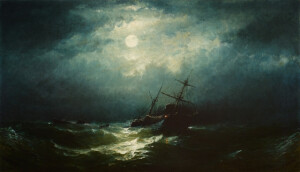 | SHORT DESCRIPTION: Oil painting on canvas by William Richardson Tyler, circa 1892, depicting the sinking of USS Monitor on December 31, 1862. The artist places the USS Rhode Island at the center of the image, in stormy seas and running lights visible. The Monitor, partially submerged, sits to the left of center and there is a small boat filled with men between them. The sky is cloudy, but the moon is visible and is providing what little light is available to highlight the scene. NOTES: George Geer's obituary states: Artist W. R. Tyler of this city is at work on an oil painting that will show the rescue of the crew of the Monitor by the steam Rhode Island, when the Monitor was sinking in a gale of Cape Hatteras in 1863 [sic]. The artist received most of his data for the scene from Mr. Geer. | CL30865 | |||||||
| 57 | 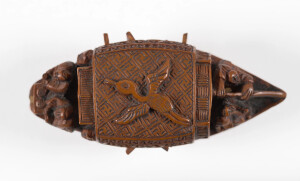 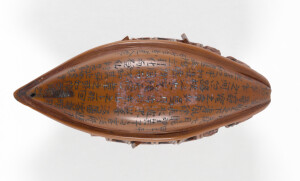 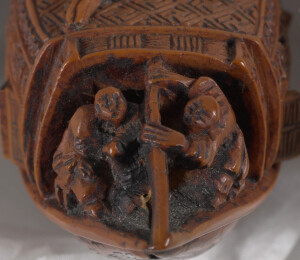 | SHORT DESCRIPTION: Olive pit carved in the form of a boat (sampan). Made in China. The carver has marked the model ‘甲子年’ which is the year of the wood rat. The carver is identified on the left with the mark ‘石谷生老道人作’ which translates ‘written by Shi Gusheng, an old Toaist.’ This appears to be the maker Zhan Gusheng (1802-1876) who Guangzhou International describes as “a veteran carver from Xintang of the Qing Dynasty (1616-1911).” This places the date of the carving at 1864. The carving features an enclosed cabin at the center of the boat with two sets of shutters that open and close on each side. One passenger sits behind each set of shutters giving a total of four people inside the cabin. Two men stand at the stern holding the end of a long oar. At the bow, two passengers sit at a table with two bowls sitting on the table top in front of them. Two servants stand behind them in the entrance to the cabin. A small awning extends from the cabin roof towards the bow. The carver has placed a crane on a roof patterned with rows of diamonds or squares which each contain a carving of a swastika with the crampons facing left or in a counterclockwise orientation (sometimes given the name sauwastika). The swastika is viewed as symbol of “long life, a multitude of blessings, great happiness” in China [page 800 in ‘The Swastika, the Earliest Known Symbol, and Its Migrations…’ by Thomas Wilson, Curator, Department of Prehistoric Anthropology, from the Report of the U. S. National Museum for 1894, published in 1896 in Washington, D.C.]. According to Patricia Welch in ‘Chinese Art, A Guide to Motifs and Visual Imagery’ the crane symbolizes status and longevity and the “swastika also has a secular symbolism of good fortune” [page 244]. Sitting below the roof is a band containing a row of circles (13 on the port side, 14 on the starboard). According to Welch ‘circles and round shapes are generally associated with heaven.’ Below the band of circles and above the shuttered windows is a band containing three stylized flowers with four petals each (possibly prunus which Welch says symbolizes “early spring, beauty and the transitoriness of life” or a stylized lotus blossom) surrounded by leaves or vines. The smooth bottom of the carving is engraved with six columns of Chinese characters of the first few sentences of the poem ‘Ode on the Red Cliffs’ written by Su Shi (蘇軾) (also known as Su Dongpo), a well-known poet from the Northern Song Dynasty. According to a translation of the poem found at Patricksiu.org the segment of text carved on the pit translates: It was the 7th month in the autumn of the year Ren Xu when the full moon was just a little on the wane, I, Su Shi, went boating with my friends in the river near the Red Cliff. A fresh cool breeze was blowing, too gentle to ripple the water. Raising my cup, I toasted my friends, recited and chanted the verses on the Bright Moon from Classic of Poetry. A little later, the moon rose from behind the eastern mountain and began to roam between the Southern Dipper and the Ox (Altair). White mist heaped up across the river, and the moonlight stretched far into the horizon to merge with the hues of the sky. Like a piece of reed, our boat drifted on a boundless expanse of water, so vast that we felt as if we were riding in the wind, not knowing when to come to a halt. We felt so ethereal as if we were ascending into heaven and becoming winged immortal. Then we drank wine, feeling exhilarated. An exquisite and charming little decoration, in excellent condition. NOTES: [J. Willoz-Egnor, 8/27/2024] See item 2247 on page 147 of ‘Water, Pine and Stone Retreat Collection, Scholarly Art’ an auction held by Sotheby’s in Hong Kong on October 9, 2010. An olive stone carving and stand by Gusheng, Qing Dynasty dated to the Jiazi year (1864). The date is similar to ours minus the characters for the month. The catalog provides the following information about the item and carver: The vogue for miniature crafts, including carving on olive, peach, walnut and various other fruit stones was started during the reign of the Qianlong emperor and remained popular throughout the Qing and Republican era. Examples of Imperial miniature craft are illustrated in ‘Masterpieces of Chinese Miniature Craft in the National Palace Museum, Taipei, 1971, plates 1-50, with an introduction to its history, pages 78-79. The present carving is the work of Gusheng (1802-1876), a scholar who became a xiucai (country-level rank) at the age of 22 but did not progress any further. A native of Guangdong, Gusheng took up a career as a carver specializing in miniature craft. He became known for his olive-stone carvings, especially those depicting the Song dynasty poet Su Shi and his companions in a pleasure boat visiting the Red Cliff (Chibi). NOTES: The model was purchased in 1946 by Commander James Sinclair Davis of the Royal Canadian Navy in Hong Kong. In a letter dated November 11, 1959 he states about its acquisition: "in 1946 I was wandering around the back alleys of Hong Kong and I was fairly sober at the time...[after the Japanese had surrendered] and before law and order could be restored there was a week's orgy, all the homes were looted and pillaged, and the contents stolen later to be sold in their back alleys. Among all the stuff I noticed was a little sampan which so attracted me that I believe I would have paid almost anything for it. Actually, after chiseling, I believe I only paid 60¢ for it. Its L.O.A. is 1-5/8", carved out of a litchi nut. Fore and aft across its bottom is a story about a Chinese family escaping a typhoon and sailing down the Canton River." [J. Willoz-Egnor, 8/27/2024: this isn't quite the case. See the updated cataloging, which was completely with some help of the staff of the Hong Kong Maritime Museum,] NOTES: [J. Willoz-Egnor, 8/27/2024] History of the ‘Ode on the Red Cliffs’ according to Patricksiu.org: Su Shi (蘇軾) (1037 – 1101) was a great scholar and had a very unstable career as a government official. In 1079 Su was falsely accused in Wutai Poem Incident (烏台詩案) and exiled to Huangzhou (黄州). This marked a turning point in his life. While he experienced great hardship in life, most of his great literary achievements were composed around this time. The Ode depicted Su and his friends traveling on a small boat to visit the Red Cliffs just outside Huangzhou in an autumn night in 1082. He recalled the Battle of Red Cliff (Battle of Chibi 赤壁之戰) in 208 AD. It was a fierce battle between the allied forces of the Southern warlord Liu Bei (劉備) and Sun Quan (孫權) and the numerically superior forces of the Northern warlord Cao Cao (曹操). Liu Bei and Sun Quan defeated Cao Cao’s army to conquer the land south of the Yangtze River. The event that happened over 800 years ago made Su thought about the rise and fall of great historical figures, the brevity of life and the hypocritical nature of people. He wrote about his philosophical views on the certainty of change in life. This Ode was written in 1083 on the invitation of Su’s friend Fu Yaoyu (傅堯俞, 字欽之)(1024 – 1091). Su was 48 years of age. From Su’s particular reminders of ‘living in fear for more troubles 多難畏事’ and ‘by your love for me, you will hold this Ode in secrecy 欽之愛我, 必深藏不出已’, this shows Su’s fear of being misinterpreted and further offended the Emperor. The Red Cliffs that Su visited were in Huangzhou (黄州) are not the site of the Battle of the Chibi. Many parts of the course of the Yangtze River have changed over the centuries and the exact location of the battle site cannot be located with precision. Scholars believe that the actual Battle field is at Puqi (蒲圻). NOTES: [J. Willoz-Egnor, 8/27/2024] The olive pits are from ganlan olives, mostly grown in Guangdong province in southern China. ChinaCulture.org discusses nut carving: Nut carving, known as Hediao in Chinese, generally refers to two kinds of carvings that respectively use a fruit stone (also known as the fruit's pit), like olive or peach, and walnut as the raw material. Nut carving generally uses relief and three-dimensional carving skills due to the materials' limited surface area. To produce a fine piece of nut carving, one has to make good use of the shape, grains, and texture of the material. Nut carving prospered in the Song Dynasty (960-1279), and by the Ming Dynasty(1368-1644) the art form had already attained very high achievements, with many of the rich and high officials considered it fashionable to wear a piece of nut carving around. Up to the Qing Dynasty(1644-1911), the carving artists upheld the notion of nut carvings requiring more delicate and refined skills. In the Ming and Qing dynasties, nut carving, with a variety of themes, was very popular in South China's Guangdong Province and the eastern provinces of Jiangsu, Fujian, and Shandong. One of the most popular themes involves the boat. TRANSLATION: 甲子年 = Jiǎ zi nián = Year of the Wood Rat; 石谷生老道人作 = Shígǔ shēng lǎodào ren zuò = Written by Taoist Shi Gusheng; 壬戌之秋,七月既望,蘇子與客泛舟遊於赤壁之下 = Rén xū zhī qiū, qī yuè jìwàng, sū zi yǔ kè fànzhōu yóu yú chìbì zhī xià = It was the 7th month in the autumn of the year Ren Xu when the full moon was just a little on the wane, I, Su Shi, went boating with my friends in the river near the Red Cliff. [The date may be Day 16 or 17 in the 7th Lunar Month.]; 清風徐來,水波不興,舉酒屬客,誦明月之詩,歌窈窕之章 = Qīngfēng xú lái, shuǐbō bù xīng, jǔ jiǔ shǔ kè, sòng míngyuè zhī shī, gē yǎotiǎo zhī zhāng = A fresh cool breeze was blowing, too gentle to ripple the water. Raising my cup, I toasted my friends, recited and chanted the verses on the Bright Moon from Classic of Poetry [Shijing 詩經]; 少焉,月出於東山之上,徘徊於斗牛之間,白露橫江,水光接天 = Shǎo yān, yuè chū yú dōng shānzhīshàng, páihuái yú dòuniú zhī jiān, báilù héngjiāng, shuǐ guāng jiē tiān = A little later, the moon rose from behind the eastern mountain and began to roam between the Southern Dipper and the Ox (Altair). White mist heaped up across the river, and the moonlight stretched far into the horizon to merge with the hues of the sky.; 縱一葦之所如,凌萬頃之茫然。浩浩乎如憑虛御風,而不知其所止;飄飄乎如遺世獨立,羽化而登仙 = Zòng yī wěi zhī suǒ rú, líng wànqǐng zhī mángrán. Hào hào hū rú píng xū yù fēng, ér bùzhī qí suǒ zhǐ; piāo piāo hū rú yí shì dúlì, yǔhuà ér dēngxiān = Like a piece of reed, our boat drifted on a boundless expanse of water, so vast that we felt as if we were riding in the wind, not knowing when to come to a halt. We felt so ethereal as if we were ascending into heaven and becoming winged immortal.; 於是飲酒樂 = Yúshì yǐnjiǔ lè = Then we drank wine, feeling exhilarated. | CL14306 | |||||||
| 58 | 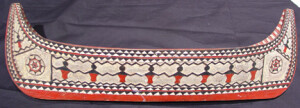   | SHORT DESCRIPTION: Model of a "Tatara" fishing canoe from Botel Tobago Island, Taiwan. The model has carved and painted ornamentation along both sides. The model is painted red on the bottom and edges, white on top and has black and red designs. On the tip of each end is carved design of a human figure holding spirals with feathers. Most of the symbols are of figures holding spirals, sun shapes, zig-zags and checker board prints. The model comes with a number of oars. NOTES: Tatara canoes are an essential element in Yami culture. The Yami are the only maritime community among Taiwan's diverse cultural groups. Botel Tobago Island is 45 miles off the coast of Taiwan and has, for the greater part of its history remained untouched from foreign cultural influences. There is a great ceremonial aspect to the creation, launching and use of these canoes every Spring, at the beginning of fly fishing season. In addition, the construction techniques are wholly unique with the exception of certain Papuan canoes in the Solomon Islands, and possibly those of certain Scandinavian groups. (H.H. Brindley) NOTES: Orchid Island, Lan yu, and Botel Tobago all refer to the same location. NOTES: Yami (Tau) Boat, The Yami (now also the "Tau") are a peaceable tribe. Living on isolated Orchid Island, the Yami develop a unique culture closely related to the ocean. Therefore, the flying-fish season, which is held during the spring and summer, is taken seriously. All the festivals and rituals the year around are in some way held in correspondence to this fishing activities. Tatara, the assembled boats, are the heritage of wisdom from the Yami's ancestors. The construction work of boat-making launches after the flying-fish season. A boat consists of 21-27 pieces of boards from different kinds of trees which are selected for each plank, and are then joined with resin (made from barok tree) and wooden pegs (made from pasuk) instead of nails. Yami boats are gracefully and delicately decorated with various carved and painting ornaments on the strakes. The abstract patterns, such as silver-helmet pattern, zigzag lines and human-shaped motif, are the reflection of their oceanic life. Through those decorations, the Yami reveal their background of livelihood as well as the natural gift for art. Among those decorations, the most important motif is Mata-o-tataras, which is a sun-ray pattern with circles and saw-tooth projections. Besides serving as the eyes of the boat, it is believed to be effective in warding off evil spirits, and overcome the wrecks and danger during the voyage. The human-shape motif presents not only the heroes of the family but also their badge. "On the beach after sunset men gathered, ready to set out to sea. Some were working hard to tie up ropes for the oars, some were sorting fishing nets, others were smoking and chatting. These Yami men appeared extremely calm while preparing to go to sea in the slanting rays of the setting sun. They were familiar with the rhythm of the waves. It was the strong smell of the ocean water and fish that especially delighted the Yami people during this season. Since ancient times, when the flying fish folklore started there they had never been any island resident who did not love the ocean. The slanting rays of the setting sun shone between the crests of the waves and frequently glittered with the silver-white sparks, as if the fallen scales of flying fish were calling the Yami people's fishing fleet. The waves were rhythmically spread over the expansive surface of the ocean. The force by which the men stuck the oars into the ocean generated small whirlpools time after time. The fleet thus swiftly moved forward to track down the sea area where the flying fish flocked. Pure moonlight shone on the ocean. The boats near and far were clearly visible. There were so many stars in the sky that you could not see them all. The emotions you felt here were totally different from those on land. The silvery light shimmered on the waves rising here and falling there. The brave Yami men in every boat waited silently for the sign of fish to appear." Excerpt from "The Call of the Flying Fish", in Leng-hai ch'ing-shen-hai-yang ch'ao-sheng-che. (Cold Sea and Deep Affection - An Ocean Pilgrim) by Hsia-man Lan-po-an, 1997. Translated by Cathy Chu. NOTES: The donor acquired this model on Orchid Island during a day trip in 1964. While riding in a truck to the airfield a small boy running alongside offered to trade his "toy" for the donor's straw hat with colorful band. | CL29773 | |||||||
| 59 | 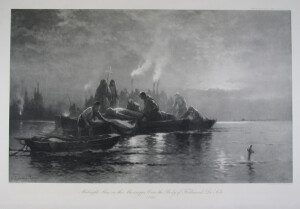  | SHORT DESCRIPTION: Black and white photogravure titled "Midnight Mass on the Mississippi Over the Body of Ferdinand [sic] De Soto (1542)". NOTES: Text from 'Thirteen Chapters of American History Represented by the Edward Moran Series of Thirteen Historical Marine Paintings' by Theodore Sutro, 1905, New York, that accompanies the image: As simple, gloomy and severe as were the circumstances surrounding the departure of the expeditions of Lief Erickson and Columbus, and subsequently of Henry Hudson and the Pilgrim Fathers, so brilliant, hopeful and coveted was the journey of Fernando De Soto, when he set sail from Spain in April, 1538, to conquer Florida and in search of a new Eldorado. Having previously returned from the conquest of Peru, as the chief lieutenant of Francisco Pizarro, possessed of great wealth, and through his marriage with the beautiful Isabella Bobadilla affiliated with the highest nobility, and having been appointed Governor of Cuba by Charles V.—the flower of the Spanish and Portuguese aristocracy flocked to his standard. The seven large and three small ships, including his flag-ship, the "San Christoval," in which the expedition set sail, were fitted out with great splendor. De Soto was then forty-two years of age, having been born at Xeres, Spain, in 1496, while his followers were mostly young men, and a more gorgeous or joyous company cannot be imagined. With them went the wife of De Soto and many other beautiful women, and the voyage was one round of pleasure and festivities. After landing and wintering in Cuba he started from there in May, 1539, with a following of one thousand men in nine ships, leaving the administration of Cuba in the hands of his wife and the Lieutenant-Governor. The original splendor was preserved, the leaders being clad in gorgeous armor and, followed by a host of servants and priests, they took with them all manner of live stock, cattle, horses, mules, etc., and were provided with all sorts of weapons and trappings, but also, significantly, with blood-hounds, handcuffs and iron neck-collars. Thus they landed in Florida, in the neighborhood of Tampa Bay, and began their march northward in the month of June, 1539, the cavaliers to the number of one hundred and thirteen on horseback, and the rest on foot. They passed the winter near the present Georgia border, and in the spring of 1540 reached the location of the present city of Savannah. Instead of pacifying, they alienated the natives through many acts of hostility, in the exuberance of their youth and prowess, in consequence of which many members of the expedition were killed in battle and others died through sickness and deprivation. Nevertheless, they pushed on still further westward towards the Rocky Mountains, and in May, 1541, discovered and crossed the Mississippi River near Lower Chickasaw Bluff, a little north of the thirty-fourth parallel of latitude, in Tunica County, in what is now the State of Mississippi. On again reaching the Mississippi on the return march, De Soto, in consequence of the exposure and hardships to which he had been subjected, sank down with a fever from which he died on May 21, 1542. Owing to the awe which he had inspired in the minds of the natives it was deemed wise by the remnant of his followers to conceal the fact of his death. Accordingly at the dead of night he was wrapped in a flag, in which sand had been sown, and taken in a boat to the middle of the river, and amid the glare of torches, the chanting by the priests of the midnight mass, and his sorrowing and silent companions, solemnly consigned to the depths of the great river. It is this solemn moment which the artist has caught in the painting bearing the above title. As in all the other pictures he has, also in this, depicted all the important details of the occasion without descending to such minute particularity that the painting would lose its poetic character. The sad scene recalls vividly to the mind—in contrast with the high hope and magnificent display of the expedition at its start—the futility of human ambition. The tone of the picture is heightened through the mingling of the pale moonlight with the lurid reflection from the torches, and the coloring altogether is such that it is in perfect harmony with the occasion. It is unnecessary to dwell upon the subsequent fate of the remnant of the expedition, except, perhaps, to say that the picture itself gains in interest by contemplating that, after wandering through the pathless forests, wading swamps, swimming rivers and fighting Indians all the time, and deprived of their leader, and after four years of hardships from the time that the expedition set out, those who were left made their way to Mexico. In the meantime the beautiful wife of De Soto had died brokenhearted, and never was there, all in all, a more tragic ending to an expedition commenced amid so much pomp and glory and with such sanguine expectations. His longed-for Eldorado was not found, and yet De Soto, not unlike Columbus, gained immortality more surely than if his expectations had been realized; for the Father of Waters, the greatest river in the world, will always be associated with his name, and the acquisition of the vast province of Louisiana by Spain led the way for its subsequent transfer to the United States. It was on April 30, 1803, that through the negotiations conducted by James Monroe and Robert Livingston the Province of Louisiana was purchased for the sum of about $15,000,000 from France, which nation had prior thereto acquired it from Spain. In view of the chapters of history which a contemplation of this picture recalls, it is of particular interest during this year (1904), when through the magnificent Louisiana Purchase Exposition we are celebrating the centennial anniversary of the acquisition by the United States of the vast territory, which before De Soto and his followers the foot of white man had never trod. ADDITIONAL INFORMATION: See "Thirteen Historical Marine Paintings by Sutro, pg. 47. | CL18432 | |||||||
| 60 | No image URL. | SHORT DESCRIPTION: Mezzotint transparent print titled "The Mars and the L'Hercule, April 21, 1798" by Edward Orme of New Bond Street, London. The image shows the action between the 74-gun ship HMS Mars and the French 74-gun ship L'Hercule at night. The two ships are anchored and fighting yard-arm to yard-arm with smoke billowing between them. The sails of HMS Mars are shown shot through with holes. NOTES: [Antony Griffiths, Prints and Printmaking: An Introduction to the History and Techniques] Transparent prints were a process invented and published by Edward Orme in his "Essay on Transparent Prints" London, 1807. An ordinary etching or engraving was hand colored both on the front and back. The highlights were then varnished on both sides and thus the paper became translucent when held up against the light. See ORME, Edward. An essay on transparent prints, and on transparencies in general. London. 1807. The book gives "Detailed instructions on making transparent prints by the inventor of the method. As an artist and publisher, Orme had promoted the fashion for transparencies and hoped even to spread it abroad, the text of this book being in French and English. Transparent prints, of which seven examples are given, are meant 'to supply the place of painted glass', and to make lanterns, lampshades, fire screens etc. Easy to make, they are coloured prints chemically treated thereby rendering parts transparent when held to the light and giving an effective illusion of moonlight, fire etc. Popular in the early 19th century, few have survived, their use inevitably leading to destruction." NOTES: The Admiralty Office reported on April 28th that the French 74-gun ship L’Hercule (launched 1797), which was actually pierced for 80 guns, was taken by HMS Mars (launched 1794), commanded by Captain Alexander Hood (1758-1798), in a single ship action on the night of April 21st, 1798. The action became known as the Battle of the Raz de Sein. Earlier in the day on April 21st Admiral Lord Bridport had detached HMS Mars (74) under Captain Alexander Hood, HMS Ramillies captained by Henry Inman and the 380-gun frigate HMS Jason, Captain Charles Stirling, from the Channel Fleet to investigate several sails that had been spotted to the east. Upon drawing closer the British ships sighted a third larger vessel to the southeast sailing close to the coastline and heading north towards Brest where the main French fleet was located. From the appearance of the ship’s sails and large size it was thought to be a French ship of the line so the three British ships changed direction to intercept the larger vessel. During the chase HMS Ramillies lost her fore topmast and fell out of the hunt and Mars quickly outpaced Jason. After five hours and with night approaching Mars nearly lost sight of the French ship but around 8 o’clock the light of the moon revealed the vessel anchored at the entrance of the narrow Raz de Sein [a stretch of water located between the Ile de Sein and the Pointe du Raz in Finistère]. A strong running tide and easterly wind had prevented the ship from escaping through the passage and forced it to anchor close to the French coast within sight of Brest Roads. The crew of the French ship, the new 74-gun ship L’Hercule, captained by experienced Louis L’Heritier (1747-1823) and with 680 men on board, furled its sails, carried a spring aft to increase its range of fire and prepared the ship for battle. L’Hercule had left Lorient the day before having been ordered on her first cruise to join the Brest fleet. As Mars quickly approached Captain Hood gave orders to double-shot the guns and told his crew not to fire until the ship was alongside the enemy. Around 9:15 PM the French ship opened fire which was soon returned by the British. The strong tidal current that prevented L’Hertier from escaping now prevented Hood from maintaining his ship’s position under sail. The crew were ordered to drop the starboard anchor and Mars fell back alongside their opponent. When the two ships crashed together many of the lower deck gun ports were unhinged and Mars’s starboard anchor grappled L’Hercule’s port anchor locking the two vessels together. The action was so close that the lower deck guns couldn’t be run out and had to be fired while inside the hull. The two ships fought a bloody action for nearly an hour and a half during which time the French attempted to board Mars twice but were repulsed by Hood’s highly trained crew. First Lieutenant William Butterfield (1767-1842) reported that Captain Hood was wounded in the thigh [his femoral artery had been severed causing him to slowly bleed to death] about twenty minutes into the conflict and expired just as the enemy ship struck her colors. Finally, around 10:30 PM the French ship surrendered. The British frigate Jason arrived about twenty minutes later and assisted in getting both ships underway and later carried about 200 of the French prisoners to Plymouth. Because of the close-fought action, neither ship was much disabled in the rigging, but both were described as “greatly shattered in their hulls.” The Kentish Weekly Post or Canterbury Journal, May 4, 1798 (page 2) provided a vivid description of the damage visible on L’Hercule: The larboard side of the ship is very little damaged, but the starboard side is terribly mauled; most part of the shot holes are in the line of the lower deck ports, many of which are beat from the side, and the port-holes, with the space between them, are covered with canvas; her starboard quarter-gallery is very much shattered, and the shot holes are very thick, in a line with the quarter-deck guns, on the same side; under the counter, and a little above the water line, there is a hole as large as if a bomb-shell of immense size had entered it, which would have rendered the situation of the ship very dangerous, if the weather had been boisterous; five of the starboard aftermost guns, on the lower deck, are dismounted, and many others much damaged. The masts and yards are very little injured, which is accounted for by the action being so close…; the guns of the Mars on the lower deck were sometimes through the starboard side of the French ship; the proximity may be easily conceived by those who have seen L’Hercule, for the starboard side, which, before, the action, was a bright yellow, is now burnt as black as a cinder. The casualties aboard L’Hercule were enormous with 290 dead and wounded (and possibly as many as 400)–about forty percent of her crew–including Captain L’Hertier. Aboard Mars 22 men were killed including Captain Hood, Captain White of the marines and 2nd midshipman James Blythe, and 60 men were wounded and 8 were missing, After the capture, Admiral Lord Bridport appointed the first Lieutenant of Mars, William Butterfield, to command the L’Hercule and carry her into port and Captain James George Shirley was temporarily appointed to the command of Mars. Butterfield was also promoted commander with seniority from 26 April and received a fifty guinea sword from the Mars crew. VESSEL HISTORY: HMS MARS 74 guns and 1842 tons, was launched at Deptford Dockyard in 1794 and would later serve in the right-hand column, nearly opposite VICTORY, during the triumph of Trafalgar. She was broken up in 1823. VESSEL HISTORY: L’Hercule, 74 guns and 1876 tons, a Téméraire class ship of the line of the French Navy built at Lorient in 1797, captured by the British on her maiden voyage in 1798. Spent the rest of her career as a British ship. Broken up in 1810. | CL29344 | |||||||
| 61 | No image URL. | SHORT DESCRIPTION: Travel/advertising poster depicting steam boat. Image of roller coaster at left and beach scene at bottom. Gulls flying over vessel. Images identical to LP 7045 but wording different. DUPLICATE NOTES: Two (2) duplicates. VESSEL INFORMATION - VESSEL NAME: BELLE ISLAND SHIPBUILDER: T.S. MARVEL BUILDER LOCATION: NEWBURGH, NEW YORK SHIP OWNER: BELLE ISLAND CO. ALL SHIP'S NAMES: USS COL. JAMES A. MOSS, MARIA DE LOURDES, (BRAZILIAN) VESSEL INFORMATION: VESSEL NAME: MAYFLOWER (1931-1941); MOOSEHEAD (1911-1917); USS MOOSEHEAD (1918-1920); USS PORPOISE (1920-1931); COLONEL WILLIAM B COWIN (1941) VESSEL TYPE: STEAM SCREW; STEAMSHIP BUILDER: BATH IRON WORKS BUILDER LOCATION: BATH, MAINE BUILD DATE: 1911 HOME PORT: NEW YORK, NEW YORK DIMENSIONS: 719 gross tons; 488 net tons; 185.3’ length, 35.8’ breadth, 13.9’ depth SHIPOWNER: MAINE CENTRAL RAILROAD (1911-1917); US NAVY (1918-1931); FRANK V. DRAKE (1931-1941); US ARMY TRANSPORTATION CORPS (1941) VESSEL HISTORY: Moosehead launched from the Bath Ironworks in Bath Maine on March 4, 1911. Built for the Maine Central Railroad feet. Home port in Portland, Maine. At this point there is some contradiction in the vessels history. The Naval History and Heritage Command states: This ship was acquired by the Navy on 28 March 1918 as USS Moosehead (ID # 2047). On 11 August 1920, she was renamed Porpoise and reclassified as a ferryboat with hull number YFB-2047. Stricken from the Navy List on 30 December 1930, sold on 24 February 1931. The magazine Sub Aqua Journal, March 1993, Vol. 3 on page 5 in an article titled “Colonel William B. Cowin, Artifact Central” by Dave Morton and Capt. Eric Takakjian gives this history: In the mid 1920s she was sold to Mr. William Mills of New York, who renamed her Porpoise, and placed her into daily service between Bridgeport, Connecticut and New York City. During the winter of 1927-1928, modifications were made to the ship, and rectangular windows were installed along both sides of her hull. In 1931, the ship was sold to Captain Frank V. Drake, and renamed Mayflower, though she continued the New York run. On July 1, 1941 Captain Drake sold Mayflower to the war department for $125,000. Commissioned into the US Army Transportation Corps and renamed Colonel William B. Cowin, her new home port became New London, Connecticut. On the afternoon of December 17, 1941, the Cowin departed New London under the command of Captain William Evans. She was bound for a Boston shipyard for overhaul. While approaching the entrance to Buzzards Bay, the Cowin struck Hens and Chickens Reef. A large hole was torn in her hull and she sank within 30 minutes. The crew of 17 escaped in a lifeboat and rowed three miles to shore. | CL9797 | |||||||
| 62 | 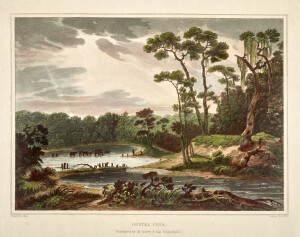 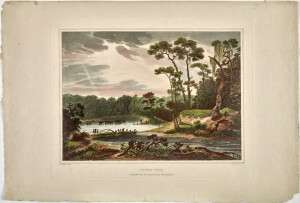 | SHORT DESCRIPTION: Aquatint depicting Oyster Cove, Virginia. The image is a landscape with the river running into the right foreground. At the left in the background cattle are fording the stream. NOTES: According to the description of a similar image offered by the Philadelphia Print Shop these scene occurs on the York River near the mouth of the Chesapeake Bay. The following text was associated with the description: A very rare group of prints from a foundation work in the history of American views, the first systematic attempt to record the country's landscape. The series combines the work of some of the most talented Americans in the early nineteenth century, including the artist Joshua Shaw (ca. 1777-1860). Shaw conceived the grand scheme of producing a folio of prints based on "correct delineations of some of the most prominent beauties of notable scenery." He planned to travel throughout the United States to make his drawings, and to issue the prints by subscription in six sets of six views each. The aquatinting of the prints was done by John Hill (1770-1850), who was another Englishman who had just settled in Philadelphia. This was Hill's first major American commission, and the next year he moved to New York City where he further enhanced his reputation as the premier aquatinter in the country. The publisher of the series, Mathew Carey & Son, was no less illustrious than the others. Mathew Carey was perhaps the dominate American publisher of the first two decades of the nineteenth century, and the successor firms of Carey & Son, and then Carey & Lea continued to play an important part in the history of American maps, books and prints. This series is seminal in the history of American prints, the first time anyone tried to produce an overall artistic documentation of American scenery. The scenes are mostly of the eastern seaboard, ranging from New York to Georgia. They show America when the country was primarily rural, and they tend to focus on the inland waterways, which were the major routes of travel and major sources of energy at the time. These prints provide us with a precious snapshot of our land in its nascent age, when it would still have been recognizable to the colonists of the previous century. The prints are quite lovely, beautifully rendered and exquisitely aquatinted. Unfortunately, the project was not a financial success and only eighteen of the intended thirty-six prints were produced. A second edition of the portfolio was issued by Thomas T. Ash in 1835, the prints from that issue as rare as the first edition by Carey & Son. These rare prints provide us with an unusual and unique look at America in its adolescence. NOTES: In 2013 Oyster Cove sits in Gloucester County on Sarah Creek. CURATORS NOTES: Picturesque Views of American Scenery, No. III. ADDITIONAL INFORMATION: Deak, Gloria Gilda. Picturing America, 1497-1899. Prints, Maps and Drawings Bearing on The New World Discoveries and on the Development of the Territory that is Now the United States. From the I.N. Phelps Stokes Collection and Other Collections In the Miriam and Ira D. Wallach Division of Art, Prints, and Other Photographs of the New York Public Library. Volume I & II. Princeton, N.J.: Princeton University, p. 213-214, catalog 315. Stauffer, David McNeely and Mantle Fielding. American Engravers Upon Copper and Steel. Volume I & II. New York: The Grolier Club, 1907, p. 1343. Stokes, I.N. Phelps. The Iconography of Manhattan Island, 1498-1909. 6 volumes. New York: R.H. Dodd, 1915-28, vol. 3, p. 567. Koke, Richard J. Checklist of John Hill (1770-1850). New York: New York Historical Society, 1961, p. 37-56. Fielding, Mantle, Dictionary of American Painters, Sculptors and Engravers. Lancaster, Pa.: Lancaster Press, 1910. Picturesque Views of American Scenery The drawings for this series were executed by Joshua Shaw, landscape painter, who conceived the idea for the Picturesque Views. A native of England, Shaw had exhibited at the Royal Academy in London before crossing the Atlantic. In 1817, bearing a recommendation of his work from Benjamin West, he settled in Philadelphia. He found it puzzling, by the second decade of the nineteenth century, so little of the landscape had found its way to artists canvases. He undertook to travel through several states, making sketches on the spot and soliciting advance subscriptions for the engravings based on his paintings. Within three years of his arrival, Shaw’s celebrated Picturesque Views came into being, representing the first systematic attempt to record the New World’s landscape. Shaw was fortunate in having the collaboration of John Hill, also a native of England and a master of aquatint, for his portfolio. The ambitious objective was to issue six numbers (sets), each containing six views "with occasional vignettes." Ultimately, only three numbers were issued. Initially undertaken by Thomas Moses as publisher, the project was turned over to M. Carey & Son. Later, because of the appeal of the views, the portfolio was republished in 1835 by Thomas T. Ash. The first state of the title page is rare, inasmuch as Moses Thomas withdrew from the project: he published none of the subsequent views. On the inside of the portfolio wrapper, the titles of the views are given as listed below. No. 1 1. Title page, vignette (Four different versions) 2. Washington’s Sepulchre Mount Vernon 3. View of the Falls of Schuylkill 4. Jones’ Falls Near Baltimore 5. View Near the Falls of Schuykill 6. View of the Spot Where Gen. Ross Fell Near Baltimore 7. Falls of St. Anthony on the Mississippi No. II 8. Lynnhaven Bay (Virginia) LP 3759 9. Spirit Creek, Near Augusta, Georgia 10. View By Moonlight, Near Fayetteville 11. Burning of Savannah 12. Norfolk; from Gosport, Virginia LP 185, 2nd state 13. View of the Wisahiccon, Pennsylvania No. III 14. Vignette Monument Near West Point 15. Passaic Falls, New Jersey 16. View of the Hudson River 17. Hell Gate, Near New York 18. Bolling’s Dam, Near Peterburgh, Virginia 19. Oyster Cove (Virginia) LP 4008 20. Passaic River, Below the Falls Accompanying each print is a letter press edition (TMM does not have these). | CL8008 | |||||||
| 63 |  | NOTES: Published in Ballou's Pictorial, February 13, 1858, Volume XIV, No. 7. The image shows the ship Serampore, off Cohasset, Massachusetts, heeled over on her starboard side with the steamer Neptune alongside. VESSEL INFORMATION: VESSEL NAME: SERAMPORE SHIP BUILDER: TALBOT SHIPBUILDER LOCATION: BOSTON, MASSACHUSETTS SHIP OWERN: BRAS d'OR STEAM CO. | CL24144 | |||||||
| 64 | 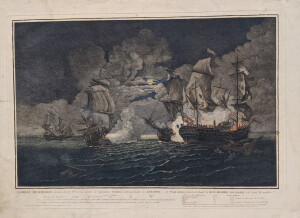 | ROUGH TRANSLATION: Memorable Combat of the 22 of February, 1779, between Captain Pearson in command of the Serapis and Paul Jones, commander of the Bonhomme Richard and its fleet.” “English forces. Serapis, 44 cannons, 250 crewmembers, 49 killed, 68 wounded. All its men and cannons that were behind the large mast on ____were blown into the air. The ship was on fire and at several attempts, the large mast was blown into the water. The countess of Scarborough, warship that had its __ and sails cut and pierced by bullets. 7 cannons raging, 4 men killed and 20 wounded.” “Enemy forces: Bonhomme Richard, 40 cannons, 375 crewmembers, engaged in combat with the Serapis” “Alliance, 40 cannoncs, 300 crewmembers, engaged in battle with the Serapis” “Pallas, 32 cannons, 275 crewmembers, engaged in battle with the Countess of Scarborough” “Vengeance Brigantin, 12 cannons, 70 crewmembers, engaged in battle with the Countess of Scarborough” “Note: the Bon Homme Richard had 306 ___. The ship suffered great damage and was twice on flame, with some cannons blown off and a large quantity of water collected in the bottom in the days following with a great number wounded on board.” NOTES: According to The British Museum Pierre Jean began by working in partnership with Louis Joseph Mondhare (began publishing circa 1760), his father in law, between 1784 and 1796. NOTES: The American ships are flying versions of the "American Stripes" flag, thirteen red and white stripes with no blue canton. NOTES: Excerpts from 'A Naval History of the American Revolution' by Gardner Weld Allen, pages 442-485: In January 1779, the French purchased a 14-year old East Indiaman called Duc de Duras. It was converted into a man-of-war despite being structurally weak and a slow sailer by Captain John Paul Jones. The vessel was renamed Bonhomme Richard in honor of Benjamin Franklin, Jones's friend and benefactor. Jones spent months preparing for a cruise against the English islands. The American frigate Alliance was detained in France by Franklin to support Jones's expedition. Three French vessels, Pallas, a merchantman or privateer fitted out as a 32-gun frigate; Cerf, an 18-gun cutter; and Vengeance, a 12-gun brigantine, were also given to Jones. The squadron was ready for sea by the middle of June and sailed from Groix Roads, near L'Orient on June 19th on a shakedown cruise during which a convoy would be escorted to Bordeaux and other ports. Franklin's orders to Jones were to cruise to the north of the British Isles and after six weeks put into Texel in order to convoy vessels from Holland to France. The squadron sailed from Groix Roads on August 14, 1779. On the 23rd the squadron was off Cape Clear. Two prizes had been taken and sent back to L'Orient. A third was taken by boat action but later lost in a fog. The Cerf dropped out of the expedition after receiving damage in a gale on August 26th. The same gale separated the ships of the squadron, but Bonhomme Richard and Vengeance proceeded northward and were off Cape Wrath by September 1st where they fell in with the Alliance and prize she had taken. The same day a British letter of marque was taken. These were later given up by Danish authorities to the British consul. On September 2nd the Pallas rejoined the squadron. The squadron cruised a few days between Orkney and Shetland and took a few unimportant prizes. Another gale and adverse winds prevented the squadron from sighting land again until September 13th when the Cheviot Hills were sighted. Two colliers were taken on the 14th. One of the prizes was sunk during a gale on the 17th. British Revenue Cutters specially fitted out and armed for service against the American squadron alerted the British population about the approached of Jones's squadron. The squadron sailed south and a few more prizes were taken. By September 21st the squadron was off Flamborough Head at which point two brigs were captured and a small fleet of vessels were chased. On September 23rd, the squadron encountered a Baltic fleet of 41 vessels under convoy by the 44-gun [but carrying 50 guns] frigate HMS Serapis, Captain Richard Pearson, and the hired armed ship Countess of Scarborough. Bonhomme Richard and Serapis entered a bitter engagement about 7:00PM. Jones described the action in an October 3rd report to Benjamin Franklin: "The battle being thus begun was continued with unremitting fury. Every method was practised on both sides to gain an advantage and rake each other, and I must confess that the enemy's ship, being much more manageable than the Bonhomme Richard, gained thereby several times an advantageous situation, in spite of my best endeavors to prevent it. As I had to deal with an enemy of greatly superior force, I was under the necessity of closing with him, to prevent the advantage which he had over me in point of manoeuvre. It was my intention to lay the Bonhomme Richard athwart the enemy's bow, but as that operation required great dexterity in the management of both sails and helm and some of our braces being shot away, it did not exactly succeed to my wishes. The enemy's bowsprit, however, came over the Bonhomme Richard's poop by the mizen mast and I made both ships fast together in that situation, which by the action of the wind on the enemy's sails, forced her stern close to the Bonhomme Richard's bow, so that the ships lay square alongside of each other, the yards being all entangled and the cannon of each ship touching the opponent's side. "When this position took place it was eight o'clock, previous to which the Bonhomme Richard had received sundry eighteen pounds shot below the water and leaked very much. My battery of 12-pounders, on which I had placed my chief dependance, being commanded by [1st] Lieut. [Richard] Dale and Col. Weibert and manned principally with American seamen and French volunteers, were entirely silenced and abandoned. As to the six old 18-pounders that formed the battery of the lower gundeck, they did no service whatever; two out of three of them burst at the first fire and killed almost all the men who were stationed to manage them. Before this time too, Col. De Chamillard, who commanded a party of twenty soldiers on the poop, had abandoned that station after having lost some of his men; these men deserted their quarters. I had now only two pieces of cannon, 9-pounders on the quarter deck, that were not silenced, and not one of the heavier cannon was fired during the rest of the action. The purser, Mr. Mease, who commanded the guns on the quarter deck, being dangerously wounded in the head, I was obliged to fill his place and with great difficulty rallied a few men and shifted over one of the lee quarter-deck guns, so that we afterwards played three pieces of 9-pounders upon the enemy. The tops alone seconded the fire of this little battery and held out bravely during the whole of the action, especially the main top where Lieut. Stack commanded. I directed the fire of one of the three cannon against the mainmast with doubleheaded shot, while the other two were exceedingly well served with grape and canister-shot to silence the enemy's musketry and clear her decks, which was at last effected. "The enemy were, as I have since understood, on the instant of calling for quarters, when the cowardice or treachery of three of my under officers induced them to call to the enemy. The English commodore asked me if I demanded quarters and, I having answered him in the most determined negative, they renewed the battle with double fury. They were unable to stand the deck, but the fire of their cannon, especially the lower battery, which was entirely formed of 18-pounders, was incessant. Both ships were set on fire in various places and the scene was dreadful beyond the reach of language. To account for the timidity of my three under officers, I mean the gunner, the carpenter, and the master-at-arms, I must observe that the two first were slightly wounded, and as the ship had received various shots under water, and one of the pumps being shot away, the carpenter expressed his fear that she would sink and the other two concluded that she was sinking, which occasioned the gunner to run aft on the poop, without my knowledge, to strike the colors. Fortunately for me, a cannon ball had done that before by carrying away the ensign staff; he was therefore reduced to the necessity of sinking, as he supposed, or of calling for quarter and he preferred the latter. "All this time the Bonhomme Richard had sustained the action alone and the enemy, though much superior in force, would have been very glad to have got clear, as appears by their own acknowledgments and their having let go an anchor the instant that I laid them on board, by which means they would have escaped, had I not made them well fast to the Bonhomme Richard. At last, at half past nine o'clock, the Alliance appeared and I now thought the battle at an end, but to my utter astonishment he discharged a broadside full into the stern of the Bonhomme Richard. We called to him for God's sake to forbear firing into the Bonhomme Richard, yet he passed along the off side of the ship and continued firing. There was no possibility of his mistaking the enemy's ship for the Bonhomme Richard, there being the most essential difference in their appearance and construction; besides, it was then full moonlight and the sides of the Bonhomme Richard were all black, while the sides of the prizes were yellow. Yet, for the greater security, I showed the signal of our reconnoissance by putting out three lanthorns, one at the head (bow), another at the stern (quarter), and the third in the middle, in a horizontal line. Every tongue cried that he was firing into the wrong ship, but nothing availed; he passed round firing into the Bonhomme Richard's head, stern, and broadside, and by one of his vollies killed several of my best men and mortally wounded a good officer on the forecastle. "My situation was really deplorable. The Bonhomme Richard received various shots under water from the Alliance, the leak gained on the pumps, and the fire increased much on board both ships. Some officers persuaded me to strike, of whose courage and good sense I entertain a high opinion. My treacherous master-at-arms let loose all my prisoners without my knowledge and my prospect became gloomy indeed." The prisoners were much frightened, believing that the ship was sinking, and were at once put to work at the pumps; otherwise, by reinforcing the enemy, they would surely have turned the scale in his favor. "I would not, however, give up the point. The enemy's mainmast began to shake, their firing decreased, ours rather increased, and the British colors were struck at half an hour past ten o'clock." Reports by Dale and Captain Pearson indicated that a hand grenade thrown into the lower decks of Serapis from one of the ship's tops (which had unknowingly been taken over by the Americans) ignited loose gunpowder and sparked a fire that spread from cartridge to cartridge all the gun deck and "blew up the whole of the people and officers that were quartered abaft the mainmast, from which unfortunate circumstance all those guns were rendered useless for the remainder of the action." Both ships were severely damaged in the action. Bonhomme Richard was on fire in several placed and leaky rapidly with five feet of water in the hold, one pump was shot away and the other three were barely able to keep the water from gaining. Jones described the damage to Bonhomme Richard as "the rudder was cut entirely off the stern frame and the transums were almost entirely cut away; the timbers, by the lower deck especially, from the mainmast to the stern, being greatly decayed with age, were mangled beyond my power of description." Both sides of the ship for a great distance were wholly shot away, leaving little support for the upper deck, and projectiles passed through without hitting anything. The mainmast and mizzen-topmast of the Serapis fell overboard immediately after her surrender and she was otherwise much injured. It was only through Jones's determination not to yield that won this battle. Serapis's consort, the Countess of Scarborough, was engaged and taken by the Pallas. Jones blamed the convoy's escape on the disinclination of the French captains of Alliance and Vengeance to pursue it. Bonhomme Richard defied all efforts to save her and sank about 36 hours later at 11:00AM on September 25th. Jones took command of Serapis, erected a jury mainmast and sailed her to Texel, arriving on October 3rd. After Jones spent three months refitting his squadron, most of which were transferred to French flags to ease tensions between the Dutch and British, the Dutch ordered Jones in USS Alliance (the only vessel of the squadron that remained under the American flag) to depart on the first favorable wind. Jones managed to leave Texel on December 27, 1779 and successfully evaded a British blockading squadron. Serapis was eventually sold at L'Orient and the Countess of Scarborough was sold at Dunkirk. | CL11030 | |||||||
| 65 | SHORT DESCRIPTION: Hand-colored etching titled 'Combat Memorable Entre Le Pearson et Paul Jones'. Taken from a drawing by Richard Paton and probably copied Lerpiniere and Fittler's engraving which was published by John Boydell in 1781. This image engraved by Blathasar Leizelt after a drawing by Richard Paton and published by the Kaiserliche Franziskische Akademie in Augsburg, Germany. The image shows the famous engagement between the converted merchantman, Bonhomme Richard, commanded by John Paul Jones, and the Serapis, under British captain Richard Pearson. The action took place in the English Channel off Flamborough Head on September 23, 1779. The vessel firing at the left is the Alliance, commanded by Pierre Landais, a French naval officer assigned to Jones's squadron. NOTES: See LE 352 which is very similar. The date of this image is unclear, it is nearly identical to the "Combat Memorable Entre Le Pearson et Paul Jones" but most of the images found show a reverse title at the top and "Collection des Prospects", our image does not have these marks. Text in French and German beneath the image. The 'Action Between the Serapis and Bonhomme Richard' was painted by Richard Paton around 1782 and is among Paton’s most celebrated works. NOTES: [J. Willoz-Egnor, 1/5/2023] The publication/copyright line "Se vend à Augsbourg au Negoce commun de l'Academie Imperiale d'Empire des Arts libereaux avec Privilege de Sa Majeste Imperiale et avec Defense ni d'en faire ni de vendre les Copies" identifies the publisher as the Kaiserliche Franziskische Akademie which was active in Augsburg, Germany at least between 1775 and 1785. Other sources say the publisher was only active until 1779, but several images in our collection attributable to this publisher depict events that date to 1784 (LE 233, LE 237 and LE 247). NOTES: Excerpts from 'A Naval History of the American Revolution' by Gardner Weld Allen, pages 442-485: In January 1779, the French purchased a 14-year old East Indiaman called Duc de Duras. It was converted into a man-of-war despite being structurally weak and a slow sailer by Captain John Paul Jones. The vessel was renamed Bonhomme Richard in honor of Benjamin Franklin, Jones's friend and benefactor. Jones spent months preparing for a cruise against the English islands. The American frigate Alliance was detained in France by Franklin to support Jones's expedition. Three French vessels, Pallas, a merchantman or privateer fitted out as a 32-gun frigate; Cerf, an 18-gun cutter; and Vengeance, a 12-gun brigantine, were also given to Jones. The squadron was ready for sea by the middle of June and sailed from Groix Roads, near L'Orient on June 19th on a shakedown cruise during which a convoy would be escorted to Bordeaux and other ports. Franklin's orders to Jones were to cruise to the north of the British Isles and after six weeks put into Texel in order to convoy vessels from Holland to France. The squadron sailed from Groix Roads on August 14, 1779. On the 23rd the squadron was off Cape Clear. Two prizes had been taken and sent back to L'Orient. A third was taken by boat action but later lost in a fog. The Cerf dropped out of the expedition after receiving damage in a gale on August 26th. The same gale separated the ships of the squadron, but Bonhomme Richard and Vengeance proceeded northward and were off Cape Wrath by September 1st where they fell in with the Alliance and prize she had taken. The same day a British letter of marque was taken. These were later given up by Danish authorities to the British consul. On September 2nd the Pallas rejoined the squadron. The squadron cruised a few days between Orkney and Shetland and took a few unimportant prizes. Another gale and adverse winds prevented the squadron from sighting land again until September 13th when the Cheviot Hills were sighted. Two colliers were taken on the 14th. One of the prizes was sunk during a gale on the 17th. British Revenue Cutters specially fitted out and armed for service against the American squadron alerted the British population about the approached of Jones's squadron. The squadron sailed south and a few more prizes were taken. By September 21st the squadron was off Flamborough Head at which point two brigs were captured and a small fleet of vessels were chased. On September 23rd, the squadron encountered a Baltic fleet of 41 vessels under convoy by the 44-gun [but carrying 50 guns] frigate HMS Serapis, Captain Richard Pearson, and the hired armed ship Countess of Scarborough. Bonhomme Richard and Serapis entered a bitter engagement about 7:00PM. Jones described the action in an October 3rd report to Benjamin Franklin: "The battle being thus begun was continued with unremitting fury. Every method was practised on both sides to gain an advantage and rake each other, and I must confess that the enemy's ship, being much more manageable than the Bonhomme Richard, gained thereby several times an advantageous situation, in spite of my best endeavors to prevent it. As I had to deal with an enemy of greatly superior force, I was under the necessity of closing with him, to prevent the advantage which he had over me in point of manoeuvre. It was my intention to lay the Bonhomme Richard athwart the enemy's bow, but as that operation required great dexterity in the management of both sails and helm and some of our braces being shot away, it did not exactly succeed to my wishes. The enemy's bowsprit, however, came over the Bonhomme Richard's poop by the mizen mast and I made both ships fast together in that situation, which by the action of the wind on the enemy's sails, forced her stern close to the Bonhomme Richard's bow, so that the ships lay square alongside of each other, the yards being all entangled and the cannon of each ship touching the opponent's side. "When this position took place it was eight o'clock, previous to which the Bonhomme Richard had received sundry eighteen pounds shot below the water and leaked very much. My battery of 12-pounders, on which I had placed my chief dependance, being commanded by [1st] Lieut. [Richard] Dale and Col. Weibert and manned principally with American seamen and French volunteers, were entirely silenced and abandoned. As to the six old 18-pounders that formed the battery of the lower gundeck, they did no service whatever; two out of three of them burst at the first fire and killed almost all the men who were stationed to manage them. Before this time too, Col. De Chamillard, who commanded a party of twenty soldiers on the poop, had abandoned that station after having lost some of his men; these men deserted their quarters. I had now only two pieces of cannon, 9-pounders on the quarter deck, that were not silenced, and not one of the heavier cannon was fired during the rest of the action. The purser, Mr. Mease, who commanded the guns on the quarter deck, being dangerously wounded in the head, I was obliged to fill his place and with great difficulty rallied a few men and shifted over one of the lee quarter-deck guns, so that we afterwards played three pieces of 9-pounders upon the enemy. The tops alone seconded the fire of this little battery and held out bravely during the whole of the action, especially the main top where Lieut. Stack commanded. I directed the fire of one of the three cannon against the mainmast with doubleheaded shot, while the other two were exceedingly well served with grape and canister-shot to silence the enemy's musketry and clear her decks, which was at last effected. "The enemy were, as I have since understood, on the instant of calling for quarters, when the cowardice or treachery of three of my under officers induced them to call to the enemy. The English commodore asked me if I demanded quarters and, I having answered him in the most determined negative, they renewed the battle with double fury. They were unable to stand the deck, but the fire of their cannon, especially the lower battery, which was entirely formed of 18-pounders, was incessant. Both ships were set on fire in various places and the scene was dreadful beyond the reach of language. To account for the timidity of my three under officers, I mean the gunner, the carpenter, and the master-at-arms, I must observe that the two first were slightly wounded, and as the ship had received various shots under water, and one of the pumps being shot away, the carpenter expressed his fear that she would sink and the other two concluded that she was sinking, which occasioned the gunner to run aft on the poop, without my knowledge, to strike the colors. Fortunately for me, a cannon ball had done that before by carrying away the ensign staff; he was therefore reduced to the necessity of sinking, as he supposed, or of calling for quarter and he preferred the latter. "All this time the Bonhomme Richard had sustained the action alone and the enemy, though much superior in force, would have been very glad to have got clear, as appears by their own acknowledgments and their having let go an anchor the instant that I laid them on board, by which means they would have escaped, had I not made them well fast to the Bonhomme Richard. At last, at half past nine o'clock, the Alliance appeared and I now thought the battle at an end, but to my utter astonishment he discharged a broadside full into the stern of the Bonhomme Richard. We called to him for God's sake to forbear firing into the Bonhomme Richard, yet he passed along the off side of the ship and continued firing. There was no possibility of his mistaking the enemy's ship for the Bonhomme Richard, there being the most essential difference in their appearance and construction; besides, it was then full moonlight and the sides of the Bonhomme Richard were all black, while the sides of the prizes were yellow. Yet, for the greater security, I showed the signal of our reconnoissance by putting out three lanthorns, one at the head (bow), another at the stern (quarter), and the third in the middle, in a horizontal line. Every tongue cried that he was firing into the wrong ship, but nothing availed; he passed round firing into the Bonhomme Richard's head, stern, and broadside, and by one of his vollies killed several of my best men and mortally wounded a good officer on the forecastle. "My situation was really deplorable. The Bonhomme Richard received various shots under water from the Alliance, the leak gained on the pumps, and the fire increased much on board both ships. Some officers persuaded me to strike, of whose courage and good sense I entertain a high opinion. My treacherous master-at-arms let loose all my prisoners without my knowledge and my prospect became gloomy indeed." The prisoners were much frightened, believing that the ship was sinking, and were at once put to work at the pumps; otherwise, by reinforcing the enemy, they would surely have turned the scale in his favor. "I would not, however, give up the point. The enemy's mainmast began to shake, their firing decreased, ours rather increased, and the British colors were struck at half an hour past ten o'clock." Reports by Dale and Captain Pearson indicated that a hand grenade thrown into the lower decks of Serapis from one of the ship's tops (which had unknowingly been taken over by the Americans) ignited loose gunpowder and sparked a fire that spread from cartridge to cartridge all the gun deck and "blew up the whole of the people and officers that were quartered abaft the mainmast, from which unfortunate circumstance all those guns were rendered useless for the remainder of the action." Both ships were severely damaged in the action. Bonhomme Richard was on fire in several placed and leaky rapidly with five feet of water in the hold, one pump was shot away and the other three were barely able to keep the water from gaining. Jones described the damage to Bonhomme Richard as "the rudder was cut entirely off the stern frame and the transums were almost entirely cut away; the timbers, by the lower deck especially, from the mainmast to the stern, being greatly decayed with age, were mangled beyond my power of description." Both sides of the ship for a great distance were wholly shot away, leaving little support for the upper deck, and projectiles passed through without hitting anything. The mainmast and mizzen-topmast of the Serapis fell overboard immediately after her surrender and she was otherwise much injured. It was only through Jones's determination not to yield that won this battle. Serapis's consort, the Countess of Scarborough, was engaged and taken by the Pallas. Jones blamed the convoy's escape on the disinclination of the French captains of Alliance and Vengeance to pursue it. Bonhomme Richard defied all efforts to save her and sank about 36 hours later at 11:00AM on September 25th. Jones took command of Serapis, erected a jury mainmast and sailed her to Texel, arriving on October 3rd. After Jones spent three months refitting his squadron, most of which were transferred to French flags to ease tensions between the Dutch and British, the Dutch ordered Jones in USS Alliance (the only vessel of the squadron that remained under the American flag) to depart on the first favorable wind. Jones managed to leave Texel on December 27, 1779 and successfully evaded a British blockading squadron. Serapis was eventually sold at L'Orient and the Countess of Scarborough was sold at Dunkirk. NOTES: The American ships are flying versions of the "American Stripes" flag, although none have thirteen stripes. | CL280 | ||||||||
| 66 | NOTES: Excerpts from 'A Naval History of the American Revolution' by Gardner Weld Allen, pages 442-485: In January 1779, the French purchased a 14-year old East Indiaman called Duc de Duras. It was converted into a man-of-war despite being structurally weak and a slow sailer by Captain John Paul Jones. The vessel was renamed Bonhomme Richard in honor of Benjamin Franklin, Jones's friend and benefactor. Jones spent months preparing for a cruise against the English islands. The American frigate Alliance was detained in France by Franklin to support Jones's expedition. Three French vessels, Pallas, a merchantman or privateer fitted out as a 32-gun frigate; Cerf, an 18-gun cutter; and Vengeance, a 12-gun brigantine, were also given to Jones. The squadron was ready for sea by the middle of June and sailed from Groix Roads, near L'Orient on June 19th on a shakedown cruise during which a convoy would be escorted to Bordeaux and other ports. Franklin's orders to Jones were to cruise to the north of the British Isles and after six weeks put into Texel in order to convoy vessels from Holland to France. The squadron sailed from Groix Roads on August 14, 1779. On the 23rd the squadron was off Cape Clear. Two prizes had been taken and sent back to L'Orient. A third was taken by boat action but later lost in a fog. The Cerf dropped out of the expedition after receiving damage in a gale on August 26th. The same gale separated the ships of the squadron, but Bonhomme Richard and Vengeance proceeded northward and were off Cape Wrath by September 1st where they fell in with the Alliance and prize she had taken. The same day a British letter of marque was taken. These were later given up by Danish authorities to the British consul. On September 2nd the Pallas rejoined the squadron. The squadron cruised a few days between Orkney and Shetland and took a few unimportant prizes. Another gale and adverse winds prevented the squadron from sighting land again until September 13th when the Cheviot Hills were sighted. Two colliers were taken on the 14th. One of the prizes was sunk during a gale on the 17th. British Revenue Cutters specially fitted out and armed for service against the American squadron alerted the British population about the approached of Jones's squadron. The squadron sailed south and a few more prizes were taken. By September 21st the squadron was off Flamborough Head at which point two brigs were captured and a small fleet of vessels were chased. On September 23rd, the squadron encountered a Baltic fleet of 41 vessels under convoy by the 44-gun [but carrying 50 guns] frigate HMS Serapis, Captain Richard Pearson, and the hired armed ship Countess of Scarborough. Bonhomme Richard and Serapis entered a bitter engagement about 7:00PM. Jones described the action in an October 3rd report to Benjamin Franklin: "The battle being thus begun was continued with unremitting fury. Every method was practised on both sides to gain an advantage and rake each other, and I must confess that the enemy's ship, being much more manageable than the Bonhomme Richard, gained thereby several times an advantageous situation, in spite of my best endeavors to prevent it. As I had to deal with an enemy of greatly superior force, I was under the necessity of closing with him, to prevent the advantage which he had over me in point of manoeuvre. It was my intention to lay the Bonhomme Richard athwart the enemy's bow, but as that operation required great dexterity in the management of both sails and helm and some of our braces being shot away, it did not exactly succeed to my wishes. The enemy's bowsprit, however, came over the Bonhomme Richard's poop by the mizen mast and I made both ships fast together in that situation, which by the action of the wind on the enemy's sails, forced her stern close to the Bonhomme Richard's bow, so that the ships lay square alongside of each other, the yards being all entangled and the cannon of each ship touching the opponent's side. "When this position took place it was eight o'clock, previous to which the Bonhomme Richard had received sundry eighteen pounds shot below the water and leaked very much. My battery of 12-pounders, on which I had placed my chief dependance, being commanded by [1st] Lieut. [Richard] Dale and Col. Weibert and manned principally with American seamen and French volunteers, were entirely silenced and abandoned. As to the six old 18-pounders that formed the battery of the lower gundeck, they did no service whatever; two out of three of them burst at the first fire and killed almost all the men who were stationed to manage them. Before this time too, Col. De Chamillard, who commanded a party of twenty soldiers on the poop, had abandoned that station after having lost some of his men; these men deserted their quarters. I had now only two pieces of cannon, 9-pounders on the quarter deck, that were not silenced, and not one of the heavier cannon was fired during the rest of the action. The purser, Mr. Mease, who commanded the guns on the quarter deck, being dangerously wounded in the head, I was obliged to fill his place and with great difficulty rallied a few men and shifted over one of the lee quarter-deck guns, so that we afterwards played three pieces of 9-pounders upon the enemy. The tops alone seconded the fire of this little battery and held out bravely during the whole of the action, especially the main top where Lieut. Stack commanded. I directed the fire of one of the three cannon against the mainmast with doubleheaded shot, while the other two were exceedingly well served with grape and canister-shot to silence the enemy's musketry and clear her decks, which was at last effected. "The enemy were, as I have since understood, on the instant of calling for quarters, when the cowardice or treachery of three of my under officers induced them to call to the enemy. The English commodore asked me if I demanded quarters and, I having answered him in the most determined negative, they renewed the battle with double fury. They were unable to stand the deck, but the fire of their cannon, especially the lower battery, which was entirely formed of 18-pounders, was incessant. Both ships were set on fire in various places and the scene was dreadful beyond the reach of language. To account for the timidity of my three under officers, I mean the gunner, the carpenter, and the master-at-arms, I must observe that the two first were slightly wounded, and as the ship had received various shots under water, and one of the pumps being shot away, the carpenter expressed his fear that she would sink and the other two concluded that she was sinking, which occasioned the gunner to run aft on the poop, without my knowledge, to strike the colors. Fortunately for me, a cannon ball had done that before by carrying away the ensign staff; he was therefore reduced to the necessity of sinking, as he supposed, or of calling for quarter and he preferred the latter. "All this time the Bonhomme Richard had sustained the action alone and the enemy, though much superior in force, would have been very glad to have got clear, as appears by their own acknowledgments and their having let go an anchor the instant that I laid them on board, by which means they would have escaped, had I not made them well fast to the Bonhomme Richard. At last, at half past nine o'clock, the Alliance appeared and I now thought the battle at an end, but to my utter astonishment he discharged a broadside full into the stern of the Bonhomme Richard. We called to him for God's sake to forbear firing into the Bonhomme Richard, yet he passed along the off side of the ship and continued firing. There was no possibility of his mistaking the enemy's ship for the Bonhomme Richard, there being the most essential difference in their appearance and construction; besides, it was then full moonlight and the sides of the Bonhomme Richard were all black, while the sides of the prizes were yellow. Yet, for the greater security, I showed the signal of our reconnoissance by putting out three lanthorns, one at the head (bow), another at the stern (quarter), and the third in the middle, in a horizontal line. Every tongue cried that he was firing into the wrong ship, but nothing availed; he passed round firing into the Bonhomme Richard's head, stern, and broadside, and by one of his vollies killed several of my best men and mortally wounded a good officer on the forecastle. "My situation was really deplorable. The Bonhomme Richard received various shots under water from the Alliance, the leak gained on the pumps, and the fire increased much on board both ships. Some officers persuaded me to strike, of whose courage and good sense I entertain a high opinion. My treacherous master-at-arms let loose all my prisoners without my knowledge and my prospect became gloomy indeed." The prisoners were much frightened, believing that the ship was sinking, and were at once put to work at the pumps; otherwise, by reinforcing the enemy, they would surely have turned the scale in his favor. "I would not, however, give up the point. The enemy's mainmast began to shake, their firing decreased, ours rather increased, and the British colors were struck at half an hour past ten o'clock." Reports by Dale and Captain Pearson indicated that a hand grenade thrown into the lower decks of Serapis from one of the ship's tops (which had unknowingly been taken over by the Americans) ignited loose gunpowder and sparked a fire that spread from cartridge to cartridge all the gun deck and "blew up the whole of the people and officers that were quartered abaft the mainmast, from which unfortunate circumstance all those guns were rendered useless for the remainder of the action." Both ships were severely damaged in the action. Bonhomme Richard was on fire in several placed and leaky rapidly with five feet of water in the hold, one pump was shot away and the other three were barely able to keep the water from gaining. Jones described the damage to Bonhomme Richard as "the rudder was cut entirely off the stern frame and the transums were almost entirely cut away; the timbers, by the lower deck especially, from the mainmast to the stern, being greatly decayed with age, were mangled beyond my power of description." Both sides of the ship for a great distance were wholly shot away, leaving little support for the upper deck, and projectiles passed through without hitting anything. The mainmast and mizzen-topmast of the Serapis fell overboard immediately after her surrender and she was otherwise much injured. It was only through Jones's determination not to yield that won this battle. Serapis's consort, the Countess of Scarborough, was engaged and taken by the Pallas. Jones blamed the convoy's escape on the disinclination of the French captains of Alliance and Vengeance to pursue it. Bonhomme Richard defied all efforts to save her and sank about 36 hours later at 11:00AM on September 25th. Jones took command of Serapis, erected a jury mainmast and sailed her to Texel, arriving on October 3rd. After Jones spent three months refitting his squadron, most of which were transferred to French flags to ease tensions between the Dutch and British, the Dutch ordered Jones in USS Alliance (the only vessel of the squadron that remained under the American flag) to depart on the first favorable wind. Jones managed to leave Texel on December 27, 1779 and successfully evaded a British blockading squadron. Serapis was eventually sold at L'Orient and the Countess of Scarborough was sold at Dunkirk. NOTES: The American ships are flying the "American Stripes" flag, thirteen red and white stripes with no blue canton. | CL10866 | ||||||||
| 67 | 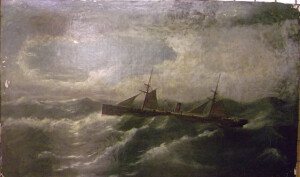 | SHORT DESCRIPTION: Oil painting on canvas of an American Line steamship in a storm at night. The painting is in poor condition and has been severely overpainted at some point in the past. The painting depicts an American Line vessel of the 1873 to 1884 time period. NOTES: A photograph of this painting in the library identifies the ship as the Pennsylvania. There is no identifying marks on the painting which indicate which American Line ship is represented. The American Line built four identical ships for Pennsylvania (1873), Ohio (1873), Illinois (1874) and Indiana (1874). Fifteen other ships were chartered during the 1873-1884 time period. Although its impossible to know for sure, the painting probably represents one of the four ships owned by the line not one of the ships chartered by the line. Information compiled by Elwin Eldredge from the Steamboat Inspection (1875, pg 54) states that on February 27, 1874 at 12 o'clock midnight, while on a voyage from Liverpool to Philadelphia in a severe storm, the Pennsylvania was struck by heavy seas which carried away the forward house and the bridge. The watch was being relieved at the time and the captain, first and second officers and two seamen were carried overboard and lost. The ship was saved through the prompt actions of a passenger and the remaining officers and crew who brought the ship safely into port. Although this painting depicts a ship in a storm at night, it is impossible to know if the scene described above depicts the events that occurred aboard the Pennsylvania. NOTES: The American Line ships were identified by the red funnel with narrow white band below black top with a white keystone on the red between 1873-1884. [http://www.theshipslist.com/ships/lines/american.html] American Line / American Steamship Company: Formed in 1872 as the American Steamship Co., Philadelphia and commenced passenger and cargo services to Queenstown and Liverpool, mostly with chartered ships. By 1884 passenger traffic on the North Atlantic had fallen and trade to Philadelphia decreased dramatically and the International Navigation Co. of Philadelphia (Red Star Line) acquired the company. In 1892 an Act of Congress ensured that two large vessels of the British flagged Inman Line (owned by International Navigation Co.) were transferred to the U.S. flag under the title of American Line. The parent company, International Navigation Co. changed it's name in 1902 to International Mercantile Marine Co. and purchased the share capitals of White Star, Dominion, Atlantic Transport and Leyland Lines as well as owning Red Star Line. Services ceased in 1925. Subsequent history of the company is covered by Red Star Line. VESSEL INFORMATION: The American Steamship Company of Philadelphia came into existence out of the joint action of the merchants of Philadelphia and the Pennsylvania Railroad Company (hence the keystone in the logo). The company was organized under a charter dated April 18th 1871 for the purpose of establishing steam communication between Philadelphia and Liverpool. A contract for four vessels was given to William Cramp & Sons of Philadelphia for the contruction of four first class iron propeller steamships all to be alike in model and machinery. The four ships were the Pennsylvania, Ohio, Indiana and Illinois. The general dimensions and models of these vessels are identical. The ships had ample beam for stability and great depth of hold, which, with a flush spar deck extending the entire length and breadth of the ship insures a comfortable, dry and safe vessel. The Pennsylvania's performance on her first round trip voyage was satisfactory. On her official trip, her average speed was 12.2 knots. The thorough description of the Pennsylvania (the first built) was prepared by Captain Bartham Snyder, which also applies to the other ships is in the object file. | CL12552 | |||||||
| 68 | 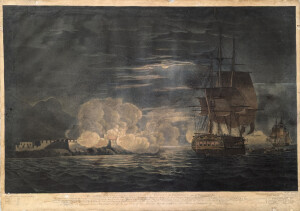 | SHORT DESCRIPTON: Hand-colored aquatint titled "The Cutting of the SPANISH (late his MAJESTY'S) FRIGATE the HERMIONE out of Porto Cavallo." The artist was Thomas Whitcombe and the image was aquatinted by John William Edy. The image shows the HMS Hermione/Santa Cecilia under sail and tow at the right. HMS Surprise sits at the extreme right in the background. At the left is a large crenellated fort firing upon the escaping frigate. The moon is visible at the center near the top, partially obscured by clouds. NOTES: In September 1797 off Puerto Rico, part of the crew of HMS Hermione mutinied and murdered Captain Hugh Pigot, two lieutenants, the purser, surgeon, captain’s clerk, a midshipman, a lieutenant of marines and the boatswain and threw their bodies overboard. A few warrant officers, the master and the master's mate were spared because they were needed to navigate the ship and a master's mate or midshipman, David Brian O'Casey. The crew surrendered the ship to the Spaniards at La Guaira, Venezuela. The Spanish commissioned Hermione into Spanish service as Santa Cecilia. The vessel became the most sought after prize for the British in the West Indies. On October 25, 1799, British Captain Edward Hamilton in HMS Surprise found Santa Cecilia at Puerto Cabello in Venezuela. The frigate was anchored under a battery of 200 guns. As Hamilton led his boats, filled with 100 hand picked seamen and marines, to attack the vessel they were spotted by two Spanish gun-vessels who raised the alarm warning 400 sailors aboard ‘Hermione’. The British boarded the vessel in several locations and as a desperate fight raged the ship's anchor cables were cut, the sails were loosed, and in spite of the fire from the batteries she was safely towed from the port. No British sailors were killed and just twelve, including Captain Hamilton, were wounded. The Spanish lost 120 killed, 231 taken prisoner (97 were wounded) and 15 escaped by jumping overboard and swimming ashore. Twenty more escaped in a launch. All of the prisoners except three officers were returned to the port the next day. Admiral Sir Hyde Parker renamed Hermione HMS Retaliation. On January 31, 1800 the Admiralty ordered vessel renamed HMS Retribution. | CL18959 | |||||||
| 69 | 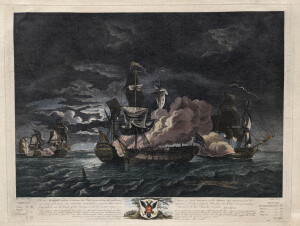 | SHORT DESCRIPTION: Line engraving on paper. NOTES: Excerpts from 'A Naval History of the American Revolution' by Gardner Weld Allen, pages 442-485: In January 1779, the French purchased a 14-year old East Indiaman called Duc de Duras. It was converted into a man-of-war despite being structurally weak and a slow sailer by Captain John Paul Jones. The vessel was renamed Bonhomme Richard in honor of Benjamin Franklin, Jones's friend and benefactor. Jones spent months preparing for a cruise against the English islands. The American frigate Alliance was detained in France by Franklin to support Jones's expedition. Three French vessels, Pallas, a merchantman or privateer fitted out as a 32-gun frigate; Cerf, an 18-gun cutter; and Vengeance, a 12-gun brigantine, were also given to Jones. The squadron was ready for sea by the middle of June and sailed from Groix Roads, near L'Orient on June 19th on a shakedown cruise during which a convoy would be escorted to Bordeaux and other ports. Franklin's orders to Jones were to cruise to the north of the British Isles and after six weeks put into Texel in order to convoy vessels from Holland to France. The squadron sailed from Groix Roads on August 14, 1779. On the 23rd the squadron was off Cape Clear. Two prizes had been taken and sent back to L'Orient. A third was taken by boat action but later lost in a fog. The Cerf dropped out of the expedition after receiving damage in a gale on August 26th. The same gale separated the ships of the squadron, but Bonhomme Richard and Vengeance proceeded northward and were off Cape Wrath by September 1st where they fell in with the Alliance and prize she had taken. The same day a British letter of marque was taken. These were later given up by Danish authorities to the British consul. On September 2nd the Pallas rejoined the squadron. The squadron cruised a few days between Orkney and Shetland and took a few unimportant prizes. Another gale and adverse winds prevented the squadron from sighting land again until September 13th when the Cheviot Hills were sighted. Two colliers were taken on the 14th. One of the prizes was sunk during a gale on the 17th. British Revenue Cutters specially fitted out and armed for service against the American squadron alerted the British population about the approached of Jones's squadron. The squadron sailed south and a few more prizes were taken. By September 21st the squadron was off Flamborough Head at which point two brigs were captured and a small fleet of vessels were chased. On September 23rd, the squadron encountered a Baltic fleet of 41 vessels under convoy by the 44-gun [but carrying 50 guns] frigate HMS Serapis, Captain Richard Pearson, and the hired armed ship Countess of Scarborough. Bonhomme Richard and Serapis entered a bitter engagement about 7:00PM. Jones described the action in an October 3rd report to Benjamin Franklin: "The battle being thus begun was continued with unremitting fury. Every method was practised on both sides to gain an advantage and rake each other, and I must confess that the enemy's ship, being much more manageable than the Bonhomme Richard, gained thereby several times an advantageous situation, in spite of my best endeavors to prevent it. As I had to deal with an enemy of greatly superior force, I was under the necessity of closing with him, to prevent the advantage which he had over me in point of manoeuvre. It was my intention to lay the Bonhomme Richard athwart the enemy's bow, but as that operation required great dexterity in the management of both sails and helm and some of our braces being shot away, it did not exactly succeed to my wishes. The enemy's bowsprit, however, came over the Bonhomme Richard's poop by the mizen mast and I made both ships fast together in that situation, which by the action of the wind on the enemy's sails, forced her stern close to the Bonhomme Richard's bow, so that the ships lay square alongside of each other, the yards being all entangled and the cannon of each ship touching the opponent's side. "When this position took place it was eight o'clock, previous to which the Bonhomme Richard had received sundry eighteen pounds shot below the water and leaked very much. My battery of 12-pounders, on which I had placed my chief dependance, being commanded by [1st] Lieut. [Richard] Dale and Col. Weibert and manned principally with American seamen and French volunteers, were entirely silenced and abandoned. As to the six old 18-pounders that formed the battery of the lower gundeck, they did no service whatever; two out of three of them burst at the first fire and killed almost all the men who were stationed to manage them. Before this time too, Col. De Chamillard, who commanded a party of twenty soldiers on the poop, had abandoned that station after having lost some of his men; these men deserted their quarters. I had now only two pieces of cannon, 9-pounders on the quarter deck, that were not silenced, and not one of the heavier cannon was fired during the rest of the action. The purser, Mr. Mease, who commanded the guns on the quarter deck, being dangerously wounded in the head, I was obliged to fill his place and with great difficulty rallied a few men and shifted over one of the lee quarter-deck guns, so that we afterwards played three pieces of 9-pounders upon the enemy. The tops alone seconded the fire of this little battery and held out bravely during the whole of the action, especially the main top where Lieut. Stack commanded. I directed the fire of one of the three cannon against the mainmast with doubleheaded shot, while the other two were exceedingly well served with grape and canister-shot to silence the enemy's musketry and clear her decks, which was at last effected. "The enemy were, as I have since understood, on the instant of calling for quarters, when the cowardice or treachery of three of my under officers induced them to call to the enemy. The English commodore asked me if I demanded quarters and, I having answered him in the most determined negative, they renewed the battle with double fury. They were unable to stand the deck, but the fire of their cannon, especially the lower battery, which was entirely formed of 18-pounders, was incessant. Both ships were set on fire in various places and the scene was dreadful beyond the reach of language. To account for the timidity of my three under officers, I mean the gunner, the carpenter, and the master-at-arms, I must observe that the two first were slightly wounded, and as the ship had received various shots under water, and one of the pumps being shot away, the carpenter expressed his fear that she would sink and the other two concluded that she was sinking, which occasioned the gunner to run aft on the poop, without my knowledge, to strike the colors. Fortunately for me, a cannon ball had done that before by carrying away the ensign staff; he was therefore reduced to the necessity of sinking, as he supposed, or of calling for quarter and he preferred the latter. "All this time the Bonhomme Richard had sustained the action alone and the enemy, though much superior in force, would have been very glad to have got clear, as appears by their own acknowledgments and their having let go an anchor the instant that I laid them on board, by which means they would have escaped, had I not made them well fast to the Bonhomme Richard. At last, at half past nine o'clock, the Alliance appeared and I now thought the battle at an end, but to my utter astonishment he discharged a broadside full into the stern of the Bonhomme Richard. We called to him for God's sake to forbear firing into the Bonhomme Richard, yet he passed along the off side of the ship and continued firing. There was no possibility of his mistaking the enemy's ship for the Bonhomme Richard, there being the most essential difference in their appearance and construction; besides, it was then full moonlight and the sides of the Bonhomme Richard were all black, while the sides of the prizes were yellow. Yet, for the greater security, I showed the signal of our reconnoissance by putting out three lanthorns, one at the head (bow), another at the stern (quarter), and the third in the middle, in a horizontal line. Every tongue cried that he was firing into the wrong ship, but nothing availed; he passed round firing into the Bonhomme Richard's head, stern, and broadside, and by one of his vollies killed several of my best men and mortally wounded a good officer on the forecastle. "My situation was really deplorable. The Bonhomme Richard received various shots under water from the Alliance, the leak gained on the pumps, and the fire increased much on board both ships. Some officers persuaded me to strike, of whose courage and good sense I entertain a high opinion. My treacherous master-at-arms let loose all my prisoners without my knowledge and my prospect became gloomy indeed." The prisoners were much frightened, believing that the ship was sinking, and were at once put to work at the pumps; otherwise, by reinforcing the enemy, they would surely have turned the scale in his favor. "I would not, however, give up the point. The enemy's mainmast began to shake, their firing decreased, ours rather increased, and the British colors were struck at half an hour past ten o'clock." Reports by Dale and Captain Pearson indicated that a hand grenade thrown into the lower decks of Serapis from one of the ship's tops (which had unknowingly been taken over by the Americans) ignited loose gunpowder and sparked a fire that spread from cartridge to cartridge all the gun deck and "blew up the whole of the people and officers that were quartered abaft the mainmast, from which unfortunate circumstance all those guns were rendered useless for the remainder of the action." Both ships were severely damaged in the action. Bonhomme Richard was on fire in several placed and leaky rapidly with five feet of water in the hold, one pump was shot away and the other three were barely able to keep the water from gaining. Jones described the damage to Bonhomme Richard as "the rudder was cut entirely off the stern frame and the transums were almost entirely cut away; the timbers, by the lower deck especially, from the mainmast to the stern, being greatly decayed with age, were mangled beyond my power of description." Both sides of the ship for a great distance were wholly shot away, leaving little support for the upper deck, and projectiles passed through without hitting anything. The mainmast and mizzen-topmast of the Serapis fell overboard immediately after her surrender and she was otherwise much injured. It was only through Jones's determination not to yield that won this battle. Serapis's consort, the Countess of Scarborough, was engaged and taken by the Pallas. Jones blamed the convoy's escape on the disinclination of the French captains of Alliance and Vengeance to pursue it. Bonhomme Richard defied all efforts to save her and sank about 36 hours later at 11:00AM on September 25th. Jones took command of Serapis, erected a jury mainmast and sailed her to Texel, arriving on October 3rd. After Jones spent three months refitting his squadron, most of which were transferred to French flags to ease tensions between the Dutch and British, the Dutch ordered Jones in USS Alliance (the only vessel of the squadron that remained under the American flag) to depart on the first favorable wind. Jones managed to leave Texel on December 27, 1779 and successfully evaded a British blockading squadron. Serapis was eventually sold at L'Orient and the Countess of Scarborough was sold at Dunkirk. NOTES: The American ships are flying the "American Stripes" flag, thirteen red and white stripes with no blue canton. | CL18028 | |||||||
| 70 | 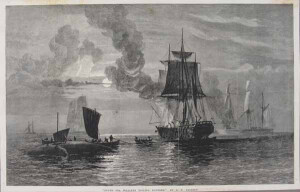 | SHORT DESCRIPTION: Wood engraving titled 'South Sea Whalers Boiling Blubber' published in the July 1, 1876 edition of The Illustrated London News (Vol. LXIX, No. 1927, page 5). The artist was O. W. Brierly. Image depicts whalers performing the procedures of processing the whales and boiling their blubber. Boats are preparing to get a whale alongside. NOTES: The remainder of the text that appears under the image in the original publication states 'in the exhibition of the Society of Painters in Water Colours.' The text supporting this image appears on page 3: This picture, by Mr O.W. Brierly, in the present exhibition of the Society of Painters in Water Colours, is noticeable not only for its excellence as a work of art, but is also of considerable interest from the novelty of the subject. It appears that the customs in South Sea whaling differ in some respects form whaling as it is carried on in the Artic regions, where the blubber is cut up and put into tanks to be brought home and boiled. In the South Sea ships, which capture both sperm and 'right' whale, the whales are brought alongside, where the blubber is first stripped off in great masses, called 'blanket pieces', which are then cut up into more manageable sizes, and finally boiled down in the try-pots - large boilers fixed into brickwork on the forepart of the ship, the fuel being supplied from the scraps from which the oil has been extracted. A whaler so employed at night, with a mass of smoke rising high above the sails, which are lighted up by a red glare as the fires are stirred up, has very much the appearance of a ship on fire, and passing vessels not unfrequently bear down to render assistance for what is taken for a burning ship. We understand that the picture is a commission from Lord Elphinstone. NOTES: This print was later made into a popular watercolor. Oswald Walter Brierly was an English artist and a member of the Scoeity of Painters in Water-Colours. For some years he was a " Marine Painter in Ordinary to Her Majesty." He sailed with the Duke of Edinburgh from 1867-1868 on the Galatea's trip around the world, painting that ship off the Cape of Good Hope. NOTES: Nantucket native William F. Macy learned the printer’s trade at Nantucket’s newspaper, ‘The Inquirer and Mirror.’ After going to the mainland he worked in several printing shops around Boston and was appointed as the first instructor in printing at the Lyman School for Boys in Westboro, Massachusetts. Later Macy opened an insurance agency in Boston. Throughout this time he continued studying Nantucket history and frequently contributed articles to ‘The Inquirer and Mirror’ (signing his articles "Yorick"). Around 1912, in collaboration with Anna Gardner Fish and Roland Bunker Hussey, Macy issued the first edition of the "Nantucket Scrap Basket". He arranged for a second edition of this publication in 1932. In 1915, Mr. Macy prepared and published "The Story of Old Nantucket," a condensed history of Nantucket (reprinted in 1931). He was a founder and one time president of "The Sons and Daughters of Nantucket." In 1924, Macy was appointed President of the Nantucket Historical Association and served until his death in 1935. During this time Edward F. Sanderson approached the Association about receiving his collection of whaling paraphernalia with the purpose of establishing a whaling museum on Nantucket. When he returned to Nantucket in 1928 Mr. Macy purchased the old American House property, on the corner of Orange Street and Martins Lane, and built the house now standing there. This became Macy’s headquarters during his decade of planning, raising money and finally establishing the Nantucket Whaling Museum which opened its doors on July 24, 1930. | CL502 | |||||||
| 71 | 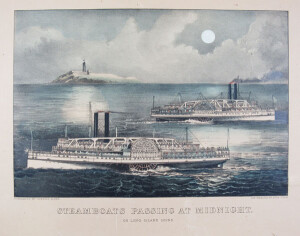 | SHORT DESCRIPTION: Colored lithograph titled "Steamboats Passing at Midnight, On Long Island Sound" published by Currier & Ives. The image shows two Fall River Line side-wheel steamships passing in opposite directions. The steamboat in the foreground is the Bristol while the boat in the background at the right is unidentified (another version of the images has that vessel identified as Providence). A lighthouse standing on an island in the background shines a beacon on light. NOTES: The Fall River Line was a famous and long-running passenger transportation service (1847–1937) that connected New York City and Boston via a combination of overnight steamboat travel along Long Island Sound (and Narragansett Bay) and rail connections. Passengers typically took a night boat from New York to Fall River, Massachusetts, then continued by train to Boston (or vice versa), making it a luxurious and popular "rail-water" route, especially during the Gilded Age. The company was founded by Richard Borden who began a regular steamboat service between New York City and Fall River in 1847 (the Bay State Steamboat Company/Bay State Line). In 1863 the Bay State Steamboat Company was sold to the Boston, Newport and New York Steamboat Company, and the railroad was extended between Fall River and Newport, Rhode Island. In 1869 the line was sold to the Narragansett Steamboat Company (Narragansett Steamship Company). In 1872 the Fall River Line was completely reorganized and became part of the Old Colony Railroad, under the name Old Colony Steamboat Company. In 1893, the Fall River Line became part of the New York, New Haven and Hartford Railroad (commonly called the New Haven Railroad). Under this railroad's influence, the steamboat operations (including the prominent Fall River Line) were reorganized and operated through the New England Navigation Company (organized January 1, 1905, the Fall River Line became a division in 1906). By the early 1910s (evidenced by references like 1913 stock certificates and reports), operations and marketing increasingly used New England Steamship Company (often abbreviated N.E.S.S. Co.). The shift to the new name likely occurred gradually between 1905 and 1910, with the name "New England Steamship Company" becoming the primary public and operational identity by the late 1900s/early 1910s. No single "renaming date" is pinpointed in primary sources, but the effective transition to the Steamship Company name for day-to-day branding and management was complete by around 1910–1912. The New England Steamship Company directly managed and marketed the Fall River Line's fleet of elegant side-wheel steamships (such as the Pilgrim, Priscilla, Puritan, Commonwealth, and Providence). After its employees went on strike in the middle of 1937, the company chose, in the face of ongoing losses due to land transportation, to liquidate rather than negotiate with the union. Vessels operated by the line: Bay State (1847), Massachusetts (1847), Empire state (1848), State of Maine (acquired 1849), Metropolis (1854), Old Colony (1865), Newport (1865), Bristol (1867, acquired 1869), Providence (1867, acquired 1869), Pilgrim (1883), City of Fall River (1883, freighter), City of Brockton (1886, freighter), Puritan (1889), Plymouth (1890; rebuilt 1906-1907), City of Taunton (1892, freighter), Priscilla (1894), Providence (1905), and Commonwealth (1908). VESSEL INFORMATION - VESSEL NAME: BRISTOL VESSEL TYPE: AMERICAN WOODEN PADDLE SIDE-WHEEL STEAMBOAT SHIP BUILDER: WILLIAM H. WEBB SHIPBUILDER LOCATION: NEW YORK, NEW YORK VESSEL BUILT: 1866 SERVICE DATES: 1866-1888 SHIP OWNERS: NARRAGANSET STEAMSHIP CO. VESSEL DIMENSIONS: 362' length, over all 373' x 48'4" breadth x 16'6" depth of hold, gross tonnage 2962 VESSEL HISTORY: She was considered one of the most celebrated steamboats ever built, and with her sister ship the PROVIDENCE became world renowned for their magnificent and most complete appointments; the best that could be found on any steamboat. She cost over $1,250,000.00 when new. Her floors were of white oak, every beam bolted fore and aft, and cross-braced with iron from the keel to the tops of the paddle boxes, and in addition to being strengthened by the heavy hog frames, she was also fitted with water tight compartments. During the first years of her service, she ran from New York to Bristol, Rhode Island. In 1874, she was sold to the Old Colony Steamboat Company (Fall River Line), and was accidentally burned at Newport, Rhode Island, while laid up on December 30th, l888. | CL19103 | |||||||
| 72 | 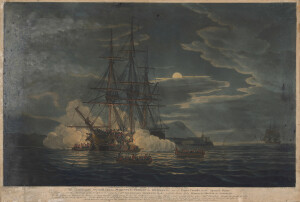 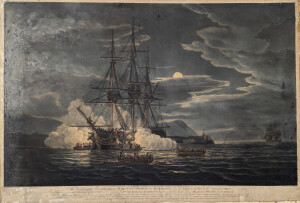 | SHORT DESCIPTION: Hand-colored aquatint titled ' The Cutting of the SPANISH (late his MAJESTY'S) FRIGATE the HERMIONE, out of Port Cavallo, on the Spanish Main.' Artist Thomas Whitcomb and aquatinted by John William Edy. The image shows HMS Hermione/Santa Cecilia at anchor. British boats sit at either side of the bow with sailors and marines who are boarding the vessel. Hand to hand combat is visible on the deck and the cannons of the ship are being fired. Two other British boats filled with sailors and marines sit in the water around the vessel. HMS Surprise sits at the right in the background. To the right of HMS Hermione/Santa Cecilia is a fort on a point of land. Large mountains are in the background. The moon is visible above the clouds at the center right. NOTES: In September 1797 off Puerto Rico, part of the crew of HMS Hermione mutinied and murdered Captain Hugh Pigot, two lieutenants, the purser, surgeon, captain’s clerk, a midshipman, a lieutenant of marines and the boatswain and threw their bodies overboard. A few warrant officers, the master and the master's mate were spared because they were needed to navigate the ship and a master's mate or midshipman, David Brian O'Casey. The crew surrendered the ship to the Spaniards at La Guaira, Venezuela. The Spanish commissioned Hermione into Spanish service as Santa Cecilia. The vessel became the most sought after prize for the British in the West Indies. On October 25, 1799, British Captain Edward Hamilton in HMS Surprise found Santa Cecilia at Puerto Cabello in Venezuela. The frigate was anchored under a battery of 200 guns. As Hamilton led his boats, filled with 100 hand picked seamen and marines, to attack the vessel they were spotted by two Spanish gun-vessels who raised the alarm warning 400 sailors aboard ‘Hermione’. The British boarded the vessel in several locations and as a desperate fight raged the ship's anchor cables were cut, the sails were loosed, and in spite of the fire from the batteries she was safely towed from the port. No British sailors were killed and just twelve, including Captain Hamilton, were wounded. The Spanish lost 120 killed, 231 taken prisoner (97 were wounded) and 15 escaped by jumping overboard and swimming ashore. Twenty more escaped in a launch. All of the prisoners except three officers were returned to the port the next day. Admiral Sir Hyde Parker renamed Hermione HMS Retaliation. On January 31, 1800 the Admiralty ordered vessel renamed HMS Retribution. | CL24154 | |||||||
| 73 | 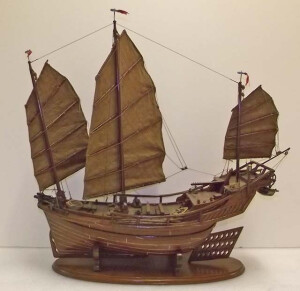 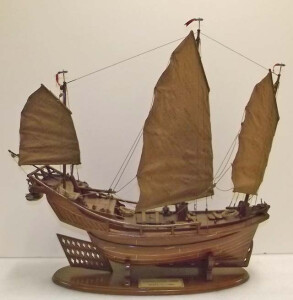  | SHORT DESCRIPTION: Model of a Chinese junk from the Kwangtung (Guangdong) province. The model has three masts with handstitched brown fabric sails with six round wood battens. The model has a sharply pointed bow and a square stern. There is a thin piece of wood attached to the stem and keel that has diamond-shaped cut-outs similar to the rudder. The tall stern (with several decks structures/cabins) has an overhang with a smaller vessel hanging underneath. The little boat has a square bow and stern and has a large yuloh (steering oar) laying across it. There is a large rhomboid shaped, fenestrated rudder (diamond shaped openings) at the stern. The tiller has a block and tackle system attached to it. There are large windlass-type cranks at the base of the fore and main masts that are used with the halyard to raise and lower the sails. The decks and hull of both the model and the small boat hanging from the stern are solid pieces of wood that have been scored and filled with some sort of white compound to make them appear as though they are made of individual pieces of wood. There are two cannons mounted near the main mast and two large coils of woven grass or bamboo "rope" are laying on the deck. Along the sides of the ship are open grated walkways. On the port side there are five boat hooks and poles used for fending the boat off of other vessels or piers. There are three adze anchors [the arms of the adze anchor form an acute angle with the shaft (40 degrees or less) at the crown instead of diverging from it at a right angle or in an arc. The stock is passed through the shaft at the crown-end instead of the ring-end. The advantage of an anchor of this type is that it is almost non-fouling.] on chains at the bow and a smaller grapnel type anchor at the stern. The masts are topped with wooden windvanes in the shape of fish. They are painted blue and white and have with red fabric pennants attached to their tails. The wood of the model is dark and might be teak or mahogany, but an interior surface could not be examined to make an accurate determination of the wood type. NOTES: Excerpt of letter from Capt. Whitney I. Eisler dated September 18, 1936: Some time ago I procured thru the kindness of Capt. George Yardley of the "President Hoover" a model of the hull of a [Kwantung] junk, a type which is now almost obsolete on the China Coast. I secured the services of an old Chinese Junk Master who is rigging the model for me. It is to absolute scale in all respects, 1/8 of an inch = 1 foot. [label on model says 1/4"] and when completed will be one of the finest models in existence. LABEL COPY: [Waterside Junks exhibition] This model represents a typical Chinese ocean-going vessel. Junks of the Kwangtung province were usually large craft, some having the capacity of 300 tons or more. At one time, these vessels carried on a good trade between the Kwangtung ports of Canton, Macao, and Hong Kong, south to Hainan Island and Siam (Thailand), and to Shanghai and Ningpo in the north, but they have gradually been replaced by steam-powered vessels. The Kwangtung junks had the rounded hull and sharp bow typical of the deep-water vessels of southern China. They carried the balance-lug sail with hump-backed leech and bamboo battens so characteristic of Chinese craft. The pierced rudder, keel, and stem are peculiar to Kwangtung province. Many of the large junks carried deck guns to repel the infamous Amoy pirates that prowled the Formosa Straits off Taiwan. Most sea-going junks had decorative wind vanes at the mast-heads. Fish, one of the favored motifs, are a symbol of wealth and, since fish never close their eyes, are presumed to be ever-vigilant. The pennants flying from the fishes' tails are red because, in China, red is a happy color and a powerful agent against devils and evil spirits. It was traditional to adorn the hull of a Chinese vessel with good luck symbols and phrases. The three Chinese characters painted in gold on the stern of this model can be loosely translated, "Love Means Happiness." NOTES: From: Fields from the Sea: Chinese Junk Trade with Siam During the Late Eighteenth ... By Jennifer Wayne Cushman Kwangtung junks were distinctive, particularly with regard to sail conformation. As one moves southward along the Chinese coast, the sail leech becomes progressively rounder, culminating in the sails of Kwangtung craft on which the shoulder of the leech is fully rounded. Additional features usually found on these vessels were a gently rounded bottom, an overhanging stern with a railed gallery, and fenestrated rudder. The latter was probably developed to reduce drag on the vessel when directional changes were made in deep water navigation. From: Needham, Joseph (1986). Science and Civilization in China: Volume 4, Physics and Physical Technology, Part 3, Civil Engineering and Nautics. [With regards to the rudder] ...such fenestrations, generally diamond shaped and cut out at the edges of the planks, ease the steering by reducing pressure against which the riller has to act, and minimised the drag ont he ship caused by turbulence in the hydrodynamic flow past the rudder. But as water is a viscous medium the efficiency of the rudder is very little impaired. From: Sail & Sweep in China by G. R. G. Worcester [with regards to windvanes] Most sea-going junks, and many types of inland craft have a decorative wind vane at the mast head. The device indicates in a general way the district from which the junk hails. The most favoured motif in the wind vane is the fish which is a symbol of wealth on account of the similarity in the pronunciation of the works Yu meaning fish, and Yu superfluity. Moreover, it is happy in its own element and is, therefore, regarded as a symbol of harmony....Red is the prevailing color of the pennants, for it is a powerful devil-dispelling colour and constitutes a really powerful agent against maliciously-disposed spirits. [with regards to words/sayings on stern] Although few of the junkmen can read or write, they make a point of adorning their craft with a Tui-tzǔ on the stern in a prominent position. This is not the name of the vessel, as one would suppose, but a couplet, a portent of happy omen. Here the junkmen are stirred to poetry; 'Water that sleeps in the moonlight', 'White robe crumpled by the Son of heaven', 'Pale cheek touched by the rainbow' and so on. NOTES: The translation of the characters on the stern of our model was provided by Xixi Wang, a student at Old Dominion University on November 4, 2013. The characters in the right-side column essentially mean: downwind enrichment (or downwind benefit). The characters in the left-side column mean: no sea waves. And the bottom row of characters means: enjoying happiness. ADDITIONAL INFORMATION: See Ivon A. Donnelly, "Chinese Junks And Other Native Craft", 1930. See G.R.G. Worcester, "The Floating Population in China: An Illustrated Record of the Junkmen and Their Boats on Sea and River", Figure four, "The Main Armament of a Junk", page 8-9. See G.R.G. Worcester, "Sail & Sweep in China", chapter on sea-going junks. | CL14355 | |||||||
| 74 | No image URL. | NOTES: The Fall River Line was a famous and long-running passenger transportation service (1847–1937) that connected New York City and Boston via a combination of overnight steamboat travel along Long Island Sound (and Narragansett Bay) and rail connections. Passengers typically took a night boat from New York to Fall River, Massachusetts, then continued by train to Boston (or vice versa), making it a luxurious and popular "rail-water" route, especially during the Gilded Age. The company was founded by Richard Borden who began a regular steamboat service between New York City and Fall River in 1847 (the Bay State Steamboat Company/Bay State Line). In 1863 the Bay State Steamboat Company was sold to the Boston, Newport and New York Steamboat Company, and the railroad was extended between Fall River and Newport, Rhode Island. In 1869 the line was sold to the Narragansett Steamboat Company (Narragansett Steamship Company). In 1872 the Fall River Line was completely reorganized and became part of the Old Colony Railroad, under the name Old Colony Steamboat Company. In 1893, the Fall River Line became part of the New York, New Haven and Hartford Railroad (commonly called the New Haven Railroad). Under this railroad's influence, the steamboat operations (including the prominent Fall River Line) were reorganized and operated through the New England Navigation Company (organized January 1, 1905, the Fall River Line became a division in 1906). By the early 1910s (evidenced by references like 1913 stock certificates and reports), operations and marketing increasingly used New England Steamship Company (often abbreviated N.E.S.S. Co.). The shift to the new name likely occurred gradually between 1905 and 1910, with the name "New England Steamship Company" becoming the primary public and operational identity by the late 1900s/early 1910s. No single "renaming date" is pinpointed in primary sources, but the effective transition to the Steamship Company name for day-to-day branding and management was complete by around 1910–1912. The New England Steamship Company directly managed and marketed the Fall River Line's fleet of elegant side-wheel steamships (such as the Pilgrim, Priscilla, Puritan, Commonwealth, and Providence). After its employees went on strike in the middle of 1937, the company chose, in the face of ongoing losses due to land transportation, to liquidate rather than negotiate with the union. Vessels operated by the line: Bay State (1847), Massachusetts (1847), Empire state (1848), State of Maine (acquired 1849), Metropolis (1854), Old Colony (1865), Newport (1865), Bristol (1867, acquired 1869), Providence (1867, acquired 1869), Pilgrim (1883), City of Fall River (1883, freighter), City of Brockton (1886, freighter), Puritan (1889), Plymouth (1890; rebuilt 1906-1907), City of Taunton (1892, freighter), Priscilla (1894), Providence (1905), and Commonwealth (1908). VESSEL INFORMATION - VESSEL NAME: BRISTOL VESSEL TYPE: AMERICAN WOODEN PADDLE STEAMER SHIP BUILDER: WILLIAM H. WEBB SHIPBUILDER LOCATION: NEW YORK, NEW YORK VESSEL BUILT: 1867 SERVICE DATES: 1869-1888 SHIP OWNERS: NARRAGANSETT STEAMSHIP COMPANY VESSEL DIMENSIONS: 362' length, over all 373' x 48'4" breadth x 16'6" depth of hold, gross tonnage 2962 VESSEL HISTORY: She was considered one of the most celebrated steamboats ever built, and with her sister ship the PROVIDENCE became world renowned for their magnificent and most complete appointments; the best that could be found on any steamboat. She cost over $1,250,000.00 when new. Her floors were of white oak, every beam bolted fore and aft, and cross-braced with iron from the keel to the tops of the paddle boxes, and in addition to being strengthened by the heavy hog frames, she was also fitted with water tight compartments. During the first years of her service, she ran from New York to Bristol, Rhode Island. In 1874, she was sold to the Old Colony Steamboat Company (Fall River Line), and was accidentally burned at Newport, Rhode Island, while laid up on December 30th, 1888. | CL19101 | |||||||
| 75 | 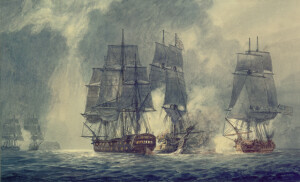 | NOTES: Excerpts from 'A Naval History of the American Revolution' by Gardner Weld Allen, pages 442-485: In January 1779, the French purchased a 14-year old East Indiaman called Duc de Duras. It was converted into a man-of-war despite being structurally weak and a slow sailer by Captain John Paul Jones. The vessel was renamed Bonhomme Richard in honor of Benjamin Franklin, Jones's friend and benefactor. Jones spent months preparing for a cruise against the English islands. The American frigate Alliance was detained in France by Franklin to support Jones's expedition. Three French vessels, Pallas, a merchantman or privateer fitted out as a 32-gun frigate; Cerf, an 18-gun cutter; and Vengeance, a 12-gun brigantine, were also given to Jones. The squadron was ready for sea by the middle of June and sailed from Groix Roads, near L'Orient on June 19th on a shakedown cruise during which a convoy would be escorted to Bordeaux and other ports. Franklin's orders to Jones were to cruise to the north of the British Isles and after six weeks put into Texel in order to convoy vessels from Holland to France. The squadron sailed from Groix Roads on August 14, 1779. On the 23rd the squadron was off Cape Clear. Two prizes had been taken and sent back to L'Orient. A third was taken by boat action but later lost in a fog. The Cerf dropped out of the expedition after receiving damage in a gale on August 26th. The same gale separated the ships of the squadron, but Bonhomme Richard and Vengeance proceeded northward and were off Cape Wrath by September 1st where they fell in with the Alliance and prize she had taken. The same day a British letter of marque was taken. These were later given up by Danish authorities to the British consul. On September 2nd the Pallas rejoined the squadron. The squadron cruised a few days between Orkney and Shetland and took a few unimportant prizes. Another gale and adverse winds prevented the squadron from sighting land again until September 13th when the Cheviot Hills were sighted. Two colliers were taken on the 14th. One of the prizes was sunk during a gale on the 17th. British Revenue Cutters specially fitted out and armed for service against the American squadron alerted the British population about the approached of Jones's squadron. The squadron sailed south and a few more prizes were taken. By September 21st the squadron was off Flamborough Head at which point two brigs were captured and a small fleet of vessels were chased. On September 23rd, the squadron encountered a Baltic fleet of 41 vessels under convoy by the 44-gun [but carrying 50 guns] frigate HMS Serapis, Captain Richard Pearson, and the hired armed ship Countess of Scarborough. Bonhomme Richard and Serapis entered a bitter engagement about 7:00PM. Jones described the action in an October 3rd report to Benjamin Franklin: "The battle being thus begun was continued with unremitting fury. Every method was practised on both sides to gain an advantage and rake each other, and I must confess that the enemy's ship, being much more manageable than the Bonhomme Richard, gained thereby several times an advantageous situation, in spite of my best endeavors to prevent it. As I had to deal with an enemy of greatly superior force, I was under the necessity of closing with him, to prevent the advantage which he had over me in point of manoeuvre. It was my intention to lay the Bonhomme Richard athwart the enemy's bow, but as that operation required great dexterity in the management of both sails and helm and some of our braces being shot away, it did not exactly succeed to my wishes. The enemy's bowsprit, however, came over the Bonhomme Richard's poop by the mizen mast and I made both ships fast together in that situation, which by the action of the wind on the enemy's sails, forced her stern close to the Bonhomme Richard's bow, so that the ships lay square alongside of each other, the yards being all entangled and the cannon of each ship touching the opponent's side. "When this position took place it was eight o'clock, previous to which the Bonhomme Richard had received sundry eighteen pounds shot below the water and leaked very much. My battery of 12-pounders, on which I had placed my chief dependance, being commanded by [1st] Lieut. [Richard] Dale and Col. Weibert and manned principally with American seamen and French volunteers, were entirely silenced and abandoned. As to the six old 18-pounders that formed the battery of the lower gundeck, they did no service whatever; two out of three of them burst at the first fire and killed almost all the men who were stationed to manage them. Before this time too, Col. De Chamillard, who commanded a party of twenty soldiers on the poop, had abandoned that station after having lost some of his men; these men deserted their quarters. I had now only two pieces of cannon, 9-pounders on the quarter deck, that were not silenced, and not one of the heavier cannon was fired during the rest of the action. The purser, Mr. Mease, who commanded the guns on the quarter deck, being dangerously wounded in the head, I was obliged to fill his place and with great difficulty rallied a few men and shifted over one of the lee quarter-deck guns, so that we afterwards played three pieces of 9-pounders upon the enemy. The tops alone seconded the fire of this little battery and held out bravely during the whole of the action, especially the main top where Lieut. Stack commanded. I directed the fire of one of the three cannon against the mainmast with doubleheaded shot, while the other two were exceedingly well served with grape and canister-shot to silence the enemy's musketry and clear her decks, which was at last effected. "The enemy were, as I have since understood, on the instant of calling for quarters, when the cowardice or treachery of three of my under officers induced them to call to the enemy. The English commodore asked me if I demanded quarters and, I having answered him in the most determined negative, they renewed the battle with double fury. They were unable to stand the deck, but the fire of their cannon, especially the lower battery, which was entirely formed of 18-pounders, was incessant. Both ships were set on fire in various places and the scene was dreadful beyond the reach of language. To account for the timidity of my three under officers, I mean the gunner, the carpenter, and the master-at-arms, I must observe that the two first were slightly wounded, and as the ship had received various shots under water, and one of the pumps being shot away, the carpenter expressed his fear that she would sink and the other two concluded that she was sinking, which occasioned the gunner to run aft on the poop, without my knowledge, to strike the colors. Fortunately for me, a cannon ball had done that before by carrying away the ensign staff; he was therefore reduced to the necessity of sinking, as he supposed, or of calling for quarter and he preferred the latter. "All this time the Bonhomme Richard had sustained the action alone and the enemy, though much superior in force, would have been very glad to have got clear, as appears by their own acknowledgments and their having let go an anchor the instant that I laid them on board, by which means they would have escaped, had I not made them well fast to the Bonhomme Richard. At last, at half past nine o'clock, the Alliance appeared and I now thought the battle at an end, but to my utter astonishment he discharged a broadside full into the stern of the Bonhomme Richard. We called to him for God's sake to forbear firing into the Bonhomme Richard, yet he passed along the off side of the ship and continued firing. There was no possibility of his mistaking the enemy's ship for the Bonhomme Richard, there being the most essential difference in their appearance and construction; besides, it was then full moonlight and the sides of the Bonhomme Richard were all black, while the sides of the prizes were yellow. Yet, for the greater security, I showed the signal of our reconnoissance by putting out three lanthorns, one at the head (bow), another at the stern (quarter), and the third in the middle, in a horizontal line. Every tongue cried that he was firing into the wrong ship, but nothing availed; he passed round firing into the Bonhomme Richard's head, stern, and broadside, and by one of his vollies killed several of my best men and mortally wounded a good officer on the forecastle. "My situation was really deplorable. The Bonhomme Richard received various shots under water from the Alliance, the leak gained on the pumps, and the fire increased much on board both ships. Some officers persuaded me to strike, of whose courage and good sense I entertain a high opinion. My treacherous master-at-arms let loose all my prisoners without my knowledge and my prospect became gloomy indeed." The prisoners were much frightened, believing that the ship was sinking, and were at once put to work at the pumps; otherwise, by reinforcing the enemy, they would surely have turned the scale in his favor. "I would not, however, give up the point. The enemy's mainmast began to shake, their firing decreased, ours rather increased, and the British colors were struck at half an hour past ten o'clock." Reports by Dale and Captain Pearson indicated that a hand grenade thrown into the lower decks of Serapis from one of the ship's tops (which had unknowingly been taken over by the Americans) ignited loose gunpowder and sparked a fire that spread from cartridge to cartridge all the gun deck and "blew up the whole of the people and officers that were quartered abaft the mainmast, from which unfortunate circumstance all those guns were rendered useless for the remainder of the action." Both ships were severely damaged in the action. Bonhomme Richard was on fire in several placed and leaky rapidly with five feet of water in the hold, one pump was shot away and the other three were barely able to keep the water from gaining. Jones described the damage to Bonhomme Richard as "the rudder was cut entirely off the stern frame and the transums were almost entirely cut away; the timbers, by the lower deck especially, from the mainmast to the stern, being greatly decayed with age, were mangled beyond my power of description." Both sides of the ship for a great distance were wholly shot away, leaving little support for the upper deck, and projectiles passed through without hitting anything. The mainmast and mizzen-topmast of the Serapis fell overboard immediately after her surrender and she was otherwise much injured. It was only through Jones's determination not to yield that won this battle. Serapis's consort, the Countess of Scarborough, was engaged and taken by the Pallas. Jones blamed the convoy's escape on the disinclination of the French captains of Alliance and Vengeance to pursue it. Bonhomme Richard defied all efforts to save her and sank about 36 hours later at 11:00AM on September 25th. Jones took command of Serapis, erected a jury mainmast and sailed her to Texel, arriving on October 3rd. After Jones spent three months refitting his squadron, most of which were transferred to French flags to ease tensions between the Dutch and British, the Dutch ordered Jones in USS Alliance (the only vessel of the squadron that remained under the American flag) to depart on the first favorable wind. Jones managed to leave Texel on December 27, 1779 and successfully evaded a British blockading squadron. Serapis was eventually sold at L'Orient and the Countess of Scarborough was sold at Dunkirk. NOTES: EDITOR'S NOTE from Proceedings, ‘Naval Actions of the American Revolution’ (Pictorial), page 26: This was undoubtedly the most famous naval encounter of the American Revolution, for here John Paul Jones displayed that daring leadership which caused both the British and the Americans to have a genu-ine respect for his fighting ability. Considerable historical argument has been expended on the exact words uttered by Jones when asked by Captain Pearson if he wished to surrender. Whatever were Jones' words, there was no mistaking their meaning that he did not intend to surrender and had "just begun to fight." Of considerable interest also is the fact that among Jones' several commands is listed the Serapis, for he took her as his own ship when the Bonhomme Richard went to the bottom. NOTES: Information concerning the Bailey Collection of watercolor views of U.S. Naval actions (1745-1850) in The Mariners’ Museum, Newport News, Virginia. In 1940 The Mariners’ purchased from a dealer in London a collection of 254 watercolor drawings, which were at the time attributed to Charles T. Warren (1767-1823), an engraver. They were represented as having belonged to a Charles Kingsley Bailey, and have henceforth been referred to as the Bailey Collection. The views in the collection range from the Siege of Louisburg in 1745 to an action which occurred in 1850. Simply on the basis of the breadth of coverage, then, it appeared unlikely that these were executed contemporary to the action by one person. Moreover, persons making studies of individual vessels represented in the collection have pointed out that there are major inaccuracies in the details of the vessels. Research initiated by the museum from 1974 to 1982 subsequently revealed that the watercolors were actually done by Irwin John Bevan (1852-1940). Welsh-born Bevan was a keen naval historian and his sketches and paintings included many maritime subjects. His work can be seen in Sea Fights of the Great War by W.L. Wyllie and M. F. Wrenn, published in 1918. Since Bevan did book illustrations, the present assumption is that this group of watercolors was executed to illustrate a projected work on the history of the U.S. Navy, especially as it related to the British Navy. Detailed contemporary accounts of the U.S.-British actions were written down in letters, official reports and newspapers of the day and nineteenth century historians had these sources available for their texts. The accounts accompanying Bevan’s paintings relied heavily on all these sources. Notwithstanding this however, the paintings must not be taken as primary documents of either the vessels or the engagements. They should be viewed in the context of the artist’s conceptions, which may vary considerably in their reliability. It is left to the discretion of the researcher whether or not this material will be of value in the current project. VESSEL HISTORY: Alternate vessel names: (1) DUC DE DURAS (1765-1779); (2) USS BONHOMME RICHARD (1779). | CL12861 | |||||||
| 76 |  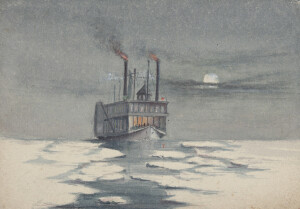  | SHORT DESCRIPTION: Watercolor drawing by Lt. William Henn of the Royal Navy showing the steamboat Louisiana in an icebound Chesapeake Bay on January 25, 1865. The scene appears to be taking place at night as the moon is visible and the vessel appears lit. NOTES: Although the artist was British, he was in the Hampton Roads, probably at Fort Monroe when this artwork was created. NOTES: The Philadelphia Inquirer, January 23, 1865 (page 8) published a report from Baltimore on January 22 that the ice in the Chesapeake Bay had delayed the departure of the steamer for Old Point and Norfolk. A later report stated that this vessel was forced to return to port due to the ice and fog so it probably wasn’t the vessel Henn saw. However, a letter from William Anderson, Special Correspondent of the Inquirer at Fortress Monroe published on page 1 of The Philadelphia Inquirer of January 30, 1865 reported on January 28th “that the effects of the cold weather on navigation” had “ice-olated” the fort from regular communication. Anderson does state that “We have had two mail steamers from Baltimore this week; and there is one due here daily.” It is likely one of these two steamers was the Louisiana. The Chicago Tribune of January 27, 1865 (page 1) reported: “The navigation on the Potomac is closed for the present, owing to the ice, which for miles down the river is twelve inches in thickness. The mail boats plying between here and City Point have been compelled to suspend their trips. There is also a great deal of ice in the Chesapeake, and it is with great difficulty that boats run from Annapolis to Fortress Monroe.” The Philadelphia Inquirer of January 27, 1865 (page 1) backs this up with a report from Baltimore that states “Our harbor is again closed, except a small track kept open by ice boats. The Norfolk boats arrive and depart very irregularly.” NOTES: Vessel history compiled from "Steam Packets on the Chesapeake: A History of the Old Bay Line since 1840" by Alexander Crosby Brown, and articles published in The Baltimore Sun on May 13, 1854 (page 1), October, 26, 1854 (page 1), May 27, 1871 (page 4), and November 16, 1874 (page 1): Louisiana was built by Cooper & Butler of Baltimore, Maryland, for the Baltimore Steam Packet Company (Old Bay Line) at a cost of about $125,000. The vessel was built to run between Norfolk/Portsmouth/Old Point Comfort and Baltimore. Louisiana was launched on the afternoon of May 13, 1854 (reported in the Baltimore Sun, May 13, 1854, page 1). The steamboat was 1100 tons burthen, 275 feet long, beam of 36 feet with 60 feet overall (also reported 62 feet), depth of hold 12 feet 4 inches (also reported 12 feet 8 inches). Her wheels were 35 feet in diameter, with 9 feet face (also reported 10 feet). Louisiana was considered one of the largest, most commodious and most elegant boats of the day and the largest wooden-hulled craft ever operated by the Old Bay Line. Her hull was of white oak and cedar, copper and iron fastened and painted white above the waterline. The vessel was propelled by a 500hp walking beam engine made by Charles Reeder, Jr. During the vessel’s trial trip on October 25th its speed reached 18mph. Her maiden voyage took place on November 9, 1854, as an excursion to Old Point Comfort and the Virginia Capes. Louisiana maintained a regular service between Baltimore and Old Point Comfort through the Civil War. In 1871 Louisiana was completely rebuilt and modernized by the Baltimore shipbuilding firm of William Skinner and Company at a cost of nearly $100,000. On November 14, 1874 around 1:30 AM Louisiana was sunk after a collision with the Baltimore-Charleston steamer Falcon off Smith’s Point in the Chesapeake Bay. The vessel stayed afloat for almost 45 minutes which allowed the passengers, their baggage and the mails to be safely transferred to the Falcon. The cargo was salvaged from the wreck which was later raised and the hull was broken up. The engines and boilers were installed in the new steamboat Carolina in 1878. NOTES: Lieutenant William Henn, R.N. (1847-1894) was born in Dublin in 1847. Henn joined the Royal Navy in 1860 at the age of 13 and his first service was as a naval cadet aboard the HMS Trafalgar (Dublin Evening Packet and Correspondent, October 3, 1861). His next service was as a midshipman aboard the steam frigate HMS Galatea from 1862 to 1866 during the American Civil War. The ship was on the North American and West Indies station. In November 1863 the ship was off the Rio Grande in the Gulf of Mexico and in January/February 1865 it was in the Chesapeake Bay. He was present at the bombardment and capture of the forts at Cape Haytien, and at the Morant Bay Rebellion in Jamaica in 1865. VESSEL INFORMATION - VESSEL NAME: LOUISIANA SERVICE DATES: 1854-1874 SHIPBUILDER: COOPER & BUTLER BUILDER LOCATION: BALTIMORE, MARYLAND SHIP OWNERS: BALTIMORE STEAM PACKET CO. | CL30945 | |||||||
| 77 | 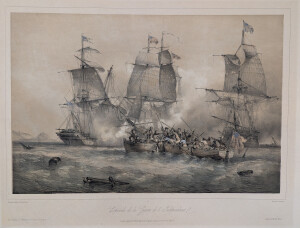 | NOTES: Print related to a series of images by French lithographer Ferdinand Perrot. Possibly showing an episode from the engagement between the Bon Homme Richard, Alliance and the HMS Serapis. The image shows sailors in two ship's boats, one flying a British flag, attacking each other with guns, swords, pikes and oars in the foreground. In the background two larger American ships can be seen attacking a single British ship. NOTES: Excerpts from 'A Naval History of the American Revolution' by Gardner Weld Allen, pages 442-485: In January 1779, the French purchased a 14-year old East Indiaman called Duc de Duras. It was converted into a man-of-war despite being structurally weak and a slow sailer by Captain John Paul Jones. The vessel was renamed Bonhomme Richard in honor of Benjamin Franklin, Jones's friend and benefactor. Jones spent months preparing for a cruise against the English islands. The American frigate Alliance was detained in France by Franklin to support Jones's expedition. Three French vessels, Pallas, a merchantman or privateer fitted out as a 32-gun frigate; Cerf, an 18-gun cutter; and Vengeance, a 12-gun brigantine, were also given to Jones. The squadron was ready for sea by the middle of June and sailed from Groix Roads, near L'Orient on June 19th on a shakedown cruise during which a convoy would be escorted to Bordeaux and other ports. Franklin's orders to Jones were to cruise to the north of the British Isles and after six weeks put into Texel in order to convoy vessels from Holland to France. The squadron sailed from Groix Roads on August 14, 1779. On the 23rd the squadron was off Cape Clear. Two prizes had been taken and sent back to L'Orient. A third was taken by boat action but later lost in a fog. The Cerf dropped out of the expedition after receiving damage in a gale on August 26th. The same gale separated the ships of the squadron, but Bonhomme Richard and Vengeance proceeded northward and were off Cape Wrath by September 1st where they fell in with the Alliance and prize she had taken. The same day a British letter of marque was taken. These were later given up by Danish authorities to the British consul. On September 2nd the Pallas rejoined the squadron. The squadron cruised a few days between Orkney and Shetland and took a few unimportant prizes. Another gale and adverse winds prevented the squadron from sighting land again until September 13th when the Cheviot Hills were sighted. Two colliers were taken on the 14th. One of the prizes was sunk during a gale on the 17th. British Revenue Cutters specially fitted out and armed for service against the American squadron alerted the British population about the approached of Jones's squadron. The squadron sailed south and a few more prizes were taken. By September 21st the squadron was off Flamborough Head at which point two brigs were captured and a small fleet of vessels were chased. On September 23rd, the squadron encountered a Baltic fleet of 41 vessels under convoy by the 44-gun [but carrying 50 guns] frigate HMS Serapis, Captain Richard Pearson, and the hired armed ship Countess of Scarborough. Bonhomme Richard and Serapis entered a bitter engagement about 7:00PM. Jones described the action in an October 3rd report to Benjamin Franklin: "The battle being thus begun was continued with unremitting fury. Every method was practised on both sides to gain an advantage and rake each other, and I must confess that the enemy's ship, being much more manageable than the Bonhomme Richard, gained thereby several times an advantageous situation, in spite of my best endeavors to prevent it. As I had to deal with an enemy of greatly superior force, I was under the necessity of closing with him, to prevent the advantage which he had over me in point of manoeuvre. It was my intention to lay the Bonhomme Richard athwart the enemy's bow, but as that operation required great dexterity in the management of both sails and helm and some of our braces being shot away, it did not exactly succeed to my wishes. The enemy's bowsprit, however, came over the Bonhomme Richard's poop by the mizen mast and I made both ships fast together in that situation, which by the action of the wind on the enemy's sails, forced her stern close to the Bonhomme Richard's bow, so that the ships lay square alongside of each other, the yards being all entangled and the cannon of each ship touching the opponent's side. "When this position took place it was eight o'clock, previous to which the Bonhomme Richard had received sundry eighteen pounds shot below the water and leaked very much. My battery of 12-pounders, on which I had placed my chief dependance, being commanded by [1st] Lieut. [Richard] Dale and Col. Weibert and manned principally with American seamen and French volunteers, were entirely silenced and abandoned. As to the six old 18-pounders that formed the battery of the lower gundeck, they did no service whatever; two out of three of them burst at the first fire and killed almost all the men who were stationed to manage them. Before this time too, Col. De Chamillard, who commanded a party of twenty soldiers on the poop, had abandoned that station after having lost some of his men; these men deserted their quarters. I had now only two pieces of cannon, 9-pounders on the quarter deck, that were not silenced, and not one of the heavier cannon was fired during the rest of the action. The purser, Mr. Mease, who commanded the guns on the quarter deck, being dangerously wounded in the head, I was obliged to fill his place and with great difficulty rallied a few men and shifted over one of the lee quarter-deck guns, so that we afterwards played three pieces of 9-pounders upon the enemy. The tops alone seconded the fire of this little battery and held out bravely during the whole of the action, especially the main top where Lieut. Stack commanded. I directed the fire of one of the three cannon against the mainmast with doubleheaded shot, while the other two were exceedingly well served with grape and canister-shot to silence the enemy's musketry and clear her decks, which was at last effected. "The enemy were, as I have since understood, on the instant of calling for quarters, when the cowardice or treachery of three of my under officers induced them to call to the enemy. The English commodore asked me if I demanded quarters and, I having answered him in the most determined negative, they renewed the battle with double fury. They were unable to stand the deck, but the fire of their cannon, especially the lower battery, which was entirely formed of 18-pounders, was incessant. Both ships were set on fire in various places and the scene was dreadful beyond the reach of language. To account for the timidity of my three under officers, I mean the gunner, the carpenter, and the master-at-arms, I must observe that the two first were slightly wounded, and as the ship had received various shots under water, and one of the pumps being shot away, the carpenter expressed his fear that she would sink and the other two concluded that she was sinking, which occasioned the gunner to run aft on the poop, without my knowledge, to strike the colors. Fortunately for me, a cannon ball had done that before by carrying away the ensign staff; he was therefore reduced to the necessity of sinking, as he supposed, or of calling for quarter and he preferred the latter. "All this time the Bonhomme Richard had sustained the action alone and the enemy, though much superior in force, would have been very glad to have got clear, as appears by their own acknowledgments and their having let go an anchor the instant that I laid them on board, by which means they would have escaped, had I not made them well fast to the Bonhomme Richard. At last, at half past nine o'clock, the Alliance appeared and I now thought the battle at an end, but to my utter astonishment he discharged a broadside full into the stern of the Bonhomme Richard. We called to him for God's sake to forbear firing into the Bonhomme Richard, yet he passed along the off side of the ship and continued firing. There was no possibility of his mistaking the enemy's ship for the Bonhomme Richard, there being the most essential difference in their appearance and construction; besides, it was then full moonlight and the sides of the Bonhomme Richard were all black, while the sides of the prizes were yellow. Yet, for the greater security, I showed the signal of our reconnoissance by putting out three lanthorns, one at the head (bow), another at the stern (quarter), and the third in the middle, in a horizontal line. Every tongue cried that he was firing into the wrong ship, but nothing availed; he passed round firing into the Bonhomme Richard's head, stern, and broadside, and by one of his vollies killed several of my best men and mortally wounded a good officer on the forecastle. "My situation was really deplorable. The Bonhomme Richard received various shots under water from the Alliance, the leak gained on the pumps, and the fire increased much on board both ships. Some officers persuaded me to strike, of whose courage and good sense I entertain a high opinion. My treacherous master-at-arms let loose all my prisoners without my knowledge and my prospect became gloomy indeed." The prisoners were much frightened, believing that the ship was sinking, and were at once put to work at the pumps; otherwise, by reinforcing the enemy, they would surely have turned the scale in his favor. "I would not, however, give up the point. The enemy's mainmast began to shake, their firing decreased, ours rather increased, and the British colors were struck at half an hour past ten o'clock." Reports by Dale and Captain Pearson indicated that a hand grenade thrown into the lower decks of Serapis from one of the ship's tops (which had unknowingly been taken over by the Americans) ignited loose gunpowder and sparked a fire that spread from cartridge to cartridge all the gun deck and "blew up the whole of the people and officers that were quartered abaft the mainmast, from which unfortunate circumstance all those guns were rendered useless for the remainder of the action." Both ships were severely damaged in the action. Bonhomme Richard was on fire in several placed and leaky rapidly with five feet of water in the hold, one pump was shot away and the other three were barely able to keep the water from gaining. Jones described the damage to Bonhomme Richard as "the rudder was cut entirely off the stern frame and the transums were almost entirely cut away; the timbers, by the lower deck especially, from the mainmast to the stern, being greatly decayed with age, were mangled beyond my power of description." Both sides of the ship for a great distance were wholly shot away, leaving little support for the upper deck, and projectiles passed through without hitting anything. The mainmast and mizzen-topmast of the Serapis fell overboard immediately after her surrender and she was otherwise much injured. It was only through Jones's determination not to yield that won this battle. Serapis's consort, the Countess of Scarborough, was engaged and taken by the Pallas. Jones blamed the convoy's escape on the disinclination of the French captains of Alliance and Vengeance to pursue it. Bonhomme Richard defied all efforts to save her and sank about 36 hours later at 11:00AM on September 25th. Jones took command of Serapis, erected a jury mainmast and sailed her to Texel, arriving on October 3rd. After Jones spent three months refitting his squadron, most of which were transferred to French flags to ease tensions between the Dutch and British, the Dutch ordered Jones in USS Alliance (the only vessel of the squadron that remained under the American flag) to depart on the first favorable wind. Jones managed to leave Texel on December 27, 1779 and successfully evaded a British blockading squadron. Serapis was eventually sold at L'Orient and the Countess of Scarborough was sold at Dunkirk. | CL8473 | |||||||
| 78 | 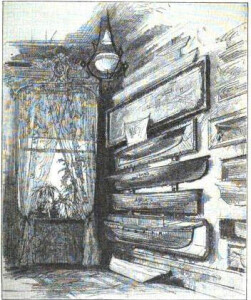 | SHORT DESCRIPTION: Builder’s half hull model, starboard side, made by George Steers of the pilot boat George Steers. The model is a basic representation of the vessel's molded lines, without constructional details. The model is not mounted on a backing board. The model is varnished and is inscribed in black-outlined letters “GEORGE STEERS.” The model has a slightly raked stem and an raked hour-glass shaped upper stern (no counter). It has moderate deadrise and little or no tumblehome. The model shows a boat with deep draft aft and a keel that slopes up to the forefoot. It has a long sharp entry and a long run aft. The model is constructed of 11 pine lifts. The bottom lift (1) is 1-5/8” and tapers to zero about 7-1/2” from the bow. Lifts 3 through 8 are flat and arranged in pairs, each consisting of 1/2” lift separated by a 1/8” lift. The sheer curve is cut into the 9th lift. It is 9/16” amidships, 2-1/16” at the stern, and 1-5/8” at the stem. Lift 10 is flat (1/8”) and curves with the sheer. Lift 11 curves with the sheer and tapers from 1-1/16” at the bow to 11/16” amidships to 3/16” at the stern. Lift 11 is also the top covering for the model, which is not hollowed out to deck level. The top and back of the model have twenty station lines running from bow to stern. Line eleven from the bow is a double line and may be the deadflat. They are spaced an 1-3/4” apart. There appear to be some scratched letters between several of the station lines but it’s unclear what they represent. The dimensions of the model are 34-1/4” (length overall); 4-11/16” (main breadth), 4-1/2” (half breadth), leaving a tumblehome of just 3/16”. Height overall is 6” (at the stern). The minimum half-breadth of the model is 3/32" along the edge of the stem and 1/8” at the stern. The lifts appear to be held together by six pegs running from top to bottom. The pegs are visible on the front surface of the model. There are a few variously sized holes whose purpose is not apparent on the top and back and front of the model. The model is in good condition. The varnish is stable. There is damage and some wood loss at the ends of lifts 2 through 5 at the bow. There is a separation between lifts 4 and 5 at the bow and stern. There is a small scratch through the ‘GE’ in the ship’s name. There is some wood loss in the second G. It appears as though another layer of varnish was applied to the model at some point in the recent past. NOTES: The collection of half models MR 5 through MR 24 are of vessels built by shipbuilders Henry (father), James Rich and George (sons), and Henry Steers (son of James Rich), builders of the famous yacht America. The models document vessels built between 1805 and approximately 1876. They encompass all types of vessels from a catboat up to large steam sloop built for the US Navy. In a February 13, 1963 letter Howard I. Chapelle, Curator of the Division of Transportation at the Smithsonian stated “The Steers Collection is important technically and it is something we envy the Mariners’ Museum’s possession.” NOTES: Text from “The Evolution of the American Yacht” in The Century Illustrated Monthly Magazine, Volume 24, page 352: Another modification of the Baltimore clipper was developed in our pilot-boats, which, little by little, assumed the type represented by the George Steers and Mary Taylor, famous little schooners designed by George Steers in 1845,--a type which continues to be followed, with little variation, in this service event now, after a lapse of forty years. They have a keel sloping up to the fore-foot, deep draft, great dead rise on a vertically sharp floor, and a sheer both at stem and stern which makes them buoyant and dry in a sea-way. Text from Pilots, The World of Pilotage Under Sail and Oar, Volume 1, page 82: [In 1851] Steers now came along with the 77ft George Steers, a shameless America derivative, but with a fashionable shorter bow overhang and an even more effective run. Steers was a favorite of Howard I. Chapelle and as one enjoys the pure perfection of her lines, one can see why....The George Steers stands as a fine example of that designer's final ideas of what a pilot schooner should be. Chapelle considered her run a slight improvement over that of America, while one can only agree that the balance of her ends is remarkable. This feature, coupled with a sensible depth of body would have conferred great seaworthiness and ease of motion, while the firm bilge of her midship section would ensure the now-usual Steer's feature of great power. Despite the altered profile, it is impossible to miss the similarity to America in the lines of this considerably smaller boat. She is said to have been one of the finest pilot craft ever built. The George Steers was driven ashore near Barnet Inlet in a notorious northeaster on February 12, 1865. All hands perished. VESSEL INFORMATION— VESSEL NAME: GEORGE STEERS VESSEL TYPE: Pilot boat, Pilot schooner DESIGNER: George Steers SHIPBUILDER: William H. Brown Shipyard BUILDER LOCATION: Foot of Twelfth Street, New York, New York SERVICE DATES: 1852-1865 DATE WRECKED: February 12, 1865 VESSEL DIMENSIONS: 60 tons; 77'4" (length overall), 71' (waterline length) x 18'10" x 9'6" VESSEL HISTORY: New Jersey Pilot Boat George Steers No. 6 • The Buffalo Commercial, Monday August 9, 1852: Launch.—A beautiful pilot-boat modeled by Geo. Steers, the builder of the yacht America, was launched by moonlight, at 12 o’clock on Thursday night, from the yard of Wm. H. Brown in New York. She was built for the Jersey pilots; has the same lines as the “America,” and is about half as large, or 87 tons. She will be the most beautiful as well as the fleetest pilot boat out of port. • The New York Times, August 20, 1852: The new pilot boat, built by Mr. George Steers for a company of Jersey Pilots, and named in honor of the builder, was got under way this morning for the first time, at the foot of Twelfth-street, East River. She left under command of Mr. Steers, who, in company with a few friends and acquaintances, will go as far as White Stone, to test the sailing qualities of the vessel, and for a pleasure excursion. • New York Herald, March 4, 1854 reported: the schooner George Steer had arrived (Honduras) with the president of the proposed railroad from Cabello to Tigre Island, who had gone on to the capital to consult with Mr. Borland. The George Steer, on her return, would take on board a Central American Minister to this country. • New York Daily Herald, March 10, 1854 reports: Interesting from Honduras (Jan. 22, 1854) Arrival of schooner George Steers—The most notable incident is the arrival of the schooner George Steers, from New York, in the unprecedented short time of a little more than thirteen days. She brings out Amory Edwards, Esq., President of the Honduras Railway Company, who left this morning for Comayagua, the capital, where he is gone with the local agent of the company to arrange for the commencement of practical operations on the line….The George Steers remains in port for the purpose of conveying to New Orleans the newly appointed Envoy to this State to the American government. • New York Daily Herald, April 8, 1854 reports: Omoa, Honduras, March 16, 1854: The George Steers is still here, in the employ of the Honduras Railway Company. • New York Daily Herald, May 24, 1854 reports: By the arrival yesterday in the lower bay, of the pilot boat George Steers, from Honduras via Omoa…The George Steers brings us as passengers General Joe Barrundia, Minister from Honduras, to represent the New Central American Mission at Washington, Don Laiuo Lasso, Secretary of Legation, the wife and son of the former, A. Edwards of New York [president of the Honduras Railroad Company], Herman Schmidt, of Brunswick, Germany, Mr. Charles Foller and Miss Foller of Omoa. The George Steers proceeds direct to New York. • New York Tribune, March 6, 1855 reports: Look out for slave catchers: A small incident occurred at the Black-slip, foot of Beekman St., in this City early this afternoon, which may serve as a caution to this community, which has been comparatively quiet on the subject of slave-catching since 26th of last May, when the case of Stephen Pembroke was so summarily disposed of. The George Steer, pilot-boat, laying is said slip, has two colored men employed in her service. As one of these men, who had been on shore, was about to step on board, he was hailed by two unstarred men, assuming to be officers in search of a burglar, intimating that he was the man, and demanding that he should go with them, at the same time touching him on the shoulder. He very wisely asked them to show their warrant. This was not done, but they insisted upon his going with them. At this time persons who had been watching the movement, stepped up and sustained the position taken by the man, that they were bound to show their warrant. While matters stood thus, two starred officers interfered, and said “he had better go with them to the Chief’s office; they are officers.” The result was that the man was attended by two faithful friends, who had some trouble before they were admitted. I have two prime witnesses to these transactions. This matter calls for explanation. Officers, starred or unstarred, have no right to arrest a man on charge of a serious crime without a warrant, or without knowing his name. This arrest was made in open day, when he was going about his honest business. (the article continues), written by J.W.C. Pennington. • Buffalo Daily Republic, October 2, 1858 reported: The steamer Delaware, hence for Philadelphia, came in contact, off the Woodlands, last evening, with the pilot boat George Steers. The latter lost bowsprit and had her bows stove in three or four feet, which caused her to leak badly. The Delaware towed her to quarantine and proceeded on her voyage. • New York Daily Herald, March 26, 1860 reported: the pilot boat George Steers towed the hulk of the sloop Spray (30 tons) from Barnegat Bay to port. It was assumed that the murder of Captain Leete and his brother had occurred and it was being investigated. • New York Daily Herald, May 10, 1860 reported: The arrival of the Japanese Embassy aboard the steam frigate Roanoke, arrived and anchored inside of Sandy Hook on May 9th.The ship was told to proceed to Hampton Roads and not enter the port (of New York). The NYDH’s special correspondent on board procured the services of the George Steers, and came up to town last evening with his despatches. • New York Times, February 23, 1865: Probable loss of the Pilot-boat George Steers and Crew. The pilot-boat George Steers has been missing since the gale of the 12th inst., and information has lately been received in this city which renders her total loss almost a matter of certainty. The last pilot was put out from her on the 11th inst., off Cape May. During the gale of the 12st inst., a pilot-boat was seen on the South Shoals near Barnegat. At daylight, the next morning, she appeared to be almost a wreck, all her masts having gone. On the 14th inst., a surf boat was enabled to get to her, but there was nothing of her left but a piece of the deck, some spars and rigging. A piece of her burgee was found in the rigging, with part of her name, which was “eorge.” All hands on board must have perished. Some dead bodies were found about twelve or fourteen miles south of where she lay, and as there was a heavy current setting in that direction at the time it is supposed they were the bodies of some of her crew. The George Steers was built in 1851 by the eminent ship-builder of that name. She belonged to the New Jersey Association; was valued at $15,000, and was supposed to be the fastest boat sailing from this port. ADDITIONAL INFORMATION: Chapelle, H.I. American Sailing Craft. 1936. pages 213-215 (VM331 C4); Russel, C.E. From Sandy Hook to 62 degrees". New York. 1929. page 387.; | CL14541 | |||||||
| 79 |    | SHORT DESCRIPTION: An "Tatara," from Pongso no Tao (the name given by the indigenous Tao, it means "island of human beings"), also called Orchid Island or Lanyu, Taiwan. The 10-foot boat is composed of 21-27 pieces of wood from different trees, each selected for a specific purpose with carved and painted ornamentation along both sides. The boat is painted red on the bottom and edges, white on top and has black and red designs. On the tip of each end is carved design of a human figure holding spirals with feathers. The feathers are dark brown with a golden shine. Most of the symbols are of figures holding spirals, sun shapes, zig-zags and checker board prints. NOTES: The Tatara canoes are an essential element in Yami culture. The Yami are the only maritime community among Taiwan's diverse cultural groups. Botel Tobago Island is 45 miles off the coast of Taiwan and has, for the greater part of its history remained untouched from foreign cultural influences. There is a great ceremonial aspect to the creation, launching and use of these canoes every Spring, at the beginning of fly fishing season. In addition, the construction techniques are wholly unique with the exception of certain Papuan canoes in the Solomon Islands, and possibly those of certain Scandinavian groups. (H.H. Brindley) [Douglas Brooks, May 16, 2016] I have talked to a few more people, having also sent photos of your tatara to them and the concensus is it comes from Dongqing Village, with the indigenous name of I-ranmeylek. Another map here names the village Dongcing, which must be another romanization of the Chinese. Its on the east central coast of the island. The boats there have noticeably more freeboard and harder bilges than the boats on the west coast. They also have the largest fleet and its the only place where the fishermen have started giving tourists rides in their boats, something which will start soon after the end of flying fish season. NOTES: Orchid Island, Lan yu, and Botel Tobago all refer to the same location. NOTES: Yami (Tau) Boat The Yami (now also the "Tau" of "Tao") are a peaceable tribe. Living on isolated Orchid Island, the Yami develop a unique culture closely related to the ocean. Therefore, the flying-fish season, which is held during the spring and summer, is taken seriously. All the festivals and rituals the year around are in some way held in correspondence to this fishing activities. Tatara, the assembled boats, are the heritage of wisdom from the Yami's ancestors. The construction work of boat-making launches after the flying-fish season. A boat consists of 21-27 pieces of boards from different kinds of trees which are selected for each plank, and are then joined with resin (made from barok tree) and wooden pegs (made from pasuk) instead of nails. Yami boats are gracefully and delicately decorated with various carved and painting ornaments on the strakes. The abstract patterns, such as silver-helmet pattern, zigzag lines and human-shaped motif, are the reflection of their oceanic life. Through those decorations, the Yami reveal their background of livelihood as well as the natural gift for art. Among those decorations, the most important motif is Mata-o-tataras, which is a sun-ray pattern with circles and saw-tooth projections. Besides serving as the eyes of the boat, it is believed to be effective in warding off evil spirits, and overcome the wrecks and danger during the voyage. The human-shape motif presents not only the heroes of the family but also their badge. BOAT INFORMATION - BOAT NAME: TATARA BOAT TYPE: FISHING BOAT DATE BUILT: LATE 20TH CENTURY ORGIN: REPUBLIC OF CHINA, TAIWAN, ORCHARD ISLAND BOAT DIMENSIONS: 12-2-0 (LENGTH OA); 2-6-0 (BEAM) | CL28621 | |||||||
| 80 | 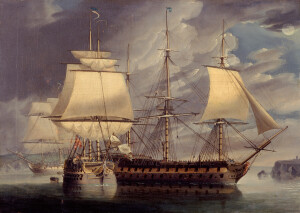 | SHORT DESCRIPTION: Oil painting on canvas titled “The Mars bringing her prize out of the passage with the appearance of the Jason frigate which came up a little after L'Hercule had struck." Unsigned, but attributed to artist Robert Dodd, circa 1798-1799. The scene shows three ships in calm waters at night with land to the left and right in the background. HMS Mars is shown to the left of center with her starboard bow facing the viewer. The British ship has her fore and main topsails set and her foresail, fore topgallant sail, mainsail and main topgallant sails are brailed up. The remnants of one of the ship’s jibs is draped over the bowsprit and spritsail yard (the only rigging damage visible on the two ships). The French ship L’Hercule has its starboard broadside facing the viewer. The entire side of L’Hercule has visible cannon damage and many gunports in disarray. All of L’Hercule’s sails are furled except for the fore topsail and a flying jib. The French ship’s main topsail and mizzen topsail spars are lowered. Behind Mars, in the background to the left, sits the frigate Jason. Several small rowing boats full of people sit between Mars and Jason. The French coastline sits to the left in the extreme background and rocks surround an island, presumably the Ile de Sein, in the background at the right. The sky is mostly cloudy, but the moon is visible in the upper right corner. NOTES: A number of artists painted views of the action between HMS Mars and the French ship L’Hercule: Robert Dodd, Robert Pocock, Thomas Luny (in 1827) and John Christian Schetky. This painting was attributed to Dodd because of its resemblance to an engraving titled “Sequel to the Action of L’Hercule and Mars on the Night of April 21st, 1798. Representing the Mars bringing her Prize out of the Passage Du Raz, the Jason Frigate having come up some time after the enemy had struck, assisted in shifting the prisoners” which is marked “Painted & Engraved by R. Dodd.” However, a view of the action itself by Schetky bears some resemblance to this work. NOTES: The Admiralty Office reported on April 28th that the French 74-gun ship L’Hercule (launched 1797), which was actually pierced for 80 guns, was taken by HMS Mars (launched 1794), commanded by Captain Alexander Hood (1758-1798), in a single ship action on the night of April 21st, 1798. The action became known as the Battle of the Raz de Sein. Earlier in the day on April 21st Admiral Lord Bridport had detached HMS Mars (74) under Captain Alexander Hood, HMS Ramillies captained by Henry Inman and the 38-gun frigate HMS Jason, Captain Charles Stirling, from the Channel Fleet to investigate several sails that had been spotted to the east. Upon drawing closer the British ships sighted a third larger vessel to the southeast sailing close to the coastline and heading north towards Brest where the main French fleet was located. From the appearance of the ship’s sails and large size it was thought to be a French ship of the line so the three British ships changed direction to intercept the larger vessel. During the chase HMS Ramillies lost her fore topmast and fell out of the hunt and Mars quickly outpaced Jason. After five hours and with night approaching Mars nearly lost sight of the French ship but around 8 o’clock the light of the moon revealed the vessel anchored at the entrance of the narrow Raz de Sein [a stretch of water located between the Ile de Sein and the Pointe du Raz in Finistère]. A strong running tide and easterly wind had prevented the ship from escaping through the passage and forced it to anchor close to the French coast within sight of Brest Roads. The crew of the French ship, the new 74-gun ship L’Hercule, captained by experienced Louis L’Heritier (1747-1823) and with 680 men on board, furled its sails, carried a spring aft to increase its range of fire and prepared the ship for battle. L’Hercule had left Lorient the day before having been ordered on her first cruise to join the Brest fleet. As Mars quickly approached Captain Hood gave orders to double-shot the guns and told his crew not to fire until the ship was alongside the enemy. Around 9:15 PM the French ship opened fire which was soon returned by the British. The strong tidal current that prevented L’Hertier from escaping now prevented Hood from maintaining his ship’s position under sail. The crew were ordered to drop the starboard anchor and Mars fell back alongside their opponent. When the two ships crashed together many of the lower deck gun ports were unhinged and Mars’s starboard anchor grappled L’Hercule’s port anchor locking the two vessels together. The action was so close that the lower deck guns couldn’t be run out and had to be fired while inside the hull. The two ships fought a bloody action for nearly an hour and a half during which time the French attempted to board Mars twice but were repulsed by Hood’s highly trained crew. First Lieutenant William Butterfield (1767-1842) reported that Captain Hood was wounded in the thigh [his femoral artery had been severed causing him to slowly bleed to death] about twenty minutes into the conflict and expired just as the enemy ship struck her colors. Finally, around 10:30 PM the French ship surrendered. The British frigate Jason arrived about twenty minutes later and assisted in getting both ships underway and later carried about 200 of the French prisoners to Plymouth. Because of the close-fought action, neither ship was much disabled in the rigging, but both were described as “greatly shattered in their hulls.” The Kentish Weekly Post or Canterbury Journal, May 4, 1798 (page 2) provided a vivid description of the damage visible on L’Hercule: The larboard side of the ship is very little damaged, but the starboard side is terribly mauled; most part of the shot holes are in the line of the lower deck ports, many of which are beat from the side, and the port-holes, with the space between them, are covered with canvas; her starboard quarter-gallery is very much shattered, and the shot holes are very thick, in a line with the quarter-deck guns, on the same side; under the counter, and a little above the water line, there is a hole as large as if a bomb-shell of immense size had entered it, which would have rendered the situation of the ship very dangerous, if the weather had been boisterous; five of the starboard aftermost guns, on the lower deck, are dismounted, and many others much damaged. The masts and yards are very little injured, which is accounted for by the action being so close…; the guns of the Mars on the lower deck were sometimes through the starboard side of the French ship; the proximity may be easily conceived by those who have seen L’Hercule, for the starboard side, which, before, the action, was a bright yellow, is now burnt as black as a cinder. The casualties aboard L’Hercule were enormous with 290 dead and wounded (and possibly as many as 400)–about forty percent of her crew–including Captain L’Hertier. Aboard Mars 22 men were killed including Captain Hood, Captain White of the marines and 2nd midshipman James Blythe, and 60 men were wounded and 8 were missing, After the capture, Admiral Lord Bridport appointed the first Lieutenant of Mars, William Butterfield, to command the L’Hercule and carry her into port and Captain James George Shirley was temporarily appointed to the command of Mars. Butterfield was also promoted commander with seniority from 26 April and received a fifty guinea sword from the Mars crew. VESSEL HISTORY: HMS MARS 74 guns and 1842 tons, was launched at Deptford Dockyard in 1794 and would later serve in the right-hand column, nearly opposite VICTORY, during the triumph of Trafalgar. She was broken up in 1823. VESSEL HISTORY: L’Hercule, 74 guns and 1876 tons, a Téméraire class ship of the line of the French Navy built at Lorient in 1797, captured by the British on her maiden voyage in 1798. Spent the rest of her career as a British ship. Broken up in 1810. | CL20621 | |||||||
| 81 | 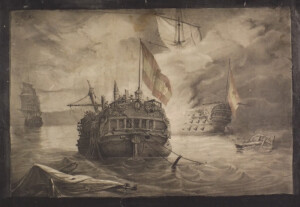 | SHORT DESCRIPTION: Colored lithograph, plate 28 from the series ‘Episodios Maritimos’ which was published in Madrid between 1849 and 1854. The image is titled “Por Salvar La Escuadra Francesa Del Contra Almirante Linoix” [To save the French Squadron of Rear Admiral Linoix]. The image was lithographed by Juan Donon after an artwork by Eusebio Lettre. It shows the dismasted Real Carlos, a Spanish 112-gun ship-of-the-line from the stern at the center left. To the right is another large Spanish ship (San Hermenegildo) which is firing its port side cannons. There is an undamaged British ship (HMS Superb) at the left in the background. The print’s margins have been obliterated with black paint. The image shows a scene from the Second Battle of Algeciras, also known as the Battle of the Gut of Gibraltar on the night of July 12/13th, 1801 (the action occurred before and after midnight) NOTES: A copy of this image was found in the collection of the MIT Museum (other copies are in the collection of the Biblioteca Nacional de España and the Museo Naval de Madrid). The series Episodios Maritimos was published between 1849 and 1854 in Madrid, Spain. The lithographer was Juan Donon and the artist was Eusebio Lettre. While the text on this print has been obliterated with black paint, the text on other copies of this print reads: EPISODIOS MARITIMOS (at top center), POR SALVAR LA ESCUADRA FRANCESA DEL CONTRA ALMIRANTE LINOIX (bottom center), fue acometida la relaguardia de las fuerzas franco-españolas en el estrecho por el navio ingles Soberbio que deslizandose á favor de la noche entre los navios españoles Real Carlos y Sn. Hermenegildo les disparò una andanada á bala roja huyendo despues á lo largo. Ent al estado tomaronse mutualmente por enemigos los dos buques españoles batiendose contodo el valor que como á tales cumplia y destrozandose completamente sin ceder un apice hasta el momento de reconocerse, (13 de Julio de 1801) (at bottom center, under title in three lines), Letre dibo. [abbreviation of dibujó or dibujar meaning "to draw" or "drew"] Y lito [abbreviation of litógrafo] (under image at left), Lit de J. Donon, Victoria 1. (under image at right). This translates: MARITIME EPISODES (at top center), TO SAVE THE FRENCH SQUADRON OF REAR ADMIRAL LINOIX (bottom center), The rearguard of the Franco-Spanish forces in the strait was attacked by the English ship Soberbio [HMS Superb], which, slipping between the Spanish ships Real Carlos and Sn. Hermenegildo at night, fired a volley of red bullets at them and then fled along them. In this state, the two Spanish ships took each other for enemies, fighting with all the courage that befitted them and completely destroying each other without yielding an inch until they recognized each other. (July 13, 1801) (at bottom center, under title in three lines), Letre drew and lithographed. (under image at left), Lithographed by J. Donon, Victoria 1. (under image at right). NOTES: Text from pages 124-125 of the publication “Galdós en el Museo del Ejército. La guerra de la Independencia a través de los Episodios Nacionales” [Galdós at the Army Museum. The War of Independence through the National Episodes] discussing this print: It starts with a quote from Benito Pérez Galdós. Trafalgar (1873): "Imagine, madam," he added, addressing Doña Francisca to obtain her favor, "that we left Cádiz to assist the French fleet that had taken refuge in Algeciras, pursued by the English. This was four years ago, and I still have such courage that my blood boils when I remember it. I was on the Real Carlos, a 112-gun ship commanded by Ezguerra, and we also had the San Hermenegildo, a 112-gun ship, the San Fernando, the Argonauta, the San Agustín, and the frigate Sabina [sic].” This series of lithographs to which these copies belong was printed under the generic title ‘Episodios Marítimos,’ as we can read at the top of the print. It was given to subscribers of the work ‘Historia de la Marina Real Española, desde el descubrimiento de las Américas hasta el batalla de Trafalgar,’ published in installments between 1849 and 1854 by Juan Ferrer Couto and José March. The work was profusely illustrated with woodcuts, as could be read in an advertisement in the newspapers of the time: “It comes out in installments of 16 folio pages, with engravings interspersed throughout the text. With all odd-numbered deliveries, an illuminated plate measuring 23 inches high and 30 inches wide is distributed, depicting maritime episodes, and with even-numbered deliveries, portraits of admirals. Around 1850, the work was directed by the Sociedad Literaria de Madrid [Literary Society of Madrid], and according to press advertisements, a relaunch was launched, reissuing the already printed runs. The lithographs, designed by various artists such as Vallejo, were printed at J. Donon's establishment on Victoria Street, Madrid, which was praised for the technical perfection it was achieving in Spain in this art. The black and white engravings included in the text, entitled Historia de la Marina Real Española (History of the Spanish Royal Navy), already capture some of the most notable episodes, such as that of the four frigates off Cape Santa María (which has become popular today for being the cause of the explosion of the frigate Mercedes) or the Battle of Trafalgar itself. This illustration depicts the battle that Galdós puts in the mouth of Marcial, an old sea wolf, and describes with great realism the ill-fated action between two Spanish ships of the line, the Real Carlos and the San Hermenegildo, which opened fire in the darkness, believing themselves to be enemy ships. NOTES: The Mariners’ Museum’s collection holds just two images from this series LP 672 and LP 2855. NOTES: On July 6th, 1801 the first Battle of Algeciras Bay was fought between three French ships-of-the-line and a frigate supported by Spanish coastal batteries and fourteen gunboats against the British Gibraltar Squadron of six ships-of-the-line under Vice Admiral Saumarez. The British were defeated and surrendered the 74-gun ship Hannibal and the 74-gun Pompee, which had grounded and were heavily damaged. The British withdrew to Gibraltar to repair damage and prepare for another action. The HMS Caesar needed to be completely remasted and rerigged. The French tried to repair the damage to their ships and Rear Admiral Charles-Alexandre-Léon Durand de Linois (1761-1848) requested reinforcements from the Spanish at Cadiz. Five ships-of-the-line (112-gun Real Carlos, 112-gun San Hermenegildo, 94-gun San Fernando, 80-gun Argonaut, 74-gun San Agustin) and the 40-gun frigate Sabina were sent to Algeciras Bay under Lt. General Juan Joaquin Moreno D’Houtlier. On July 12th the Franco-Spanish fleet began to leave the Bay of Algeciras. The French frigate Indienne took the captured HMS Hannible in tow but found it impossible to navigate, so the two vessels remained in Algeciras. The Franco-Spanish fleet sailed in three columns with the battle-damaged French ships at the head and the Spanish ships in line behind them. Linois and Moreno were fully aware that the British were watching their movements and were preparing for another action. HMS Caesar, completely re-rigged in just a few days, was the first to leave port (around 2:30 in the afternoon) and was followed by the rest of the squadron. Around 11:20PM, HMS Superb approached, undetected, the starboard quarter of the 112-gun Real Carlos and fired a broadside from her port side. Several of the projectiles passed the Real Carlos and hit the San Hermenegildo. Believing they were under attack on their starboard side, the officers of San Hermenegildo opened fire on the Real Carlos. When the officers on board Real Carlos realized they were receiving fire on their port side, they decided that the ship that had attacked their starboard side had passed to port so they opened fire on the San Hermenegildo believing it to be the British enemy. In the initial broadside from HMS Superb, Real Carlos lost its topmast and several fires broke out. When HMS Superb, which had been ordered by Saumarez to “go ahead, attack the enemy rear and keep between them and the Spanish coast,” saw that Real Carlos had begun drifting to port, Captain Keats luffed to port, sailed past the stern of San Hermenegildo, and attacked the Saint-Antoine which was sailing to the port side of the San Hermenegildo. Within a half hour the Saint-Antoine had surrendered. Around 12:15AM, the Real Carlos, having nearly run aboard the San Hermenegildo which was still firing believing it was an enemy vessel, exploded. The fire spread rapidly to San Hermenegildo which exploded about fifteen minutes later. Of the nearly 2,000 men aboard the two vessels only 349 survived. | CL18573 |
Created 2026 by Don Barker, CBMM volunteer, for the Chesapeake Shipbuilding Project. shipbuilding@sailingworkboats.es